Turbidity NTU To Visibility Calculator
Estimate Secchi depth, horizontal fishing visibility, lure sight range, and clarity class from turbidity readings, water color, particle type, light level, and surface conditions.
📌Water clarity presets
⚙Turbidity and visibility inputs
Visibility estimate
Calculation breakdown
📊Quick model indicators
Higher values mean faster contrast loss.
About 2.5 times the estimated Secchi depth.
Range after allowance and local match.
Visibility-based lure or bait signal.
🗂Comparison grid
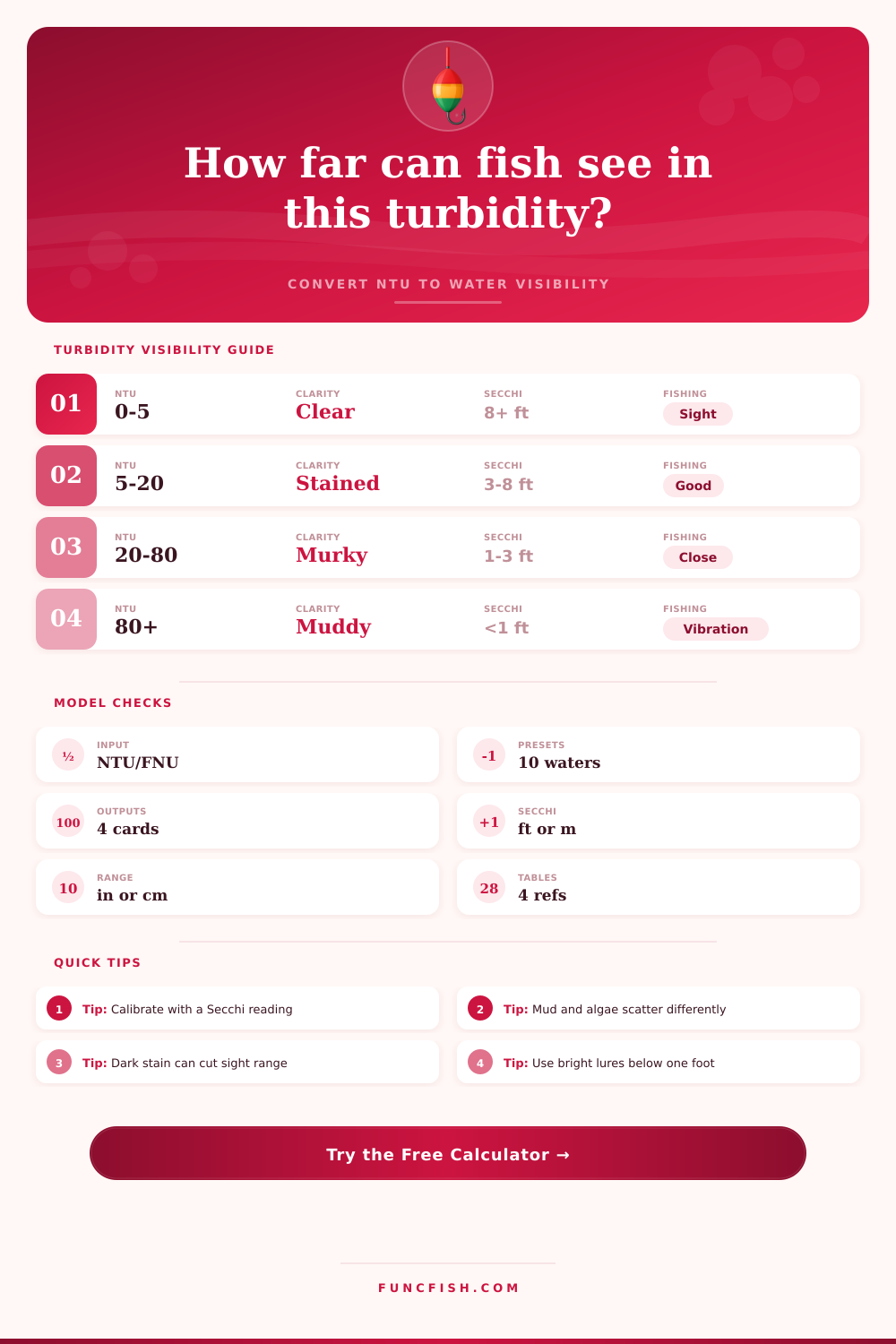
Clear sight window
Low NTU water gives long Secchi depth and enough contrast for subtle profiles, natural colors, and visual follows.
Stained but fishable
Moderate NTU or tannin stain usually favors stronger silhouettes, flash, and casts placed closer to cover.
Murky reaction zone
High suspended clay or algae compresses sight range; vibration, scent, and repeated contact become more important.
Muddy contact bite
Very high NTU often leaves only inches of visibility, so fish must locate baits by sound, displacement, or smell.
📘Reference tables
| Turbidity band | Approx. Secchi depth | Fishing visibility | Common water look | Presentation cue |
|---|---|---|---|---|
| 0 to 5 NTU | 8 ft+ / 2.4 m+ | Long sight range | Clear lake, spring creek, calm bay | Natural profile, lighter line, longer casts |
| 5 to 20 NTU | 3 to 8 ft / 0.9 to 2.4 m | Moderate sight range | Stained reservoir or normal river color | Contrast plus flash works well |
| 20 to 80 NTU | 1 to 3 ft / 0.3 to 0.9 m | Short reaction zone | Rain runoff, algae bloom, wind mud | Bold color, vibration, slower passes |
| 80 to 250 NTU | 0.3 to 1 ft / 0.1 to 0.3 m | Very close visibility | Muddy river or surf wash | Noise, scent, bottom contact, bright profile |
| 250+ NTU | Under 0.3 ft / 0.1 m | Inches only | Flood mud or dense mineral plume | Fish tight cover, current breaks, scent cues |
| Particle or color source | Model factor | Visibility effect | Best calculation use | Field caution |
|---|---|---|---|---|
| Fine clay or suspended mud | 0.88 | Strong light scatter and quick contrast loss | Rain-swollen creeks and muddy reservoirs | NTU can remain high after flow drops |
| Silt or mineral flour | 0.94 | Gray water, usually broad light scattering | Glacial rivers, dredged channels, tailwaters | Fish may feed if flow is stable |
| Algae or plankton bloom | 0.82 | Green tint cuts contrast by depth | Ponds, summer lakes, warm backwaters | Oxygen changes can matter more than clarity |
| Sand or surf chop | 1.05 | Coarse particles may settle fast | Surf troughs, wind banks, shallow flats | Visibility can change within minutes |
| Tannin or organic stain | 0.78 | Low NTU can still look dark | Blackwater creeks, cypress ponds, peat lakes | Secchi and NTU may disagree strongly |
| Fishing situation | Useful visibility | Typical NTU window | Gear or lure cue | Calculator result to watch |
|---|---|---|---|---|
| Sight fishing | 3 ft+ / 0.9 m+ | Usually under 15 NTU | Natural colors and longer lead distance | Target depth status |
| Casting moving baits | 12 to 36 in / 30 to 90 cm | 10 to 60 NTU | Flash, thump, silhouette, erratic action | Horizontal visibility card |
| Bottom contact | 6 to 18 in / 15 to 45 cm | 25 to 120 NTU | Dark profile, scent, pauses, bottom noise | Clarity class card |
| Trolling search pass | 18 in+ / 45 cm+ | 5 to 50 NTU | Repeated passes through strike depth | Bright layer estimate |
| Night dock light | Light cone dependent | Variable | Glow, flash, slow contrast edges | Light and target modifiers |
| Measurement method | What it reports | Strength | Weakness | Best practice |
|---|---|---|---|---|
| Turbidity meter | Scattered light in NTU or FNU | Repeatable spot reading | Particle color and size change the visibility link | Average several samples at fishing depth |
| Secchi disk | Vertical disk disappearance depth | Direct clarity signal | Needs sun angle, depth, and consistent method | Record down and up readings, then average |
| Visibility tube | Short-column transparency | Useful for streams and shallow water | Not the same as open-water sight distance | Use local calibration for the stream |
| Angler lure check | Practical lure disappearance distance | Matches actual target contrast | Subjective and light dependent | Use the same lure and angle each time |
✅Calculation tips
Turbidity isn’t just one thing This is what I mean when you’re thinking: “The fishfinder says there’s no visibility, so how can he catch catfish off the bank? It’s mud; we won’t be able to sight fish.” There are three things happening. Biological activity, light scattering and suspended particulates, and they’re all contributing to turbidity, which is why your friend caught fish off his boat on the other side of lake.
This confusing mix is where the calculator come in, this complicated equation bridges the gap between abstract NTU values and tangible visibility values that help dictate your casting strategy. Water clarity is black-and-white to most anglers: It’s clean enough to see the rocks, or it’s dirty enough that I can’t catch anything. But such thinking leave a lot of opportunity on the table.
Why Turbidity Matters for Fishing
Fish will adjust how they hunt based off how they see contrast. They’ll see something as long as sun angle is correct, even at a seemingly high number like twenty NTUs. The tool figure out your horizontal sight range and Secchi depth to show this window. It also factors in water color and particle type. Algae scatters light one way; fine clay another. So the same NTU value may produce different visibility values due to what is in water.
It’s important to know the inputs, which explain what sort of material are in the water and how it affects clarity: Is the water stained or colored with dissolved organics (tannins)? Or is there sediment such as sand or glacial silt? All those materials reflect and absorb light different. For example, tannic stain can make water appear opaque and dark despite a very low NTU reading. To account for that, calculator includes both light condition and color in its calculations. Heavy cloud cover will reduce your apparent visibility at dawn even if turbidity hasn’t increased.
Here, data and intuition blend together. This is where the tool show that reducing the visible range to only a few feet makes vibration and scent the main cues. On the page, you’ll find a reference table that helps put all of this into context, connecting the dots between NTU bands and fishing technique. Low levels of turbidity work well with natural colors and subtle presentations, whereas high levels requires a bold profile or sound that travels further through the water column then light does. That’s because when they can’t make out the shape of something, fish use their lateral lines and sense of hearing to locate it.
It’s not magic, just physics applied to behavioral understanding. That change in thinking give us an opportunity to alter our approach before biting is shut down entirely.
The last piece of the puzzle is calibration. There isn’t a perfect model for all bodies of water because conditions can be very different in any given location. To tighten the accuracy on your particular river or lake, you should of check the amount of time it takes a lure to dissapears compared to what the device shows you. Check it with a Secchi disk. You are creating your own database of what the water does on your lake. When you know the relationship between sight range and particle load, you quit guessing and begin fishing with a purpose.
That chocolate milk water isn’t a barrier; it’s simply another set of rules to see through. When you do, fish appear.