Fish Weigh Bag Water Weight Calculator
Estimate true fish weight by subtracting bag tare, clip or towel weight, measured water mass, retained exterior water, and density changes from temperature or salinity.
📌Weighing presets
⚙Bag and water inputs
Corrected fish weight results
Calculation breakdown
📊Bag and container comparison
Light bass or walleye sling after a quick wet-out.
Common water amount for a small live fish check.
Enough water to cover many bass during a quick read.
Large-fish setups can hide heavy water subtraction.
⚖Method comparison grid
Fastest for single fish when the empty wet sling is weighed first.
Works well when the bag must contain water during the scale read.
Useful in the field, but uncertainty rises quickly with deep bags.
Subtracts shared water and tare, then divides corrected fish weight.
📘Reference tables
| Water type | Approx density | 1 quart weight | 1 liter weight | Use note |
|---|---|---|---|---|
| Cool freshwater | 0.999 kg/L | 2.08 lb | 999 g | Streams, lakes, livewells |
| Warm freshwater | 0.997 kg/L | 2.08 lb | 997 g | Summer ponds and warm rivers |
| Brackish water | 1.010 kg/L | 2.11 lb | 1010 g | Estuary and tidal creek bags |
| Saltwater | 1.025 kg/L | 2.14 lb | 1025 g | Surf, pier, and offshore fish |
| Iced freshwater slurry | 1.003 kg/L | 2.09 lb | 1003 g | Ice-water mix without solid ice weight |
| Container | Typical wet tare | Common water | Volume uncertainty | Best match |
|---|---|---|---|---|
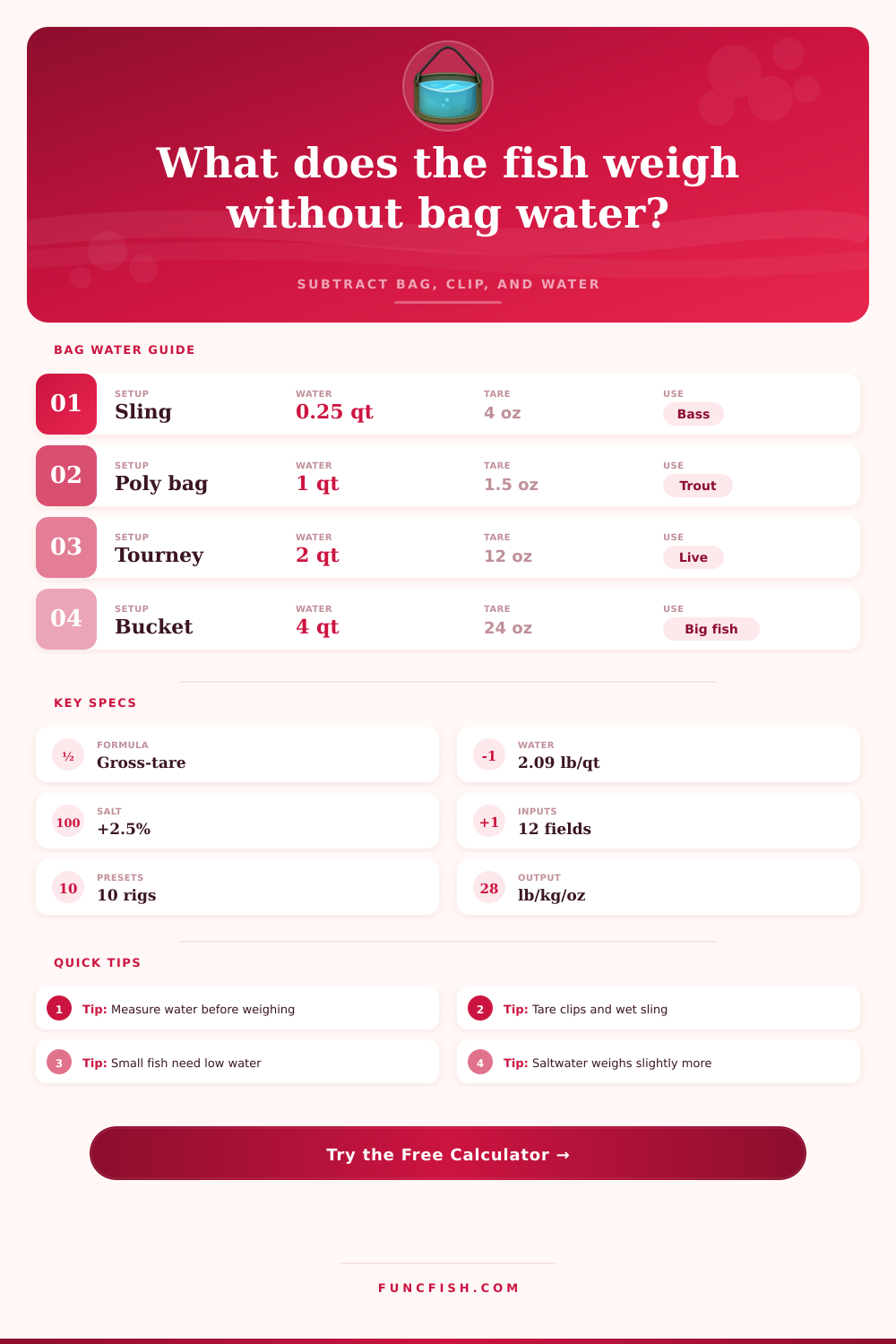
| Wet weigh sling | 3 to 8 oz | 0 to 0.5 qt | 8% to 12% | Bass, walleye, pike |
| Clear poly fish bag | 1 to 3 oz | 0.5 to 1.5 qt | 10% to 18% | Trout, panfish, bait-sized fish |
| Tournament weigh bag | 8 to 18 oz | 1.5 to 3 qt | 8% to 15% | Live bass checks |
| Bucket or tub liner | 16 to 40 oz | 3 to 8 qt | 12% to 22% | Catfish, carp, saltwater fish |
| Rubber mesh net | 8 to 20 oz | 0.2 to 0.8 qt | 15% to 25% | Fast catch-and-release reads |
| Fish size class | Typical bag water | Scale resolution | Target uncertainty | Practical note |
|---|---|---|---|---|
| Small trout or panfish | 0.25 to 0.75 qt | 0.1 oz to 0.5 oz | Under 3% | Water error can exceed fish ounces |
| Bass or walleye | 0.5 to 2 qt | 0.5 oz to 1 oz | Under 2% | Wet sling tare is usually enough |
| Carp or catfish | 2 to 6 qt | 1 oz to 4 oz | Under 3% | Measure tub water before lifting |
| Saltwater inshore | 1 to 4 qt | 1 oz to 4 oz | Under 2.5% | Use saltwater density correction |
| Batch harvest | 1 to 5 qt | 1 oz to 2 oz | Under 5% | Average weight is more stable |
| Error source | Low error | Moderate error | High error | Calculator treatment |
|---|---|---|---|---|
| Scale accuracy | 0.1 to 0.5 oz | 1 to 2 oz | 4 oz or more | Added directly to uncertainty |
| Water volume estimate | Measured cup | Bag mark | Visual guess | Percent of water mass |
| Wet bag tare | Weighed wet | Preset tare | Dry tare only | Bag-type uncertainty factor |
| Exterior water | Drained 10 sec | Drained 3 to 5 sec | No drain | Allowance plus drain note |
💡Calculation tips
The other thing about scales is water weighs something. And if you’ve ever hooked up to what appears to be a record-breaking fish only to have it weighed and find it weighs less, it’s probably because water added weight to your measurement. Anglers sometimes forget this. If you put a fish into a bag with water inside the bag, then weigh the fish, you’re not weighing just the fish. You’re measuring the fish plus wetness of the bag, the metal clip, the water, and maybe a few pound of other things too.
That’s why subtracting the excess ounces of water can mean the difference between catching nothing special or having a personal best. Even a small amount of water will make a huge difference because it adds weight to the total. A quart of fresh water only weighs about two pounds. When you’re trying to weigh a three pound bass and have half a quart of water still in the sling, that’s an additional ten ounces on your final weight. And it can mean the difference between a record effort and blowing up your own big bag to feel good about yourself.
Why Fish Weight Is Wrong With Water
Once you type in your gross weight and guess at how much water might be left in there, the calculator figures out for you whether you’re losing out on trophy status or merely gaining a bit of ego in ounces. While most folks concentrate on the fish, they forget about the container. When wet, a weigh sling are heavy, yet once removed from lake, it traps water inside the mesh and the seams. Smaller bags in clear plastic adds their own weight, plus water that clings to the exterior. To account for these variables, this tool allow you to designate the type of bag and how much water was left outside the bag. Five seconds of drain time doesn’t mean all excess weight are gone; fabric holds onto moisture. This cling factor is why weigh-ins is inaccurate.
Smaller factors are temperature and salinity, but only if precise weight is required. Cold water is denser then warm water, so the same volume will weigh slightly more. Similarly, salt water is heavier (dense), so each quart in your tournament bag have more mass than the same amount of freshwater. That doesn’t sound like much until you’re arguing over fractions of ounces in competition. The density changes appear in the reference table so you know what to expect when fishing a coastal estuary versus a mountain stream. Knowing these subtleties set the pros apart from casual angler and gives them due deference to the science behind the catch.
Perhaps the most practical aspect of this system is its confidence rating which points out where you are unsure. A visual estimate without a measured cup is flagged by the system as a rough guess. The system won’t give you bogus precision, you can’t get tournament precision out of a guess. To improve your numbers, measure the water prior to putting the fish in the bag. First, pour amount of water you want to weigh into a separate container, mark the level and go from there. This will eliminate the greatest variable in field weighing.
Good weigh-ins aren’t about fancy equipment; they’re about process. Realize surrounding environment adds weight to the fish’s overall load. If you’re just trying to prove something to a friend or keeping records for conservation science, start there: subtract. Subtract the water weight, subtract the clip weight and then subtract the bag weight before you say “Victory”. Until you solve for everything else, the fish is just a fraction of the equation. Tare weight is the key. When you get it right, the last number is what’s in lake, not on your hook. You should of subtracted early to avoid mistakes. It would of been easier to check weights naturaly.