Life Jacket Requirement Calculator
Plan the onboard life jacket count, fitted size mix, reserve buffer, and reachable staging zones for a fishing boat, paddle trip, pontoon day, offshore run, or mixed family crew.
📌Crew and boat presets
⚙Onboard count and sizing inputs
Life jacket plan
Calculation breakdown
🛟Size-band planning grid
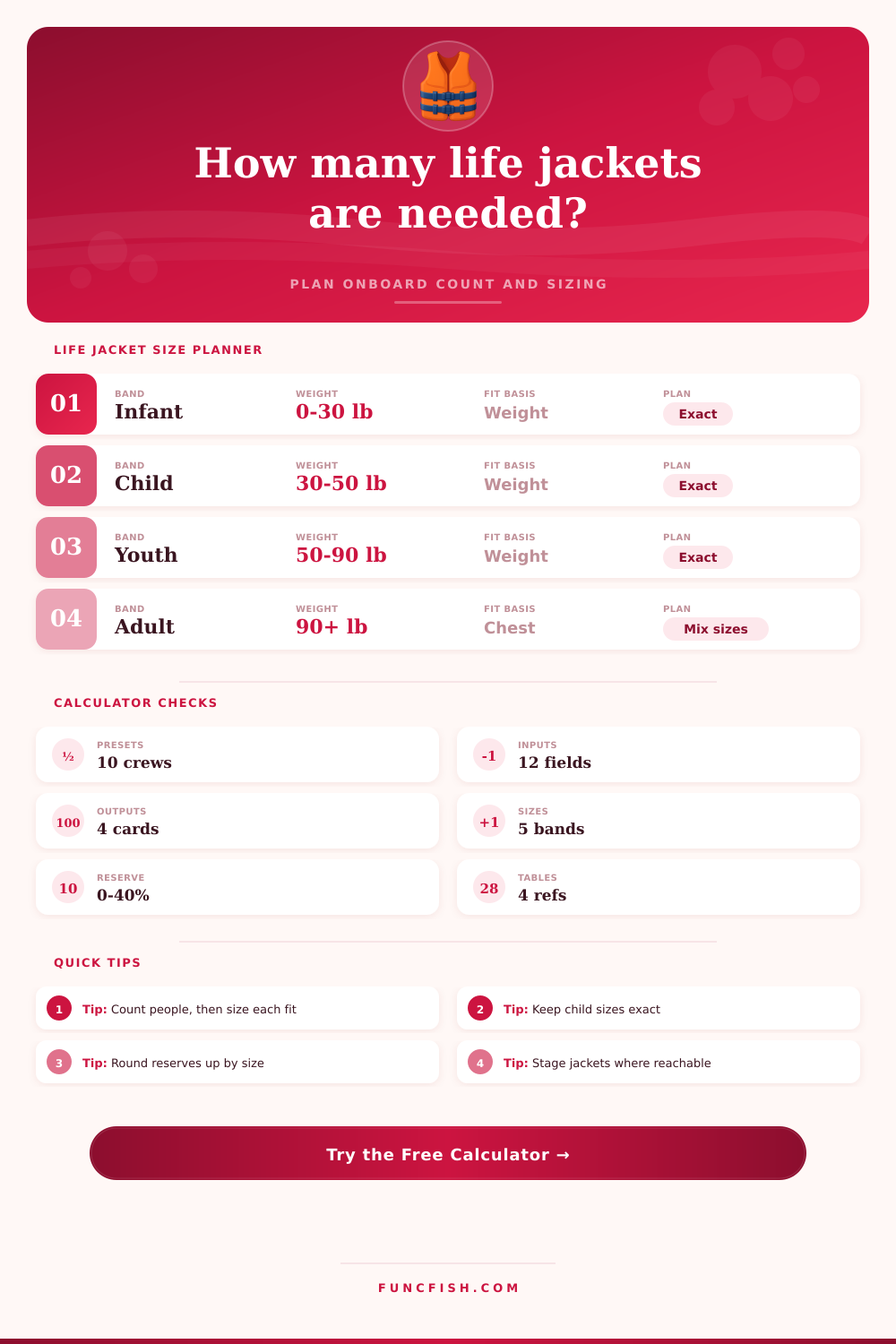
Use infant-labeled flotation with head support and secure lower strap fit.
Plan exact weight-band jackets so smaller children do not slide up.
Track youth separately from adult jackets even when height looks similar.
Adult universal labels commonly target about 30 to 52 inches of chest range.
📊Crew comparison grid
One worn jacket is the core count; a dry spare is useful for guide or shuttle use.
Mixed child and adult sizes need a labeled seat or bag plan before launch.
Remote water planning often benefits from extra adult and extended-fit reserves.
Loaner fleets should reserve by size because wearers change through the day.
📋Reference tables
| Size band | Imperial range | Metric range | Calculator use |
|---|---|---|---|
| Infant | Under 30 lb | Under 14 kg | Count separately for head support, crotch strap, and snug lift test. |
| Child | 30-50 lb | 14-23 kg | Round up count only after matching every child to the current weight band. |
| Youth | 50-90 lb | 23-41 kg | Keep youth jackets available even if a youth is close to adult height. |
| Adult universal | 90+ lb, chest based | 41+ kg, chest based | Use for standard adult torsos within the jacket label range. |
| Adult extended | Large chest or layers | Large chest or layers | Count separately when universal jackets may not close or sit correctly. |
| Trip exposure | Reserve factor | Fit emphasis | Staging emphasis |
|---|---|---|---|
| Sheltered pond or marina | 0-5% | Exact child and guest sizing | At seats or worn before moving |
| Inshore lake or river | 5-10% | Adult chest mix and child bands | Open bins, seat bags, or console hooks |
| Cold water or shoulder season | 10-15% | Layer fit, mobility, and high-support wearers | Worn jackets plus labeled backup bag |
| Rough water or night return | 15-20% | Bright, secure, and easy-to-don jackets | One zone per cockpit or deck area |
| Offshore or remote water | 20-25% | Extended-fit spares and crew assignment | Worn set plus visible reserve locker |
| Storage condition | Unavailable buffer | What it models | Calculator action |
|---|---|---|---|
| Dry labeled bags | 0-3% | Low chance of missing, wet, or mixed-size gear | Small reserve is usually enough |
| Open boat lockers | 3-8% | Normal moisture, forgotten jackets, or moved gear | Add one reserve when count is small |
| Shared loaner bin | 8-15% | Unknown fit, fast turnover, and mixed condition | Round spares within every active size band |
| Wet or compressed storage | 15-25% | Failed buckles, waterlogged foam, or blocked access | Increase inspection buffer before departure |
| Boat length band | Typical staging zones | Throwable plan | Access note |
|---|---|---|---|
| Under 16 ft / 4.9 m | 1-2 zones | Optional planning station | Keep small craft jackets worn or clipped near the paddler. |
| 16-25 ft / 4.9-7.6 m | 2-3 zones | One station is a practical planning target | Split forward and aft so gear does not bury the only set. |
| 26-39 ft / 7.9-11.9 m | 3-4 zones | One to two stations | Stage near cockpit, cabin entry, and swim platform. |
| 40+ ft / 12+ m | 4+ zones | Two stations | Separate deck, cabin, and helm access points. |
💡Planning tips
Although this might seem like common sense, it’s simply not enough, you need to plan for more than just a one-to-one headcount of PFDs per person aboard. Wearing thick layers in cold water affects how much space you have in a PFD. A kid’s pfd could be too small for them and vice versa. Boat safety isn’t always black-and-white; the number of people onboard doesn’t tell the whole story.
Weather can change, gear can be misplaced, and crew can shift between dawn and noon. Plan for who is aboard at noon; not who is on paper at daybreak. By inputting your trip conditions and passenger mix, you let the calculator do the math rather than guessing which spare size matter. The calculator also forces you to consider sizing bands versus just considering each jacket to be an adult sized unit.
Plan for All Sizes and Spares
Infants weighing less than 30 pounds require head support that isn’t found on typical adult vests. So even if the combined weights seems comparable, the fit mechanics are completly different. Having a child sliding upwards within a larger vest means they could end up with their face below water level. That’s why the tool separates the bands to avoid swapping a toddler jacket for a youth jacket where the straps won’t fit propery.
Where adult sizing adds another problem is that even people of the exact same weight can be very different in terms of how much chest they require. Two people who weigh exactly the same could have vastly different frames (shoulders), meaning the one with broader shoulders requires extra torso space different than the narrower-framed angler. This becomes important when layering for trips as well, since cold water running means thicker wetsuit/fleece under the PFD. Standard universal jackets don’t leave much space once those layers is added. It’s easy to forget about their bulk until you’re out trying to close those buckles and they just won’t close. So for situations like that, you’ll want to note those larger-chested needs to make sure your reserves includes a vest that fits on top of a bulky coat.
These are the reserve counts. Most boat owners tend to cut corners on reserve counts, but they should of treating spares like insurance rather than clutter. Spares should be treated like insurance. Just like you always carry an extra jacket because stuff gets lost, wet, or broken over time with regular use, you should do the same with vests. A buckle breaks. Foam degrades from years of sun exposure. Someone spills their coffee on it just before launch. That’s where that buffer percentage comes into play when storing your gear.
Rather than have something not used as a spare sitting in the locker vs. Instead of searching for it in the water while dealing with an emergency, you would rather have a spare just sitting there, wouldn’t you? Those staging inputs will tell you if those spares should be stashed out of sight or easily accessible near seating area and the helm.
There’s another category of items called throwable devices which have their own line on the plan for a reason, unlike wearable personal floatation devices, it makes no sense to strap a device to your own body then try to throw it. Those rings and cushions is for throwing to somebody who may be in the water and where you place them largely depends on size and deck layout of boat. If it’s a long pontoon, you’ll want access from both ends so nobody will need to traverse half the boat when there’s trouble. Depending on length and exposure level, the tool points to those areas so you don’t limit yourself with bad storage practices.
Then again, you must physically check what the numbers say. The numbers mean nothing if the actual gear isn’t there when you get to it on the back of the boat. Double check that the vests are where they’re supposed to be and in good shape. The last thing you want is to be in a situation where your plans fail because the vests aren’t the ones you thought they were. With sizes correct and spares up and off the hook, you can go without the worry of digging around in the dark at the bottom of the locker when seconds matter.