Hook Wire Gauge Strength Calculator
Estimate fishing hook wire diameter, straight tensile capacity, practical bend-opening load, line match, and safety margin from gauge, material, hook geometry, point loss, corrosion, drag, and target pull.
📌Hook wire presets
⚙Wire, hook, and load inputs
Hook wire strength estimate
Full breakdown
📋Calculated wire specs
Gauge conversion used by the current setup.
Circular wire area before any hook reductions.
Material strength used for the straight wire.
Expected pull multiplied by technique shock.
This calculator estimates fishing tackle loads only. Do not use hook wire or these estimates for lifting, climbing, towing, hoisting, or any human-support application.
🔀Wire grade comparison
Lower tensile and lighter bend profile for small flies, panfish hooks, and soft drags.
Balanced freshwater hook wire with normal bend radius and standard temper.
Higher bend resistance from forged geometry and heavy-wire hook design.
Corrosion-resistant wire, usually trading some peak tensile strength for durability.
📚Reference tables
| Gauge reference | AWG diameter | SWG diameter | Typical hook use |
|---|---|---|---|
| 26 gauge | 0.405 mm / 0.016 in | 0.457 mm / 0.018 in | Fine dry fly, tiny nymph |
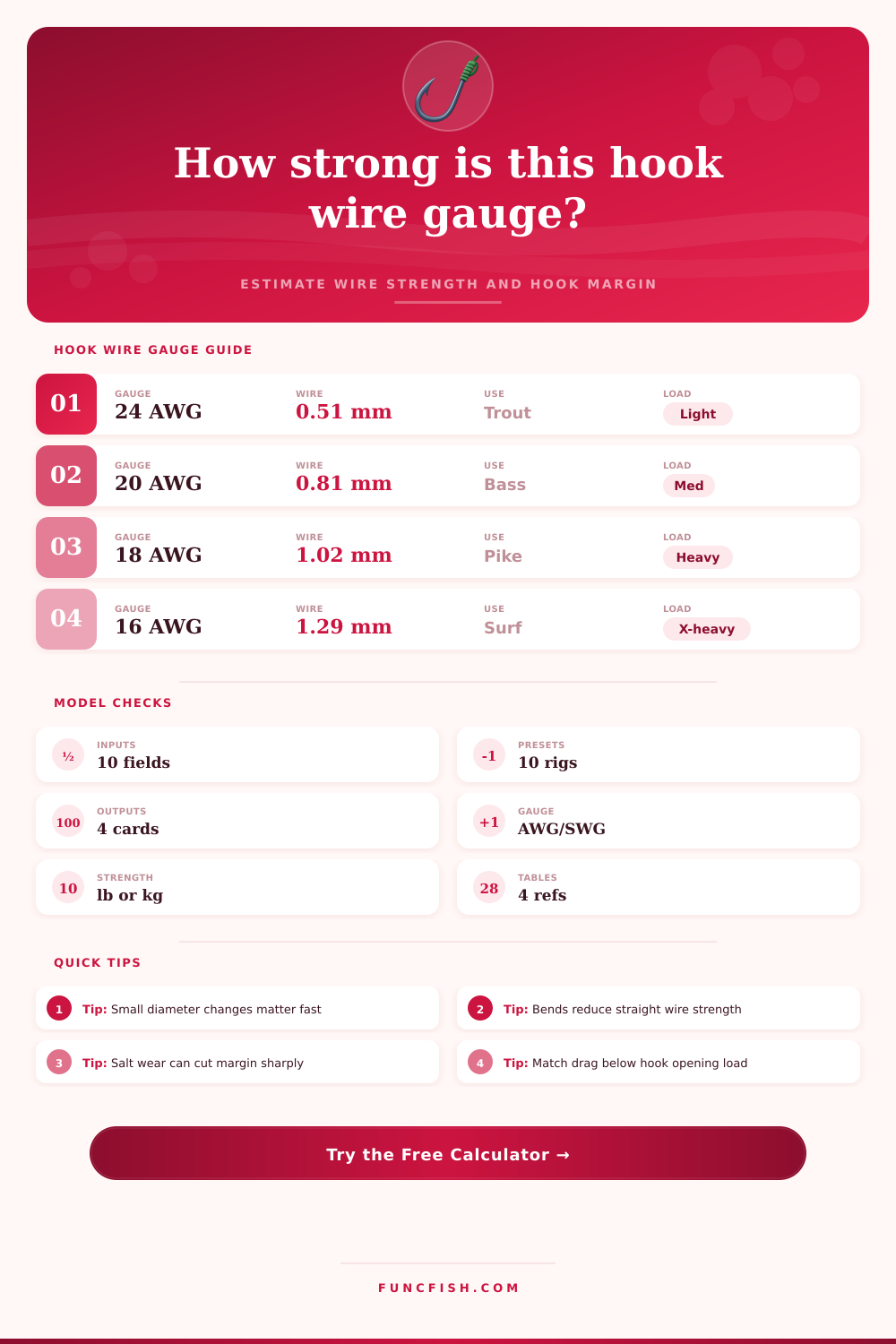
| 24 gauge | 0.511 mm / 0.020 in | 0.559 mm / 0.022 in | Trout, panfish, light bait |
| 22 gauge | 0.644 mm / 0.025 in | 0.711 mm / 0.028 in | Light bass, walleye, jig hooks |
| 20 gauge | 0.812 mm / 0.032 in | 0.914 mm / 0.036 in | Bass worm hook, inshore bait |
| 18 gauge | 1.024 mm / 0.040 in | 1.219 mm / 0.048 in | Pike, catfish, surf bait hooks |
| 16 gauge | 1.291 mm / 0.051 in | 1.626 mm / 0.064 in | Heavy surf, salmon, offshore bait |
| Wire material | Model strength | Best fit | Calculation note |
|---|---|---|---|
| Bronzed light wire | 155 ksi / 1069 MPa | Small freshwater hooks | Good penetration, lower opening reserve |
| High-carbon hook wire | 210 ksi / 1448 MPa | General freshwater hooks | Baseline for many J and worm hooks |
| Forged tempered carbon | 245 ksi / 1689 MPa | Heavy cover and salmon hooks | High strength with better bend resistance |
| Stainless saltwater wire | 175 ksi / 1207 MPa | Saltwater bait hooks | Corrosion resistance, moderate tensile model |
| Vanadium alloy wire | 260 ksi / 1793 MPa | Premium thin strong hooks | High strength at smaller diameters |
| Tin plated salt hook | 195 ksi / 1344 MPa | Surf and bait hooks | Coating helps corrosion but does not add core area |
| Hook geometry | Opening factor | Common wire | Reason for reduction |
|---|---|---|---|
| Standard J hook | 0.42 | Light to heavy | Bend opens before straight wire failure |
| EWG worm hook | 0.36 | Heavy bass wire | Wide gap creates more leverage |
| Circle hook | 0.48 | Heavy bait wire | Round bend distributes load well |
| Treble point | 0.30 | Light to standard | Individual point and small shank bend first |
| 90-degree jig hook | 0.38 | Standard to heavy | Eye bend and shank angle add stress |
| Siwash open eye | 0.40 | Salmon and spoon hooks | Open eye and long shank add leverage |
| Fishing load case | Typical peak pull | Line range | Hook wire direction |
|---|---|---|---|
| Trout stream drift | 1-4 lb / 0.5-1.8 kg | 2-6 lb | Fine wire, sharp point, soft drag |
| Bass worm in grass | 6-16 lb / 2.7-7.3 kg | 12-25 lb | Heavy EWG or forged bend |
| Catfish bottom rig | 12-30 lb / 5.4-13.6 kg | 20-50 lb | Circle hook with thick carbon wire |
| Surf bait in wash | 10-28 lb / 4.5-12.7 kg | 20-40 lb | Salt-resistant heavy bait hook |
| Salmon spoon or siwash | 12-35 lb / 5.4-15.9 kg | 15-40 lb | Forged siwash, wide radius bend |
| Offshore live bait | 25-80 lb / 11-36 kg | 40-130 lb | Extra-heavy forged or stainless wire |
💡Practical calculation tips
When’s the last time you got hung up in heavy cover and broke off with a big pull? Yeah, me too. It feels like something is wrong with your gear, but more times than not, it was a mismatch between what you thought your tackle could do and what laws of physics will permit. One of those unseen factors that make the difference between success and frustration on the water are hook wire strength. Once you know your hook style and gauge, the calculator above does all complicated math for you. You won’t ever need to wonder if that beefy-looking bait holder has the same strength as a fifty-pound test braided line or if it’s deceptively heavy duty.
Many of us have been conditioned to believe that thicker = stronger when it comes to fishing tackle. Unfortunatly, it’s not that simple. Material fatigue and shape change equation completely, making this an incomplete assumption that can be very dangerous. The other thing that throws folks off right away is that wire gauge goes backwards. Lower numbers mean thicker strands. So it’s not so much about buying direct strength as it is cross-sectional area. Strength increases exponentially, not linearly, to diameter. Double the thickness and you don’t double the strength. You quadruple it. Area goes by square of radius.
How Strong Is Your Fishing Hook?
So going from 24 gauge wire to 22 gauge are a huge increase in your reserve power. On paper it seems like such a minor jump, but when you’re fishing for pike around trees in water, that’s a night and day difference. The only catch is understanding what you’re really getting before you get on the water.
The material sets the performance ceiling; however, hook shape determines where that ceiling collapses. For fresh water applications, high carbon steel has great tensile strength because it can be heat treated to give maximum resistance to bending without making the steel brittle. In saltwater, stainless steel gives up some total strength as it corrodes its way from the exterior to the center. It’s a calculated trade-off, and one that’s needed. The materials’ properties is included in the calculation along with the geometry (shape) of each individual hook you select. Where a circle hook fails vs. A EWG worm hook vs. A standard J-hook and others all concentrate the stress differently. Straight wire breaks under load. However, wide gaps make it easier to open the hook than to break it at the bend.
Good build doesn’t always translate into good condition So while a new hook may be strong on paper, put it in salt water and its quickly a different story. Tiny little pits that occur when exposed to salt water will cause microscopic cracks similar to any other type of stress riser and expands under load. So yes you may fish a hook and never see any rust but if you don’t examine hooks carefully before reusing, your doing so at your own peril. The tool accounts for this fact through condition multipliers reflecting the truth: That a hook dug up off the beach after 3 weeks of surf fishing isn’t equal to the one out of the pack yesterday. And if you intend to use your safety margin to represent anything, then you must factor in that wear and tear.
Practice meets theory when it comes to matching the line test and opening load of your hooks. For instance, imagine you have a 15-pound hook that opens up on a shock load. If your drag settings is for a 20-pound line and your braid or mono tears off at twenty pounds, you’re going to be losing some fish. That’s what the safety factor output can help with as it compares the maximum likely peak pull versus modified strength of the hook. It shows you visually how much of a safety margin you have different than pushing the limits. In my experience, most lost fish in heavy cover isn’t due to the line being weak. Rather, the hook opened up before your drag could engage correctly.
All variables should be considered when choosing what combo works best. You need enough wire to withstand shock of first hit. You also need to be able to penetrate and cast without using too much wire. We use reference tables on page for this purpose. These pair common gauge sizes with common conditions and species. This gives you a starting point from which you can dial things in according to your specific scenario. It’s about making calculated choices based off confidence instead of hoping it’ll work.
Whether you get lucky or respect the physics, having confidence your tackle will hold up on that big one sure feels nice. Understanding how bend radius, material and diameter works together under pressure gives you that peace of mind. Don’t leave what you cannot calculate to chance; what you can control with calculation is a calculated risk. When the stakes are high, never leave anything to chance.