Drop Off Angle Calculator
Calculate a fishing ledge or breakline angle from shallow depth, deep depth, and horizontal run, then check drop rate, lure clearance, and rig fit for the edge.
📌Drop-off presets
⚙Drop-off measurements
Drop-off angle results
Formula breakdown
🎣Gear and species comparison grid
Crankbaits, Carolina rigs, and football jigs cover long feeding shelves.
Jigs and live-bait rigs track bottom where the first sharp contour appears.
Vertical spoons and controlled trolling work where open water meets a wall.
Slip floats and light jigs hold above brush on softer, stepped breaks.
Leaders need enough weight to stay near the trough without burying in sand.
Jigs and bait rigs often sit on the shoulder where tide pushes food upward.
Bottom rigs favor the lip and base; heavy current lowers effective fit.
Vertical jigs and compact leaders stay efficient on steep rock or wreck edges.
📊Reference tables
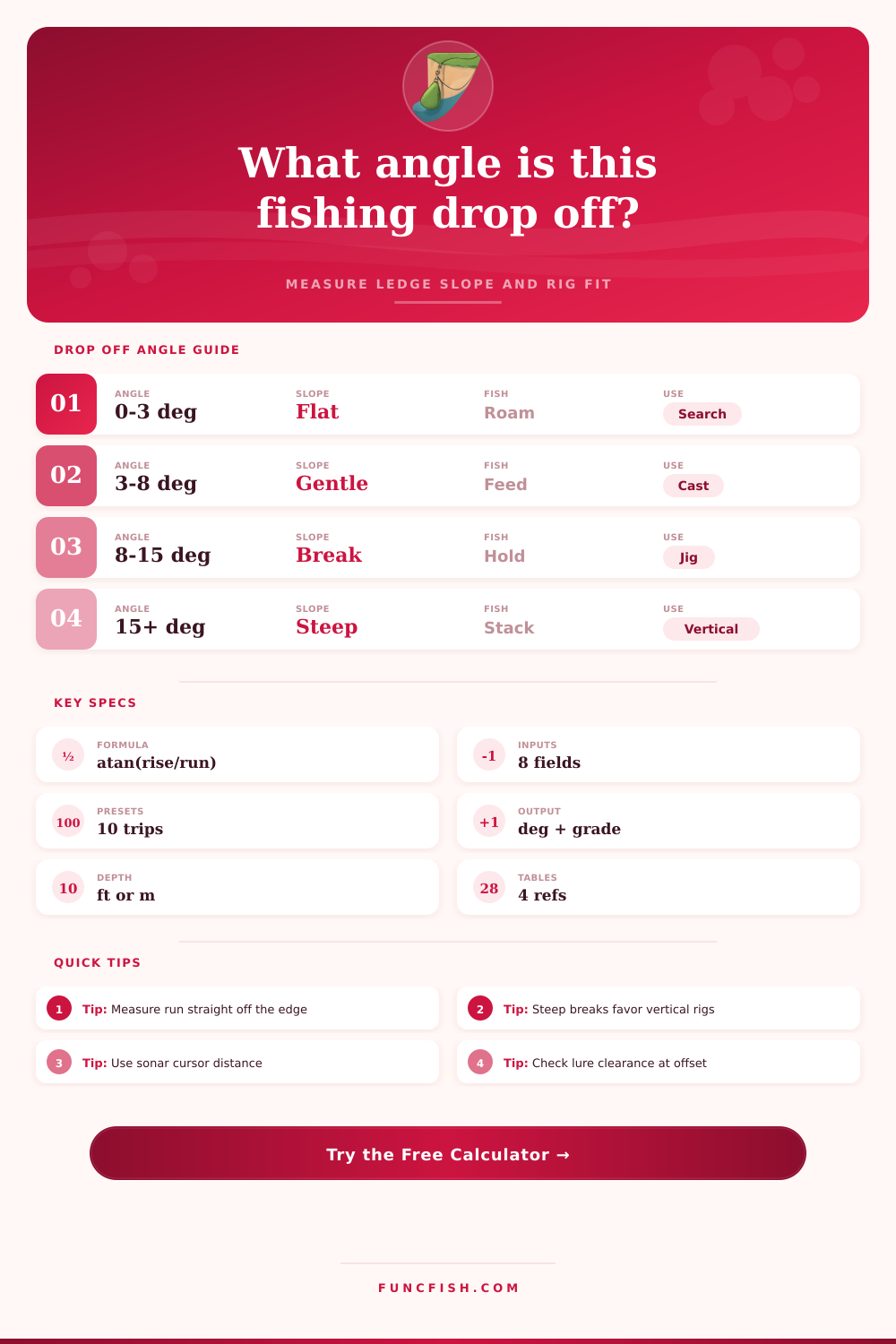
| Angle class | Angle range | Typical contour look | Fishing use |
|---|---|---|---|
| Flat shelf | 0°-3° | Slow depth change over a long cast | Search baits, drifting bait, roaming fish |
| Gentle break | 3°-8° | Noticeable but forgiving depth change | Crankbaits, Carolina rigs, float rigs |
| Defined drop | 8°-15° | Clear contour compression on sonar or map | Jigs, drop shot, live bait on the edge |
| Steep face | 15°-30° | Short run with fast depth gain | Vertical jigging, controlled bait, tight boat positioning |
| Wall or bluff | 30°+ | Very fast depth gain near the bank or structure | Vertical presentations and precise line control |
| Rig package | Typical line | Preferred angle | Drop-off role |
|---|---|---|---|
| Vertical jig | 10 lb braid, short leader | 12°-35° | Stays in a small cone over steep edges. |
| Drop shot | 6 lb fluorocarbon | 8°-24° | Holds bait just off bottom on defined breaks. |
| Carolina rig | 14 lb mono or fluoro | 3°-14° | Drags across broad ledges and soft shoulders. |
| Slip float | 8 lb mono | 2°-10° | Suspends bait above cover on gentle edges. |
| Deep crankbait | 12 lb fluorocarbon | 4°-16° | Deflects into the upper lip or first drop. |
| Bottom bait rig | 20 lb mono | 3°-18° | Plants bait at the lip, base, or current seam. |
| Surf leader | 30 lb braid to shock leader | 1°-8° | Works troughs and bars with low, rolling slopes. |
| Reef jig | 40 lb braid, abrasion leader | 15°-45° | Drops fast on rock, wreck, and coral faces. |
| Species group | Useful drop angle | Common depth position | Presentation match |
|---|---|---|---|
| Largemouth and smallmouth bass | 4°-15° | Top edge, first shelf, or base in bright light | Crankbait, jig, Carolina rig, drop shot |
| Walleye | 6°-18° | Windward breakline and base transition | Jig, live bait rig, blade bait |
| Crappie and panfish | 3°-10° | Suspended over brush or basin edge | Slip float, small jig, vertical spoon |
| Catfish | 5°-16° | Hole lip, outside bend, or downstream base | Bottom bait rig, slip sinker, heavy leader |
| Trout and salmon | 10°-28° | Cold-water shelf, thermocline edge, bluff face | Spoon, jigging bait, controlled troll |
| Redfish and inshore drum | 6°-20° | Channel shoulder and oyster edge | Jig, popping cork, bait rig |
| Measurement method | Best field source | Accuracy note | Use in calculator |
|---|---|---|---|
| Sonar cursor | Split-screen map and sonar | Good when boat track crosses straight over the edge | Use cursor distance as horizontal run. |
| Chart contour spacing | Lake map or marine chart | Depends on contour interval and map resolution | Use contour depth change and measured map distance. |
| Cast count | Known reel pickup or marked braid | Works best in calm water with straight casts | Estimate run from lure contact points. |
| Ice hole grid | GPS or measured hole spacing | Strong for basin edges and suspended fish | Use hole spacing as run and sonar depth as rise. |
| Bank or surf pacing | Paces, marker poles, or rangefinder | Current and wave wash can blur bottom location | Use as a rough horizontal distance. |
💡Calculation tips
I’m sure you’ve been out on a reservoir before where your sonar are telling you that there’s a hard line that drops from eight down to thirty feet in what seems like an inch. In reality, that bottom doesn’t look nearly as vertical as it does from the boat. Understanding if it’s a wall versus a slope will make all the difference for fishing it.
Anytime we’re around a depth change most of us just go through a jig or cast a jerkbait. We don’t really think much of the geometry; we’re simply guessing the angle. You can stop guessing by using this calculator to figure out if you are facing a steep slope or a gradual shelf. Just input horizontal run, crest depth, and base depth. It’ll do all of the mathematical work for you. It’s just basic trigonometry.
How to Choose the Right Lure for Steep Slopes
All you’re doing is taking the difference between your shallow and deep water to get the rise then using that and the run to find the angle: A 10-foot change over fifty feet of horizontal distance are going to give you a gentle slope. A 10-foot change over ten feet of horizontal space will result in a steep wall.
So what does this tell you? It tells you the angle at which your bottom drops off from your lure. And that’s important; it affects how fish is positioned and how they move around. When a bottom drop off slowly, it creates a big ledge with a lot of room for roaming bass to feed on forage dispersed over a wide area. On a steep face, however, they’ll be forced up into a narrow band along the edge, stacked one on top of the other instead of stretched out horizontally.
Knowing the angle lets you pick the right rig before you ever make a cast. Something like a four-degree angle means you’re dealing with a flat shelf, which is prime real estate for something like a heavy crankbait that requires some distance to do its thing. You could of also use a Carolina rig. Those baits can be dragged along the bottom and bounced along the contour.”
What if you are on a twenty degree drop-off? Drag ‘em around? Your lure will slide down the slope faster than you can keep up, or it will get stuck in the weeds above, if the angle is too steep for that way of fishing. The page has a handy reference table that lines up rig types against slope categories so you can get a quick idea of what works where.
Another output, clearances, alleviates one of the more frustrating aspects of fishing. Even though you may believe you’ve got your drop shot positioned on the very edge of the rock pile, when you’re throwing short to a steep slope, you could actualy be over deep water for your bait depth. Worse yet, you may not even be hanging off the edge with your lure positioned on the slope. The clearances metric lets you know whether or not you have actual water underneath your bait based off how far you’re casting to the target.
If you have positive clearance, then you’ve got some buffer space. If you have zero or negative clearance, then you’re dragging bottom. That’s where folks goes wrong. Instead of moving closer to or further from the edge, they change their weight.
In addition, wind and current factor into the feel of that angle on your line. If there’s a constant current pushing your bait along, it will push it off course, essentially changing both the horizontal run as well as the angle at which it descends towards the bottom. To account for that, the tool allow you to account for water movement conditions. A strong river current or surf surge will drag a light rig down a slope much faster than gravity alone, making a moderate drop feel more like a wall.
That’s one reason vertical jigging tends to excel over horizontal presentations on steeper structure. You’re not fighting the slope you’re working with it. So in summary, knowing the shape of the submerged structure makes random casting a targeted presentation. It transforms hoping to run across fish into putting your bait right where the shape of the bottom concentrates the fish. Bass on a rock ledge or walleye on a break line, the slope defines the game.
The angle eliminates any guesswork and allows you to concentrate on doing rather than wondering where the bottom drops off. It is a little bit, but it is important all the same. Is it a cliff or a hill? Do I drop my bait directly downward or do I work it along?