Trim Angle to Bow Lift Calculator
Estimate how much bow rise a fishing boat gains from engine or drive trim by combining hull response, length, beam, speed, load balance, setback, and water condition.
📌Fishing boat presets
⚙Trim and hull inputs
Calculated trim response
Formula breakdown
📊Hull response data
Fast bass hulls convert trim angle into bow lift quickly once aired out.
Heavier multi-species hulls lift more gradually and prefer moderate trim.
Longer, heavier offshore hulls need more leverage for visible bow rise.
Fishing pontoons trim flatter because buoyancy is distributed along the tubes.
🐟Gear and species comparison grid
Pad-V boat, high-speed casting run, moderate bow lift for reduced wetted pad.
Deep-V gear load, chop control, bow carried enough to soften spray.
Flats skiff, shallow tunnel or jack plate, trim limited by ventilation risk.
Offshore center console, bracket leverage, bow lift balanced against pounding.
Aluminum mod-V, light gear, small bow rise for economical lake cruising.
Jon boat or mod-V, stern load common, keep bow rise conservative in current.
Tiller or console deep-V, heavy casting deck load, trim for spray control.
Walkaround hull, kicker and downrigger weight, modest trim for offshore comfort.
📐Reference tables
| Drive trim angle | Typical hull attitude | Expected bow lift range | Fishing-boat interpretation |
|---|---|---|---|
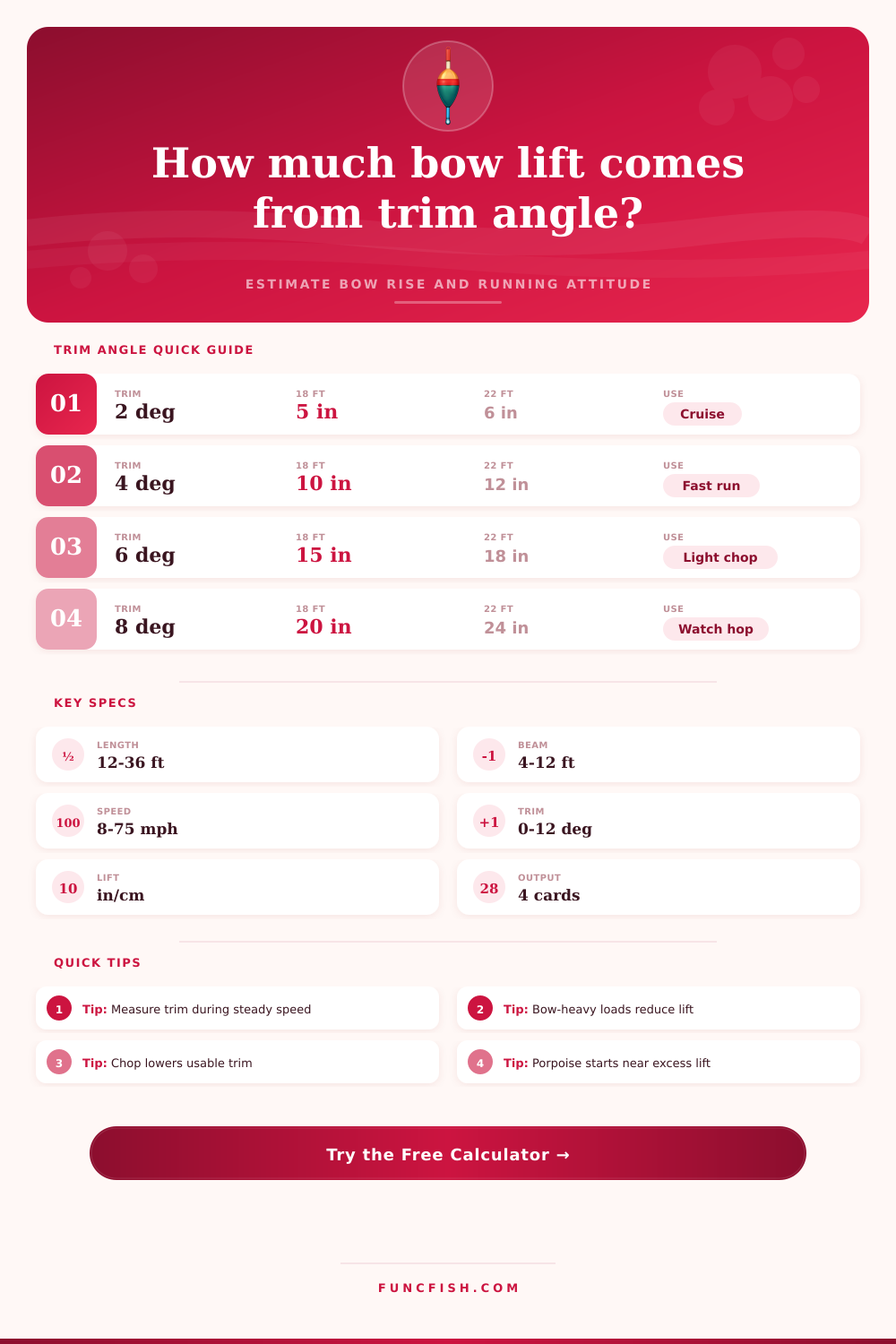
| 0-2° | 0-0.8° | 0-5 in / 0-13 cm | Neutral or tucked run; useful for hole shot, turns, and rough water. |
| 3-5° | 0.9-2.2° | 5-16 in / 13-41 cm | Common cruise band for many fishing boats carrying normal tackle loads. |
| 6-8° | 2.3-4.0° | 14-30 in / 36-76 cm | Fast-water lift band; watch steering torque, prop bite, and bow hop. |
| 9-12° | 4.1-6.0° | 24-48 in / 61-122 cm | High trim; usually limited to light fast hulls in smooth water. |
| Hull style | Response factor | Normal trim band | Bow-lift behavior |
|---|---|---|---|
| Pad-V bass boat | 0.52 | 4-8° | Strong bow lift once the hull runs on the pad; sensitive to load changes. |
| Deep-V multi-species | 0.38 | 2-6° | Stable lift with more wetted length; often trimmed down in short chop. |
| Flats or tunnel skiff | 0.34 | 1-5° | Responds quickly but can ventilate if the prop is already running high. |
| Offshore center console | 0.31 | 2-6° | Longer hull and heavier bow damp lift; bracket setback adds leverage. |
| Fishing pontoon | 0.24 | 1-4° | Trim changes engine load more than visible bow angle on many pontoons. |
| Load condition | Multiplier | Common fishing cause | Effect on bow lift |
|---|---|---|---|
| Bow-heavy | 0.86 | Trolling motor, anchor, batteries, anglers forward | Needs more trim for the same lift and may run wetter. |
| Balanced | 1.00 | Even tackle, fuel, ice, and crew placement | Best match for baseline trim-angle estimates. |
| Stern-heavy | 1.12 | Kicker, power poles, full aft livewell, batteries | Shows more bow rise and can reach porpoise sooner. |
| Crew forward | 0.90 | Two anglers on a front casting deck | Reduces bow lift but may improve sightline and control. |
| Water condition | Multiplier | Recommended trim behavior | Calculator meaning |
|---|---|---|---|
| Slick or protected | 1.06 | More lift is usable if steering, water pressure, and prop bite stay steady. | Calculator allows slightly higher effective bow rise. |
| Light ripple | 1.00 | Baseline run for comparing setups and repeated speed checks. | No water-condition correction applied. |
| One-foot chop | 0.92 | Trim down enough to keep the bow from skipping across the crests. | Bow-lift estimate is damped for usable running attitude. |
| Short steep chop | 0.84 | Carry less bow and keep more hull in the water for repeated impacts. | Usable lift is reduced and trim margin tightens. |
| Following sea | 0.88 | Avoid excessive bow rise that can reduce bite at the next trough. | Calculator warns sooner as trim approaches the upper band. |
💡Trim calculation tips
“Pointing the drive up alters where bottom of the hull contacts the water. Trimming up raise the bow, clears your sightlines and makes the ride lighter and the prop bite cleaner. But get it wrong, and the stern comes out of the water or the boat will porpoise. Or worse, you’ll lose all steering control.”
Horsepower alone rarely determines the difference between a nice smooth plane and hopping around dangerousy. It’s how your specific hull turns that angle into lift through trim. Trim is commonly thought off as a speed volume control knob. You crank her up until she’s running good and then panic when she begins to bounce. The reality is it’s all about leverage and physics.
How Boat Trim Works
You can’t compare how your twenty-foot pad-V hull bass boat will react to trim to a thirty-foot deep-V hull offshore center console. Once you enter your conditions and dimensions into the calculator above, it do the math for you. There are no conversions or coefficients to guess at. It even takes into account how a wider beam resist bow rise better than a narrow beam. This is because the greater wetted surface area push down to fight against the lift.
It also considers your drive set-up. A bracketed outboard, such as an offshore bracket or jack plate, will change the pivot point at the stern versus a direct-mount outboard. So with fewer degrees of trim, you may experience more bow lift on a bracket system different than on a transom mount. The traditional transom mount.
Most casual boaters lose sight of their running attitude when it comes to load placement. Are there three people in the front casting deck? Does your trolling motor mount way forward with two heavy battery beneath the console? That’s going to shift your center of gravity bow-heavy. This applies a multiplier to the calculator for this situation, because it will take a much greater trim angle to get equal bow rise when you need to lift weight off the pad.
On the flip side, maybe you’re running a kicker motor out the back and your fuel tanks is all the way in the rear of the boat, making the vessel stern-heavy. This can make the bow lift easily, sometimes too easy. The hull is pitched up before you ever hit full throttle button and you might be reaching porpoising speeds quicker then normal. Knowing this helps keep things stable at speed.
There’s another dynamic that static charts don’t show… Water conditions. In slick water you can carry more trim without any penalty. You can run high and dry on the bow, which reduces drag and improves mileage. But put a one foot chop on it, or short steep waves and now that amount of lift is a liability. Now you have a high nose that slaps violently down into the next wave. The tool takes sea state into account and reduces the anticipated lift in rougher seas reflecting a safer, more usable running attitude. In other words when the wind comes up, it will warn you that what works at the marina might not work out on the open lake.
But it’s all laid out in the table on the page where they show how different hull styles will react to changes in trim inputs. Because buoyancy is spread out along the tubes instead of just concentrated at the bow, a pontoon has very little response. No matter how hard you trim your engine down, you’ll never get dramatic bow rise on a pontoon. That’s not their goal…usually comfort and fuel economy. They are not cutting through water like a missile.
On the other hand, a flats skiff with a flat bottom create lift quickly but runs the risk of ventilating when the prop gets too close to the water. There is less room for error. So, really, trim isn’t all about speed; it’s about attitude control too. It will affect the ability of the boat to climb waves, execute turns and how much spray you get over the windshield.
So it comes down to finding that sweet spot between having the bow high enough to see out and low enough to be stable. Take the estimates as a start and go from there by feel. Trim down a bit if you feel any vibration through the steering wheel or the boat skitters along the top of water. It’s preferable to be a bit deeper in the water than to struggle for control pushing the limits of your hull’s capabilities. That nice balance, comfortabley ride is what makes those long days on the water enjoyable instead of grueling.