Boat Freeboard Calculator
Estimate loaded fishing-trip freeboard from waterline length, beam, hull side depth, water density, hull shape, and the crew, fuel, ice, tackle, bait, and gear you bring aboard.
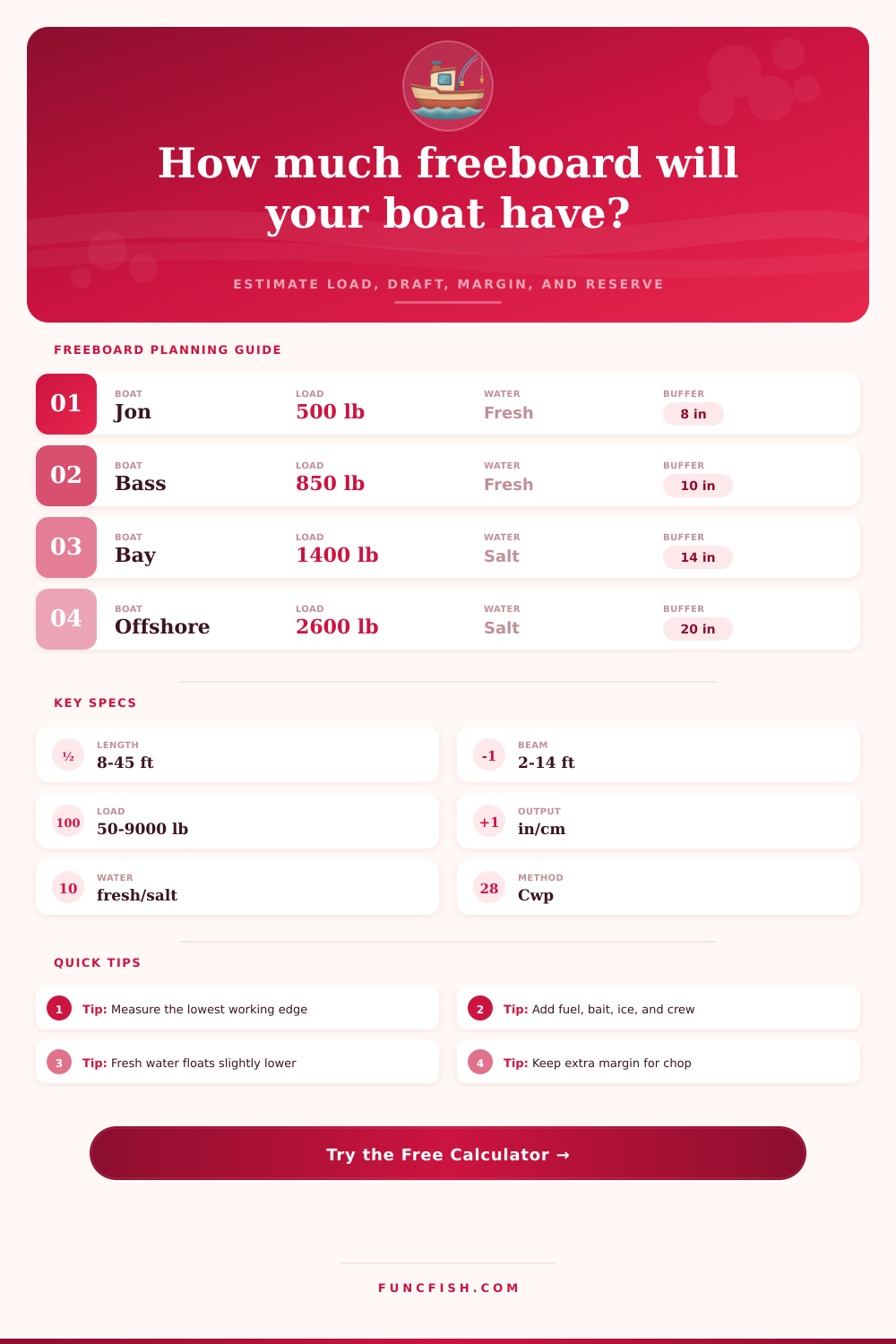
📌Fishing boat presets
⚙Freeboard inputs
Freeboard estimate
Formula breakdown
🛥Freeboard specification grid
Typical planning coefficient for many aluminum fishing hulls with tapered waterlines.
A practical minimum planning reserve for small powered fishing boats in protected water.
Salt water density used to convert carried weight into displaced volume.
Saltwater long-ton-per-inch shorthand: waterplane area divided by 420.
🎣Gear and species comparison grid
Two anglers often shift forward. Keep enough margin for bow-down trim and livewell weight.
Slow lake work has lighter dynamic demand, but batteries and rod holders add steady load.
Coolers, bait tubs, anchors, and stern current load can lower the working edge quickly.
Shallow-water crews move around decks; chop and wake exposure call for more reserve.
Rowing trim changes as anglers stand, cast, and shift between bow and stern stations.
Kicker motors, planer boards, batteries, and stern work justify an added aft margin.
Fuel, ice, bait, crew, outriggers, and sea state demand a large freeboard reserve.
Low-sided skiffs trade margin for draft; keep load centered and watch transom height.
📊Reference tables
| Hull profile | Waterplane coefficient | Typical use | Calculator effect |
|---|---|---|---|
| Kayak or canoe | 0.44 | Paddle fishing, narrow ends | Small waterplane area, faster sink per pound |
| Jon boat or punt | 0.82 | Flat bottom rivers, ponds, timber | Large waterplane area, slower sink per pound |
| Semi-V aluminum | 0.64 | General lake fishing | Moderate sink rate with tapered bow |
| Bass boat or low skiff | 0.70 | Deck casting and shallow lakes | Good waterplane area with low working edge |
| Bay or center console | 0.66 | Inshore, nearshore, mixed chop | Moderate area with higher reserve target |
| Pontoon or catamaran | 0.58 | Stable deck fishing | Twin hulls immerse differently than a box hull |
| Deep-V offshore | 0.56 | Bluewater and rougher approaches | Less waterplane area for beam, more margin needed |
| Drift boat or dory | 0.61 | River rowing and fly casting | Rockered shape changes trim with crew shifts |
| Water type | Density used | Metric equivalent | Freeboard impact |
|---|---|---|---|
| Fresh lake or river | 62.4 lb/ft³ | 999 kg/m³ | Boat sits slightly lower than in salt water |
| Brackish estuary | 63.2 lb/ft³ | 1012 kg/m³ | Middle value for tidal river and bay mixes |
| Salt bay or ocean | 64.0 lb/ft³ | 1025 kg/m³ | Boat sits slightly higher for the same load |
| Cold dense water | Use salt or fresh | Choose by salinity | Temperature effects are smaller than gear load |
| Fishing load pattern | Allowance | Typical cause | Planning note |
|---|---|---|---|
| Calm casting | 1.5 in | Balanced anglers and light wake | Best case for quiet protected water |
| Anchored bottom fishing | 2.5 in | Anchor pull, stern gear, bait tubs | Useful for catfish, snapper, and reef stops |
| Trolling stern gear | 3.0 in | Kicker motor, boards, crew aft | Watch scuppers and splashwell height |
| Livewell or heavy ice | 3.5 in | Water, bait, catch, coolers | Recheck after tanks fill and fish come aboard |
| One-side standing | 4.0 in | Casting line, netting fish, rail crowding | Heel can reduce freeboard on the low side |
| Choppy run | 5.0 in | Wake, chop, speed changes | Carry the largest reserve in exposed water |
| Load item | Common range | Metric range | Why it matters |
|---|---|---|---|
| Adult angler with clothing | 160-240 lb | 73-109 kg | People move, creating both sinkage and heel |
| Fuel | 6.1 lb/gal | 0.73 kg/L | Large tanks change trim as they empty |
| Fresh water or bait tank | 8.3 lb/gal | 1.0 kg/L | Water weight adds up faster than tackle |
| Ice and fish box | 40-250 lb | 18-113 kg | Catch load can be very aft or very low |
| Deep-cycle battery | 45-75 lb | 20-34 kg | Multiple batteries create permanent trim bias |
| Anchor, chain, rode | 15-120 lb | 7-54 kg | Bow gear affects running trim and reserve |
💡Calculation tips
The waves tell you more about a boat’s weight than a scale does. How close they come to edge of the deck means it’s riding low in the water. A couple of crew member and a tank of fuel can make a dry afternoon into a wet one if you don’t factor in how those pounds stack up.
Freeboard is the vertical measurement from the water line to the level at which waves and chop will wash across or over boat, and it gives you your safety buffer against a pounding chop. Load up on ice; fill the fuel lines; add gear and you reduce that freeboard in increments. But few anglers considers anything beyond weight capacity.
Why You Should Care About Freeboard
A boat may have a maximum capacity of fifteen hundred pounds. However, many people fail to realize that bow will rise up off the water when that weight is positioned far aft and low in the boat. This continues until your transom start taking on water. Use the calculator above. It takes into account your boat’s hull dimensions and where you place your load to help determine your true freeboard margin and how much room for error exist in inches. So it doesn’t simply say whether or not you’re over weight, it lets you know how close you are to going under by a critical inch.
Being within capacity means nothing if your boat lose enough freeboard due to unexpected swell or bad trim to actually start taking on water. How fast is your freeboard eaten away? That’s a big factor based off hull shape. A deeper v-hull cuts through waves and won’t sink as fast than a wide flat bottom. A flat bottom may be stable, but it goes under with each additional pound.
The tool accounts for these variables in their waterplane numbers which approximate the amount of surface area displacing the water. For instance a broad pontoon deck will sink less per pound than a narrow kayak. You don’t have to know the coefficient numbers off the top of your head. The presets will take care of that math for you depending on what style of hull your boat has. Knowing this helps you understand why your hull act differently than others. It can also help you decide where to place tackle box and heavy batteries.
Finally, there’s the matter of water density. Salt water is denser than fresh so you’ll notice your boat rides a bit higher in a bay versus a fresh water lake. So if you live on a river system, say, or fish a lot of freshwater lakes, you’ll find the boat sits a little lower in the water than in the ocean. It may be only an 1/8th inch here or there, but it adds up with other variables. Your draft will also change based off the salinity levels in brackish estuaries (where fresh meets tide water).
You can select the water type (fresh, brackish, salt) and the calculator toggles through each setting showing you what each environment does to your set up.
What you don’t weigh can be more dangerous than what you do weigh Crew, check…check. Fuel tank, it shifts and lightens as it empties…check. Water weight from ice melt, it’s heavy and it stays down in the hull…check. Bait in the livewell, a bucket of water attached to your deck…check. It all adds up fast.
That’s where knowing how much weight changes your boat’s depth will give you a feel for just how sensitive your boat is to those additions. If your immersion rate is high, that tells you that every 20lbs count. Your draft is going to notice. That’s why knowing that number could of help you make smart choices about what to leave on the truck when you’re pushing your limits of weight or space.
To plan for what’s going into your boat, it takes more than packing rods and reels. It requires visualizing the final state of your boat before you even arrive at the ramp. First measure from the keel to the lowest open spot. For example, if one scupper hole opens six inches lower then the rest, a high gunwale isn’t much good. Now measure from the bottom of the keel to the height of your lowest spot. That’s your real freeboard limitation.
Next, determine your estimated load and plug it in. How’s the margin? Is it tight? Think about lightening the load or shifting some weight to the middle. Boating safety is often about marginal situations rather than total failure. Never fill your boat past its maximum plate capacity. But you can slip over the edge of that margin in a heartbeat by adding little things into the mix that will rob you of your freeboard buffer.
Pay attention to that waterline and respect the physics of displacement. The bottom line is that it’s only the lowest point so it’s always going to define your safety zone. Typically, a dry boat is just one good plan away.