
The shrimp vendor tells you those shrimp are adult size even though they look like little specs of dust. So you buy them. You plop them in your tank. And then what? What happened to them? They hide under rock work. They also flow through plant cover. Why is that? Because you have a different perception of what an adult looks like different than they do. What you expect in one species doesn’t jive with the biological reality of another.
What you picture is something coming into your tank already strong and grown up. The fact is it comes as embryo inside the female’s body. Then several days later, they emerge as clear larvae that appear weak. Learn more about this journey to see how their care needs changes.
How Shrimp Grow and Change Size
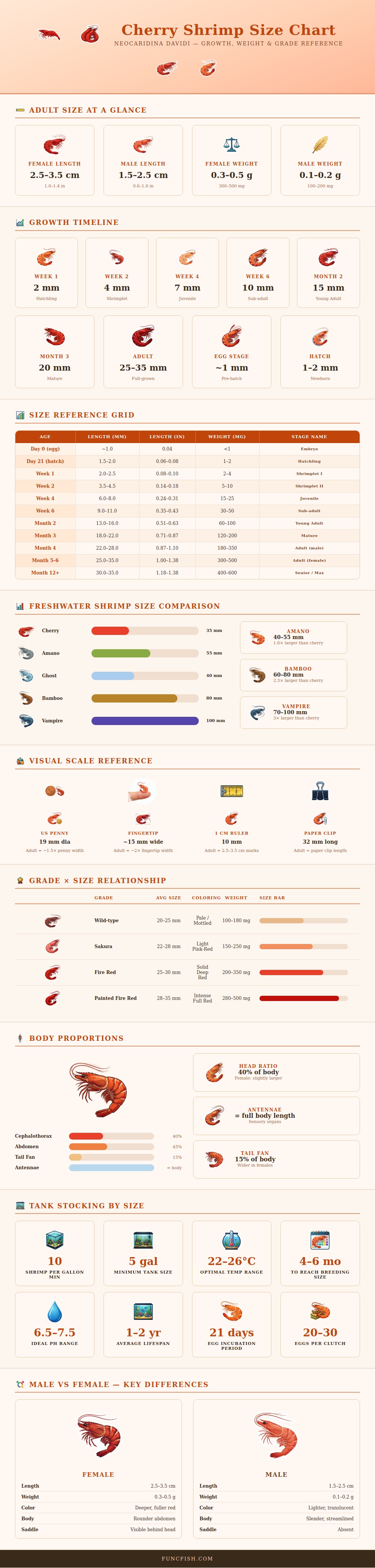
This evolution is clearly depicted in the infographic. It details exactly how far these shrimplets travel during a few short months. It’s not a straight line upward. It’s a series of quick leaps followed by sustained feeding bout. At first, they’re almost microscopic. Then they becomes a vibrant creature that holds its own against the substrate. And it all happens quickly.
That’s what makes the visual timeline important. You know when to expect them to act differently and when to adjust your feedings. Early on, they are machines that devour anything they can find. Biofilm, algae, it doesn’t matter. Small shells turn into large muscles in no time at all. Overfeed them, underfeed them, or overstock your tank and you’ll stunt their growth long before it gets going.
Perceived size also depends greatly on the physical differences between males and females. Have you noticed how your males and females looks like two separate species? Female shrimp get rounder. They get bigger. They turn bright red, something breeders drool over. In contrast, males tend to be slender. Sometimes they’re pale. Instead of being displays, they functions as workers.
Look at the chart. It points out the difference between the sexes. By the time they mature, females can weigh twice as much than males. That’s not just aesthetics. That has consequences for their movement within your tank and how many eggs they can carry. More belly = more room for embryo development. That translates into population increase over time. Grading among hobbyists is largely based off such differences. Specimens at the top of the heap are basically scored solely by body mass and intensity of their red coloring.
To put the size of cherry shrimp in perspective, I’ll compare it with other freshwater shrimp. Cherry shrimp are on the small end of the range when compared to, say, bamboo shrimp or vampire shrimp. The latter two can reach double/triple the size of cherry shrimp. In spite of being small, they still manage to fill out a given area, between crevices, among hardscape and plant roots. Larger shrimp wouldn’t be able to hide/thrive there as well.
So this niche lets you keep more shrimp without exceeding the physical capacity of your tank. In fact, you don’t even have to have a huge tank if you want a healthy population. All you really need is enough tank surface area for grazing. To help set their adult sizes in perspective, I use everyday items such as paper clips. This makes the abstract millimeter sizes easier to understand. It uses real-world visuals that we can see while looking inside our tanks.
They’ll take a while to get there. Incubation alone takes three weeks. So patience in those initial months will go a long way toward caring for them well. And remember: it could of been a long wait from the start of breeding to the arrival of the next generation.
One thing is never negotiable: the need for stable temperatures. Even slight fluctuations can cause stunted growth or stop development entirely during critical times like molts. Most keepers are obsessed with water parameters. What they fail to realize is that temperature swings will stress the animals as severely as any poor pH.
But once they’re adults, the reward is huge. It is a self-sustaining ecosystem. You get color and movement in your aquascape without constant intervention. Seeing that tiny speck of life evolve into a fiery red adult repays the careful setup you created at the start. That speck is now an anchored, permanent part of your underwater world. It’s a key component of the overall balance.