
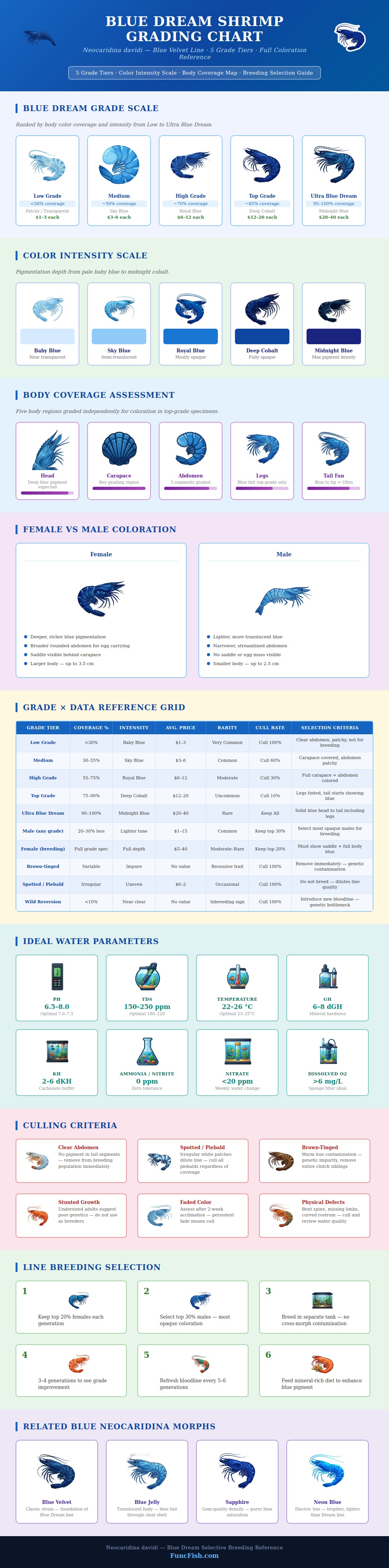
When you’re ordering shrimp based off some crappy photo and you get these pale blue shrimp as opposed to the deep cobalt ones in the photo, you might be disappointed. You feel scammed. But then you discover there is actualy no standard to grade them in the hobby. Breeders has their own definitions of what “quality” means based on percentages they can measure themselves. These are broken down into chart above.
Once you understand this scale, it will change way you view your tank. Instead of being focused entirely on color intensity, the grade is also based off amount of body covered. Even though a shrimp may be a rich dark blue in pigment, it’s still a lower grade shrimp if the pigment only covers 30% of its body.
How to Grade Blue Shrimp
What does this mean? How did we determined these grades visually? Well, it calculates surface area of the tail, abdomen, shell, and head to compare how much color is found on each part of their body.
Why should that matter? Inconsistent color mean genetics aren’t stable. If you’re seeing a lot of shrimps with transparent abdomens or other patchy colors, what you’re seeing is a less desirable animal whose offspring will probably shows weak characteristics. With the grading system, you’re forced to ignore how bright one spot is and evaluate how well whole pattern holds together.
But then there’s also intensity. Once you have your coverage, here we go. These range from near-transparent baby blue and deeper blues like sky blue or royal blue, to deepest depths of midnight blue and deep cobalt.
What does this mean? These are increasing densities of pigment inside the shell tissue. And what matters isn’t just location (where it is), but saturation (how solid it looks on the water-white background). Look at the gradient; the image above show it well. The more opaque the hue, the higher the grade. That solidness of color is what gives the blue dream shrimp a rep as being showy in planted tanks.
There’s another wrinkle on this analysis. Gender. Generally speaking, males is going to be more translucent and lighter than females. As a fish matures and begins to think about breeding, the pigments deepens and darken; thus, females will often have deeper colors then males. So even though a male appears mediocre, he may still be genetically stronger due to his ability to produce darker offspring when bred to high-grade female. You cannot judge a breeding pair by looking at individuals in isolation. As the chart points out, females will also get bigger with wider abdomens (a characteristic helping distinguish one sex from the other during selection). Knowing what two sexes look like will prevent you from eliminating a male because he’s slightly less colorful but really possesses good color genetics.
Water parameters is also important. The genetics won’t matter if the water conditions don’t allow its colors to show. This means stability matters more than perfection. Moderate ranges for pH are better, and sufficient hardness help the shrimp develop shells that retain color well. Regardless of the tier grade you’re starting with, spikes in nitrates or wild changes in temp will cause blues to wash out and turn more grayish shades. A consistent feeding routine using mineral rich foods also contribute to the biology of this process and gives the shrimp the building blocks for strong colorful exoskeletons.
While casual keepers may find this harsh, culling is also essential for line breeding. If you don’t remove brown-tinged, spotted, and other low grade shrimps from the breeding population, those genes will eventualy drift right back into wild type. Although it can be hard to part with living and healthy animals, your colony will lose its intensity in just a couple generations if you would of not cull. This is where the grading chart comes in to play as a decision tool, it helps us know who’s contributing towards progress and who’s diluting the progress. Only select the best males (opaque), and keep top twenty percent of females to speed up the process of improvement.
Having clearly defined goals at the outset will save you both time and money over the long haul. Yes, ultra-grade shrimp aren’t necessary right now, but you do need a plan of action that avoids uneven coloring. Many times disciplined selection trumps big bucks, which makes all the difference between “good” and “WOW!” tanks.
Stay the course because consistency and coverage are key. Keep the water stable and allow for the generational change; it happens. Before you know it, the colorless ghosts gives rise to quality blue shrimps, and your patience pays off with every deliberate choice.