
The flight’s booked; the hotel is reserved in Playa del Carmen. Every meal during your Mexican trip have been mapped out. Your itinerary is jam-packed, and your expectations are high.
There’s just one thing you likely haven’t thought of yet: The ocean doesn’t follow your vacation time. Moon phases, water temperatures, prey migrations and more drives fish to swim according to their own rhythm. And guess what? None of that relates to your PTO balance. Knowing when, and where… To catch them make all the difference between an empty cooler and a legendary tale.
How to Plan Your Fishing Trip in Mexico
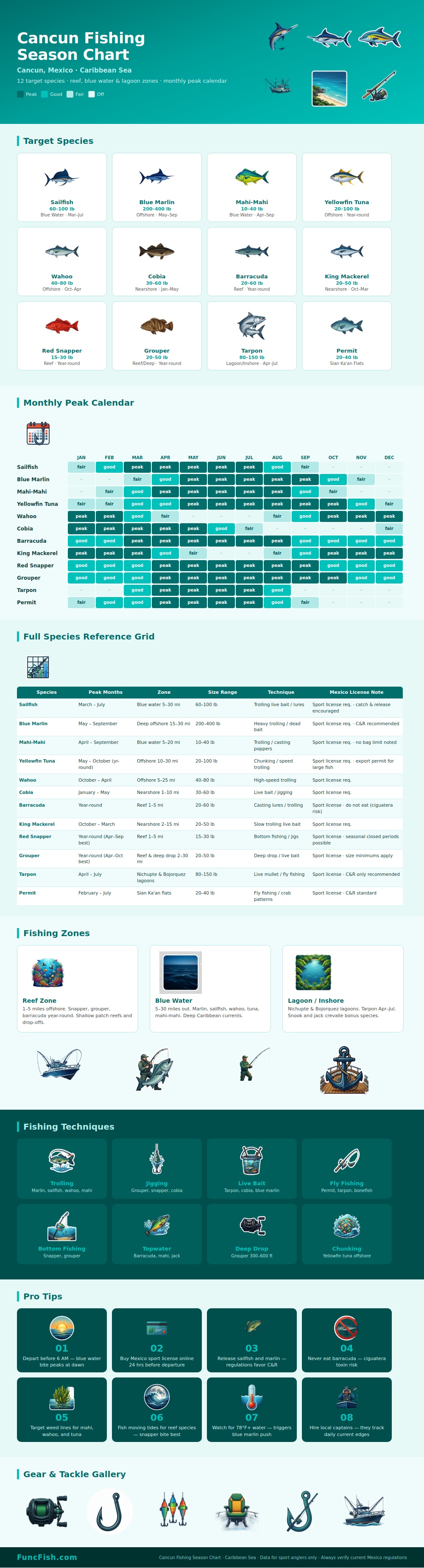
That’s the type of thing the chart on the right helps with. The monthly calendar explains details so you don’t have to guess. For example, it will break the dozen targeted species down into distinct zones so that you can visually see which months are good for each versus those which might be fair to off. This makes for a very helpful visual guide because what Cancun isn’t, realy, is just one place for fishing.
Instead, it’s a mix of three different types of environment. First, there are the shallow reefs near the shoreline where grouper and snapper remains more or less steady throughout the entire year. Second, there are the lagoons that the tarpon migrate through on their spring run. And third, there is deep blue water far out at sea. Here, thermal shifts and currents moves giants like sailfish and blue marlin around.
A common error among first-time anglers is believing that all boats handles all species. Not true. For example, targeting tarpon, which can reaches weights into the 400-pound range, requires a boat capable of running to depths of fifteen to thirty miles offshore, typically from May-September when these fish pulls into deeper water. You’ll never catch them from a shallow reef boat. Likewise, if you’re after tarpon in the lagoons (April-July), you’ll need a guide versed in the art of locating the channels of either Bojorquez or Nichupte where tarpon hang-out and ambush bait. Use the map above so you avoid trolling for tuna while tarpon sit idly in the back of the inlet behind you.
The other part of the timing is important too. Many of the “pro” points buried in the data indicates leaving no later than 6 a.m., particularly if you’re chasing blue water species. It’s not only due to the heat, several of these predators feeds heavily in low light hours. And the best time for the bite tends to be early when the rising sun clears the horizon above the Caribbean.
Lastly, be sure to understand the local rules on catch-and-release techniques. Often times, sailfish and marlin is returned not only for conservation reasons, but because it’s far more rewarding (and safer) for the angler. These animals of the sea fight as well as or better then any fish in North American waters, making the battle alone reward enough, even without the dinner plate.
Bait selection can be another hang up. Certain species will readily take an artificial lure. Other species require certain tactics, such as chunking for tuna, or new bait altogether. For example, barracuda can be abundant but also extremely risky with regard to ciguatera poisoning. They are considered strictly ornamental fish in this area. Knowing what you’re targeting and how it should of best be approached will save lots of time on the water.
As a general guide, if you try to match what you do to the situation then you’ll stay off the hook. Use heavier tackle and longer runs for offshore trips, and use lighter tackle and more patience around structure for reef fishing.
The bottom line is that success depends based off matching the time of year you go with the action. Look at all the seasons and see what’s active. For example, if it’s winter you’re going, target red snapper and wahoo. Summer? Go for the deep reef stuff and some marlin. You don’t force a bite. You’re there during their prime and in their territory when they feel like eating.
Hire an experienced local captain that knows the current flow, plan according to the biology, and let the Caribbean open up her doors. It won’t take much coaxing once you learn to listen.