
From the dock, it appears as if the ocean remains static here in San Diego, so you may think fishing couldn’t be much easier. But the underwater world transform daily based off temperature, swell, and migrating species. Learning the seasons allows you to better time your fishing trips. It converts fishing from a game of chance to one of timing.
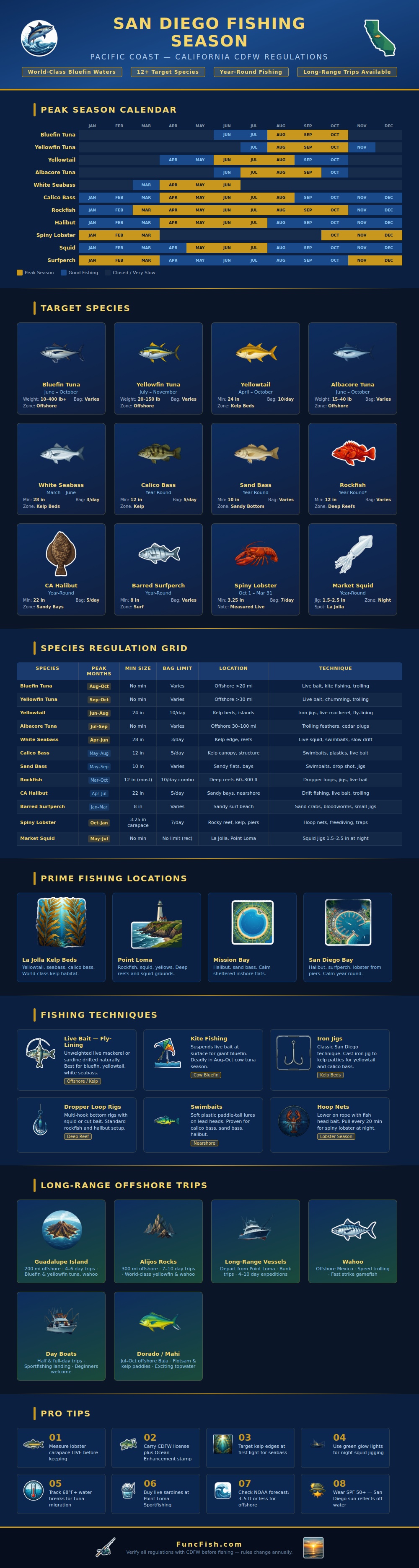
Species overlap year-round on the calendar. There are some who believe summer’s the only good time to fish. That’s too narrow a view. Summer offers the best of offshore giant yellowfin and bluefin tuna fishing (June-October). But the cooler months also offer serious action. White seabass hit their stride while the water is still turning over from winter, usually peaking between March and June. Limiting yourself to summertime window misses technical opportunities nearer shore. The visual layout provides clear proof there’s never really a dead season if you know where to look.
The Best Time to Fish in San Diego
Spiny lobster season run from October to March. When you think about it, this style of fishing is nothing like fishing off the side of a boat during the day. This involves using hoop nets. These are night trips. And it’s slow. It is meditatively slow. It is the opposite of fast, frantic tuna-trolling.
The graphic points these windows because knowing what to bring depend on them. For lobster season, you don’t bring big kite rigs. You bring gloves and lights and hang out well into wee hours of morning. Bring a cooler full of ice packs and plenty of cold beverages to keep you going all night long. Otherwise you’re liable to find yourself on the beach in July with live shrimp dangling from a hook while the rockfish is deep offshore and couldn’t care less.
Location isn’t everything: Technique makes all the difference. While La Jolla offers world class kelp bed types, you need to go after them at the right time. From April through October, yellowtails frequent the beds, striking hard and moving fast. You must be precise with your presentation, usually by drifting an unweighted, live mackerel and then fly-lining the bait. Fly-lining sounds easy; you hang a bait out and let it float around. Until you feel a forty-pounder pulling you towards reef structure. Patience and trust are key, knowing that even though you may go twenty minutes without anything happening, that bait will get bit. That’s the discipline of consistent catching versus weekend warriors.
For those willing to go further out, you open up a world of opportunities. For example, long range trips to Alijos Rocks or Guadalupe Island opens the door to those waters where bluefin can top over three hundred pounds. And they don’t mess around on these trips. You will need lots of gear, lots of days at sea, and a serious commitment to long range fishing. As you will see from the chart, these offshore runs peak in late summer. By chance, this happens at the same time as cooling ocean currents and draws predators nearer to the surface. Distance isn’t the only component, look for thermal breaks as these changes in water temperatures triggers feeding frenzies.
San Diego fishing isn’t about overcoming nature; it’s about learning how she ticks. Part of fishing is following the rules: comply with regulations, have your ocean enhancement stamp, follow bag limits and understand the rules. But then there are small details; pay attention to the water. Feel for currents flowing around kelp patties and notice when the water becomes clearer. The chart lays out the structure and your experience add the details. And when you hook into a fish that pulls hard, knowing exactly what month and tide delivered you there makes the victory taste sweeter. It’s the connection between doing and knowing that brings you back to the water, tide or no tide. You should of known about these seasons earlier!