
Baitfish migration and water temperatures is all things most bass anglers take to heart. But many times we neglect to consider what hooks we are using, which actualy causes more lost strikes than bad conditions do.
Does the thickness of the soft plastic you throw line up with the gap in your hook? Because if not, the bass will feel it before the barb grabs them. If the two does match, then the hook slip into its mouth with almost no resistance. That leads to a significantly increased connection percentage.
How to Choose the Right Hook for Your Bait
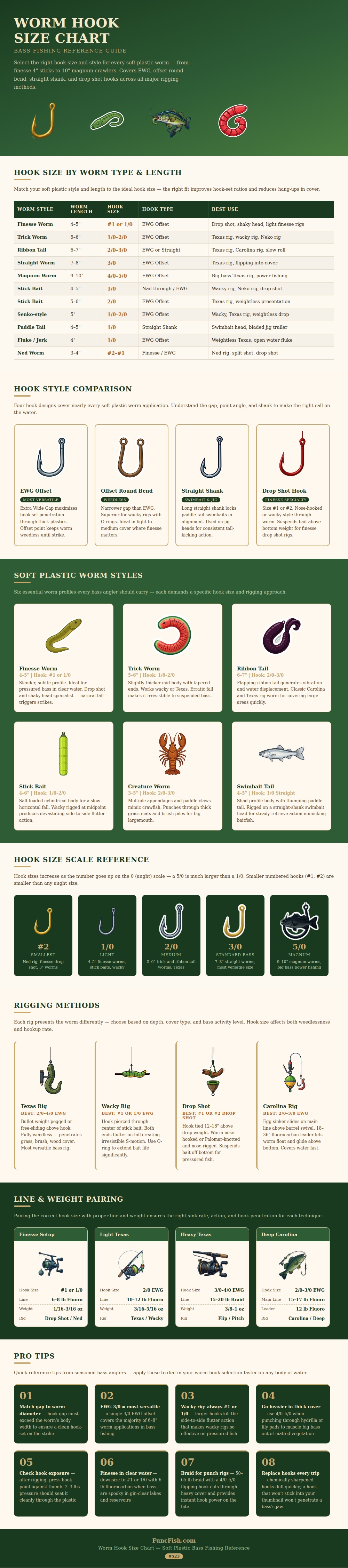
Matching Hook Sizes to Worm Profiles The chart above details the appropriate hook size according to worm profile. This will eliminate guessing when organizing your tackle box. So next time you want to get more precise with your fishing, follow these guidelines.
For example, finesse worms are skinny four-inch sticks designed for clear water when fishing under pressure. They needs small hooks like number ones or 1/0s. Anything bigger than that and it’s too much hook for the dainty profile. That kills its naturaly action and makes it look unnatural to those picky bass.
On the other end of the spectrum we have Magnum worms that call for bigger hooks. Four/0 or five/0 hooks is recommended in heavy cover situations. It give them the power to horse big largemouth away from heavy hydrilla without bending, and the extra wide gap let the hook point come through thick body of the worm.
Presentation and mechanical advantage. You should of know your hooks. It’s not all about size; it’s also about understanding your hook style. Since they keep the bait weedless until the very last millisecond, you’ll see a lot of Extra Wide Gap offset hooks being used. For wacky rigs, however, you want a narrower gap in a traditional round bend hook. This allow the plastic to float freely around a nail knot or O-ring. Using a heavy extra-wide gap hook and attempting to wacky-rig is a bad idea. The plastic won’t flutter properly and the action are gone. The wrong hook style doesn’t fit the presentation.
This is where many people go astray thinking one hook fit all. Line pairing is noted in the infographic, too. Large hooks paired with big baits and heavier braids works great for punching techniques. Tiny drop-shot hooks pair nicely with light fluorocarbon.
A lot of guys throw the same three-oh hook for everything. And while a three-oh extra-wide gap will do the job in most typical Texas rig scenarios, sticking with that only choice put a damper on things. Downsize when fishing around scant cover and suspended fish in wide open water. A smaller hook minimizes profile, helps faster retrieves without break offs, and keep bass from seeing it as much.
Upsize when fishing heavy stuff like matted grass. Because you’re often battling big boys, you’ll want bigger hooks that penetrates better and help extract them from the cover before launching the bait. This chart provides a handy reminder of those compromises and will help you determine which is more important given the situation.
When matching your hook to your worm, don’t think of it as a table to memorize. Think of it as a way to protect your gear from water. Not only does a good fitting hook keep the action of the bait, but it also helps increase your hookup percentage. Whether you’re power-fishing in the lily pads or finesse fishing with a small Ned rig, the principle is the same. Let the hardware support the presentation, not fight it.
Before your next outing, take a look at what you have. Is your hook too large for the plastic? You’re losing fish. Does the point hardly stick out because the gap is too tight? You’re missing out on opportunities. Make an adjustment here and a bad day on the water could turn into a good one.