
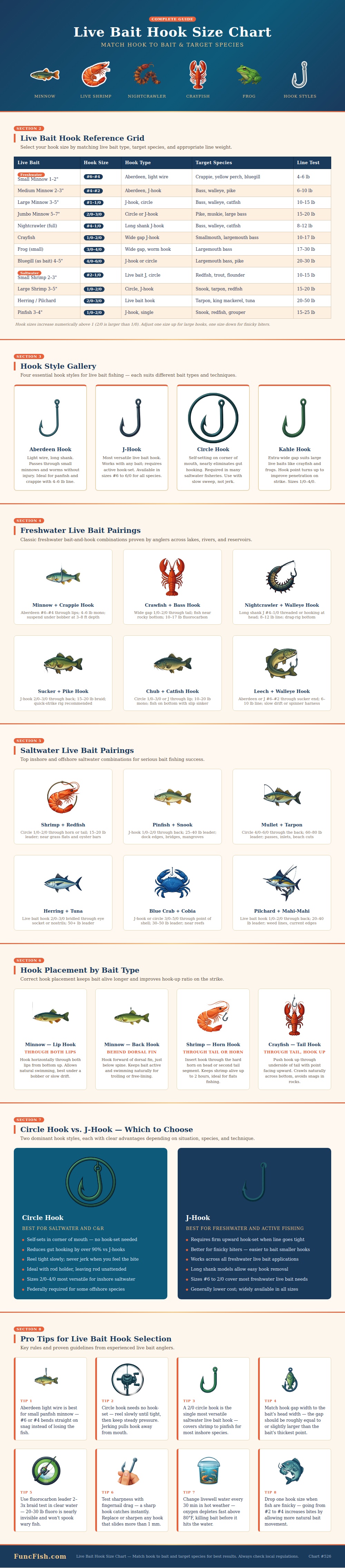
The next thing is what size hook to use to tie your bait onto your line. When you guess at this rather than look at a chart, you will tear up your baits. This chart gives you a good reference and allows you to avoid that. It pairs certain baits with the species they are most commonly used to target. Size is important to keep the bait lively and looking naturaly.
For example, when targeting perch or crappie, they prefers tiny minnows, so a small hook (like an Aberdeen hook) sized between 4 and 6 is what you want. Thin gauge hooks also requires lighter line (between 4 and 6 pound test), otherwise they will go through the minnow body and kill it to fast. With the right combo, the minnow will swim normaly below a bobber. If it’s swimming strangely or won’t swim at all, heavy gauge hooks is killing the minnow rapidly or making it swim funny. Wary panfish will notice this.
How to Choose the Right Hook
When going after larger predators like pike or bass, you have to up your ante. Use jumbo minnows on a 2/0 or 3/0 circle hook with heavier line (15 to 20 pound). Line and hook should be stout enough that a big fish won’t snap it off on the first run.
When it comes to what type of hook you use, the key lies in what the fish does when he hits it. For example, if you’re doing some catch-and-release or saltwater fishing, it is better if the hook catches in corner of the fish’s mouth. This minimizes your chances of getting gut hooked. With a circle hook, you don’t even try to jerk the rod. Instead, you reel tight and let the line go solid so the hook turns and locks into position.
On the other hand, active freshwater fishing seem to favor j-hooks as you have to pull up hard and firmly. And it’s not limited to certain baits, either; a J-hook will work well for everything from night crawlers off the bottom to a crayfish around rock. It is versatile and offered in all sizes from small perch bait to big musky rigs.
Hook placement matters just as much as selection If you want a minnow to swim directly beneath the bobber, then hook it both lips. If you want it to stay lively while being trolled, you can also hook it behind the dorsal fin. When live bait fishing for trout and redfish in clear water, try threading your shrimp through its hard horn on the head or even through its tail. This will keep your shrimp alive for hours which is critical to your success.
In hot weather, baits runs out of oxygen fast, so make sure to change your livewell water often and keep your baits active. Make each cast count.
Make sure they’re sharp on every cast. Before throwing the bait out, dig your fingernail into each one and test its sharpness. A dull hook won’t come through the fish’s mouth, and you’ll just waste more time if the hook simply slides different than catches. Keep both your bait moving and your hooks sharp, then everything will work smoothly.
Whether it’s aggressive snook on pinfish or timid walleye hooked on leeches, matching the hook to how the bait moves can make all the difference. Match the tackle right, and you stop wrestling with your equipment and begin to catch fish. To be successful, what you have in your hands must connect to what is underneath it.