
A fishing net is not simply a big ol’ bag of holes that you throw in the water to hope for luck. Nope! Gill netting is a science involving both biology and geometry. It’s about making sure you intersect fish when they attempt to reverse course.
It’s a simple, uncompromising process: A fish enters an opening, his head goes through and he attempts to retreat. As he do, his gill plates spread open and catch on the net’s twine. Too small? Bounce. Too big? Right past you, buddy. There has to be a happy medium, and that means size is everything.
How to Choose and Use a Gill Net
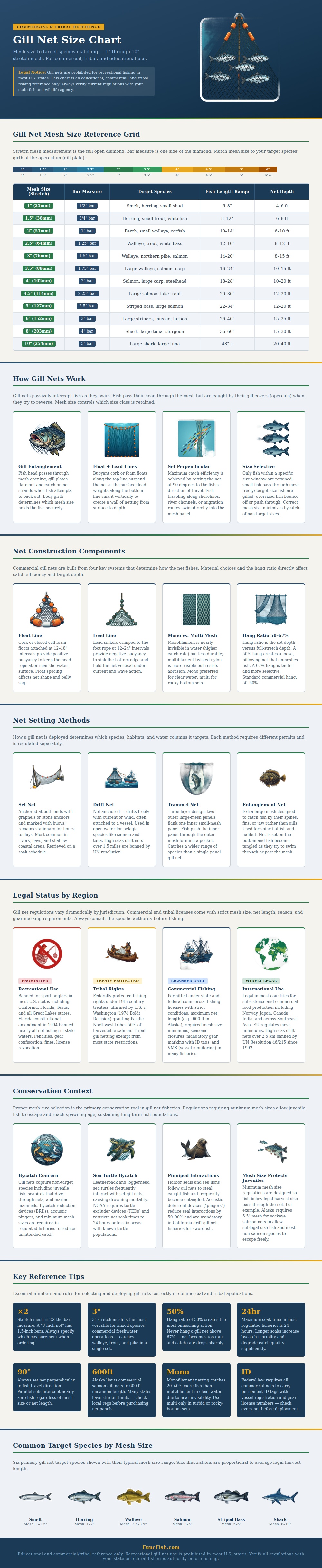
The reference chart breaks down this matching process by matching the stretch mesh measurements to specific fish species. It’s not random either. If you’re going after small herring and smelt, then you want a one inch stretch mesh because these two fish species has narrow girths near their gill covers. Go to a four-inch mesh and now you’re targeting big carp or salmon. The chart demonstrates that the larger the fish, the larger opening needed. Not only is this about selectivity, it is about not taking everything out of the water column.
Mesh size is selected according to girth of the body of your target species, not necessarily how long it is. Get this wrong and you will get an empty net, or worse, catch something you shouldn’t be keeping.
A lot of guys think thicker is better. Nope. Not really. Catching power has little to do with thickness. Catching power are all about visibility. Mono is almost invisible in clear water. That makes a big difference in catch rates vs. One option is multifilament nylon. But mono wears out. If your waters have rocky bottom surfaces and you get a bunch of wear, you may want to consider switching to multifilament to gain a bit of durability at the expense of invisibility.
You have to make this decision before hitting water. And it will impact what the net can endure and how well it conceals itself from wary fish.
The second thing is how do you hang the net? That’s what completely determines how it behave. If you have a tight net, it’s going to be like a wall, the fish are going to swim around it or hit it and bounce off of it. What you’re trying to create is a billowing curtain that’s loose and wraps around the animal.
That’s why you’ve got to set your net at half of its full depth with a stretch. So you want to set the net at fifty percent of its full stretch depth to get that nice sag so that the mesh can flex and enmesh the fish and not just block it. And if you tighten it up too much, like over sixty-seven percent, you’ll notice that the catch rate go down very sharply because it’s now a barrier, not a trap. That’s why most of the commercial guys operates within that fifty to sixty percent range.
The type of habitat it can target depends on how it is used. Anchored set nets remains passive in a bay or river. They’re stationary walls of twine that fish swim into while migrating along a shoreline. Drift nets follows wind and current and target pelagic species in open water. Regulatory constraints differ based off deployment methods. Set nets require marking buoys and anchors. Drift nets have more restrictive international bans because they catch unwanted fish.
Knowing what mesh size applies to you also requires understanding what method suits your legal zone. It’s designed for conservation. There are limits on the mesh so that juveniles gets released back. If a young salmon swims through a net without being gilled, it lives long enough to return years later to spawn again. That maintains the stock.
These minimums are frequently enforced by law. It’s not only unethical, but in most jurisdictions it’s illegal. Thus the chart has these restrictions noted. In many states, including Florida and all of the Great Lakes areas, recreational fishing with this gear is prohibited. It’s reserved for licensed tribal or commercial fishermen only. Before you cast a single line, always check your local regulations.
And then there’s orientation. The fish are traveling in schools, following particular paths. They’ll hit something if you put your net parallel with the current but not if it’s set perpendicular to the way they’re going. That 90 degree angle makes all the difference. It turns what would of otherwise been a limp sheet of nylon into an active interception point.
Add the appropriate orientation with the proper mesh size and the right hang ratio, and now you’ve got a system that works with nature instead of fighting against it. Precision is the difference between a great haul and a wasted afternoon on the water.