
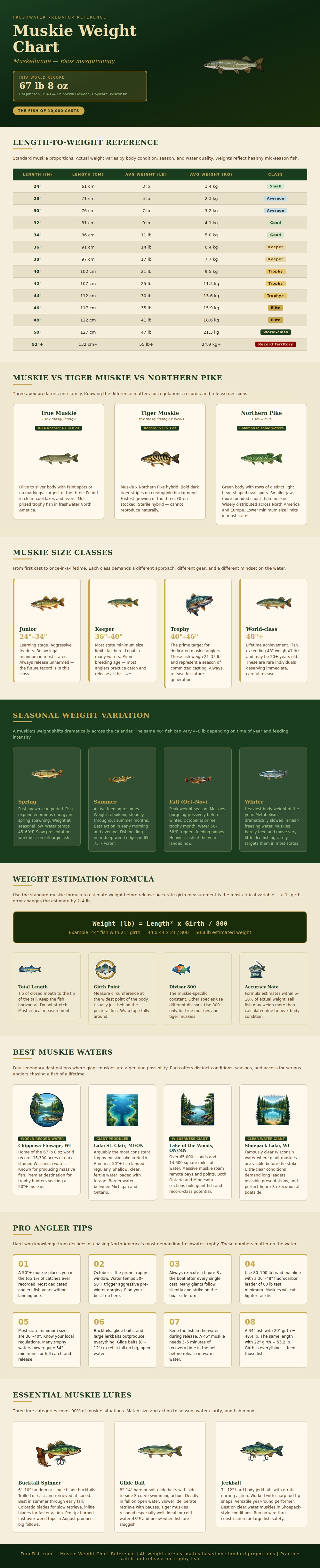
Most muskie anglers live in fear of tape measure. When you hook up with a big one and bring her into boat she’s only average. Sure, she’s got some meat on her. But maybe you didn’t get a great looking photo of her. She won’t even appear on your local leader boards. The fish fought hard but she doesn’t weigh as much as you thought she would. Many anglers will become frustrated by this disconnect.
Before you make the cast, you’re wondering what success would feel like. What’s a good benchmark for you? How do you know if you should continue fighting that final foot or cut your losses? Having a good benchmark take the guesswork out of it and helps you decide if it’s worth keeping fish alive or not. So how much should you expect? Take a look at the chart above that show average weights based on length. Rather than hoping for something in general, you have an actual expectation.
Muskie Weight and Size Guide
An eleven pound muskie isn’t going to be more than about thirty-four-inches long and that’s what most novices think is trophy territory. But it’s really not. That size fish are the entry level fish. It’s where the real work begins. You’ll notice a lot of experienced anglers won’t even mess with fish less than forty inches. The information supports that decision.
Once you get into the keepers, the weight doesn’t increases at a steady rate. Instead, it ramps up quickly. A thirty-eight inch muskie could weigh as little as seventeen pounds. So a forty-inch fish will weigh twenty-one pounds. Two additional inches equals four pound. That’s the difference between a trophy moment and a snapshot.
Knowing these ratios allows you to make informed decisions about your equipment. Knowing there’s a good chance a forty-two-incher is a twenty-five-pounder or better makes you less likely to trust lightweight equipment. It won’t hold up on big fish. Heavier equipment are more secure.
You’ll realize how important it is to care about conservation too. Those fish at the larger end of the chart are very special. They’re extremely old fish; they take time. There aren’t giant muskies caught each year. And when one is caught, they’re anomalies (not normal catches). To catch them takes persistence and patience on the part of angler. Every second fish you catch, you have to let go to keep those fish alive. These fish don’t show themselves very often. Real reward lies way up on that curve where most fisherman never go.
These figures has a lot to do with seasonal timing. A muskie’s weight varies wildly from month-to-month. One caught in the spring won’t feel as heavy than the same size caught in October. Spring muskies is often slow and skinny due to burning off energy reserves while making the spawn run. But by late fall, they gorge themselves to store up calories for the winter months. That leads to packing on some serious condition that adds several pounds to its frame. Because of this weight gain, autumn is widely regarded as prime time for trophy hunting.
These fish becomes aggressive feeders when water temperatures trigger those behaviors. To do that most efficiently, they hold deep adjacent to weed edges where they can ambush prey quickly. If there’s ever a time you’d like to know something about a fish but don’t want to hurt it, learning to estimate weight in the field will come in handy. By using a common formula from their length and girth measurements, you’re able to get an estimated weight for the fish and keep them in water at the same time. The key to getting accurate results with this technique is taking an accurate girth measurement. Even a slight mistake can make the estimated weight differ by multiple pounds. It satisfies your curiosity about the fish, but also shows respect for it. It is a good compromise between conservation ethics and record keeping.
While there’s always an element of chance in chasing predator fish, preparing properly will make you much better at it. Muskies has strong jaws and razor sharp teeth that can cut right through lighter tackle in an instant. So stout line, think braided mainline and strong fluorocarbon leaders (is mandatory). Because the typical prey species these fish chase are pretty sizable, throwing something similar in size helps you get a bite out of a wary giant. Patience and presentation are critical. You must make your big lure appear natural to entice a strike.
To conclude. The chase for muskie is all about the respect you earn for having the persistence to land fish in the higher weight classes. It’s more than catching your best fish or filling your cooler. It’s learning about the behavior and biology that produce these monsters of the fresh water. And when you do catch one of those world class fish, all that time spent studying the way to get to them will make you appreciate the moment like no other. Moving from small to elite requires time but the view from up here is well worth every cast.