
The rippling water laps side of a sunken log. You lean over the water and stare. The light is flat and you cannot see much, but your line dangles lifelessly in current. You’ve felt the disturbance and know something’s there but throw one more crankbait at them, what’s the point?
That’s what the Colorado spinner blade does; it’s not some sort of flashy show piece. Rather, it’s a thumping signal that projects outward toward fish lurking within the murk. It produces a distinct vibration that completely bypasses sight and instead communicates direct to even most reluctant predator’s lateral line system.
How to Use a Colorado Blade
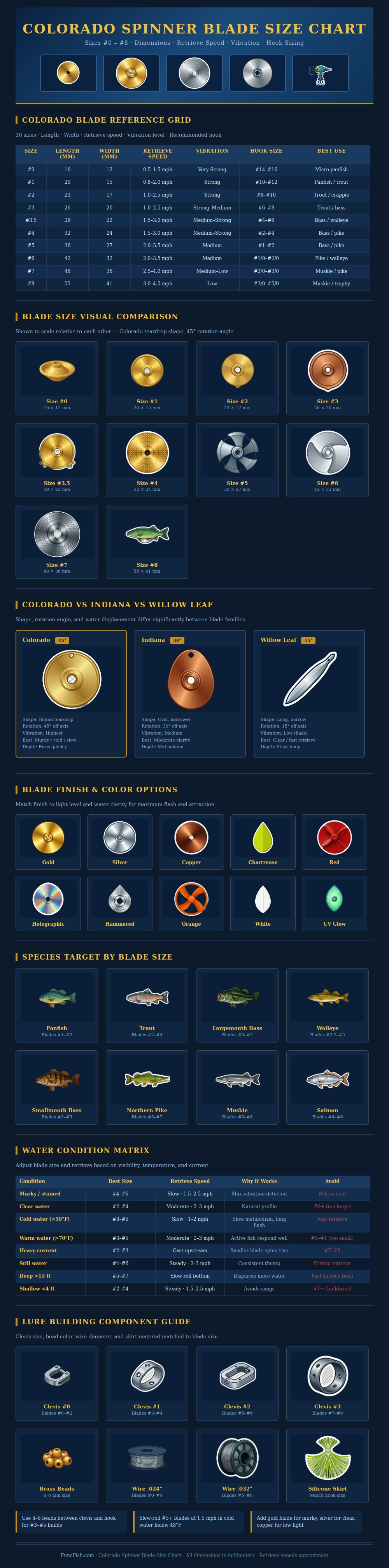
The following chart show exactly how each blade size relates to hook size and retrieve speed. When the conditions is constantly changing, it will save you from guesswork.
Most guys consider all spinner blades to be like interchangeable metal discs with a “bigger-is-better” mentality toward large fish. Wrong. Although a larger blade may appear more natural in shallow, clear water, it’s too violent for them to ignore. Not only does it sound unnatural, but it thumps so hard that wary bass won’t even pay attention to it; they’ll see it coming and swim away.
Look at visual comparison. You can see there is a huge difference in surface area between size one and a size eight. This serves as a reminder that while length play an important role in water displacement, so does width. When the water are cold and stained, you want a lot of vibration to entice the bite.
Blades data show sizes six through eight will need more speed to keep spinning. They will also need to put off more force to overpower sluggish metabolism when water is cold. Anything smaller than a size zero is simply not going to have the hydrodynamic presence to dig into the cover and exert much forward pressure at all.
It’s mostly mental. I just has to convince myself that I’m better off using a medium blade slowly then trying to force a big blade to work during a frantic burn.
The rotation angle dictates both depth and vibration. Understanding the differences between Willow, Indiana, and Colorado blade shapes will clarify how rotation angle determines depth and vibration. Round tear drop profiles of Colorado blades push water aggressively at forty-five degree angle. That results in a fast-rising signature in the water column with a high-thump. It is great for working around structure when you don’t need slow deep diving but want something to get your point across right now to suspend fish or other target.
Long, narrow Willow leaf blades creates less resistance in the water. They allow for deeper dives. They also create a flashier and faster pulse, which works well in clearer waters.
Not all blades matches up with all fish. To get best match, go beyond selecting the largest hook; select based off species. Two or three blade work better for trout and panfish because they don’t create too much vibration, but they still mimic a fleeing baitfish. Musky and pike need the heavier seven or eight hooks to penetrate their hard mouths and absorb the sudden burst of power they will put out.
The hook size balance how the lure moves, preventing it from spinning out of control or diving too deep because of an imbalance between drag and vibration. The other wrinkle to this careful decision making process come with finish selection. Silver mirrors your local forage such as herring or shad better in clear water, whereas gold seems to reflect warmth from light and penetrate stained water well. Copper sits somewhere in between which can work wonders during the low-light periods at both ends of the day. And it’s less about perfect color selection than the match of the metal’s reflectivity to ambient light.
The bottom line with learning how to fish a Colorado blade is that it’s more of a read-the-water deal than one that requires memorization from a table. Begin by using size that seems right based on depth and clarity. Then vary your retrieve speed to get a solid thump. That’s when you’ll know you have the presentation going as you’ll feel it in your rod tip every time.
Don’t make it complicated; let it vibrate and trust it would of work. Focus on staying connected to whatever it is down there and let the blade do the talking.