Bait Dozen Cost Calculator
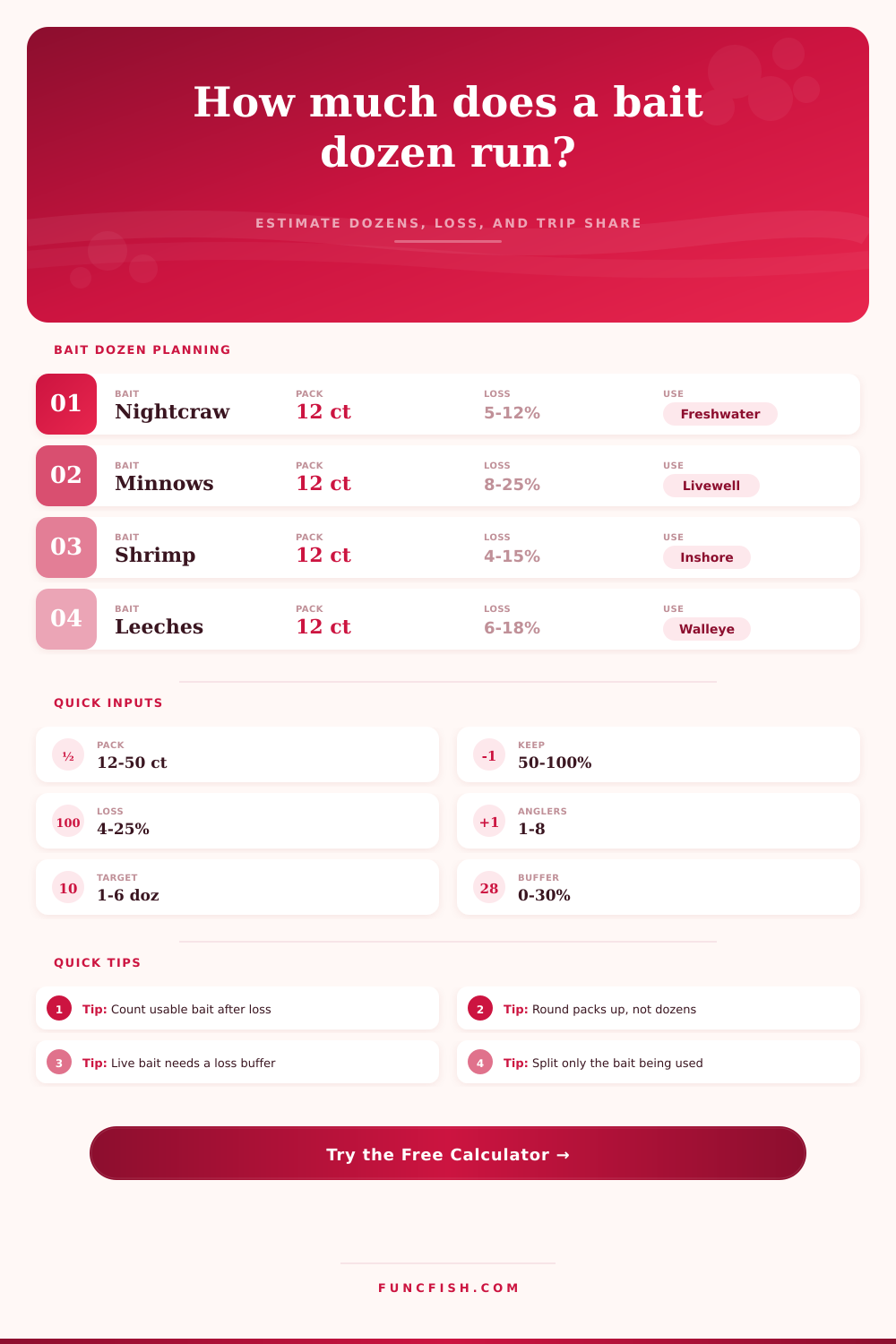
Convert pack count, listed total, bait loss, and angler demand into usable dozens, pack needs, and per-angler share for a fishing trip.
📌Bait trip presets
⚙Dozen inputs
Bait dozen estimate
Formula breakdown
📋Bait comparison grid
📐Reference tables
| Bait category | Typical pack count | Dozen equivalent | Count note |
|---|---|---|---|
| Nightcrawlers | 12 pieces | 1.00 dozen | Often sold as a counted cup |
| Redworms | 24 pieces | 2.00 dozen | Small worms may be packed double |
| Fathead minnows | 24 pieces | 2.00 dozen | Count after transfer losses |
| Shiners | 12 pieces | 1.00 dozen | Larger live bait is commonly counted |
| Spikes / maggots | 50 pieces | 4.17 dozen | Small bait often starts above a dozen |
| Holding condition | Sorting loss | Trip loss | Best calculator setting |
|---|---|---|---|
| Fresh worms in bedding | 3% to 8% | 4% to 10% | Use 92% usable and 8% buffer |
| Aerated minnow bucket | 5% to 12% | 10% to 20% | Use 88% usable and 18% buffer |
| Cool leech container | 4% to 10% | 8% to 16% | Use 90% usable and 14% buffer |
| Salt bait on ice | 2% to 6% | 4% to 12% | Use 95% usable and 8% buffer |
| Long hot session | 8% to 18% | 18% to 30% | Raise trip loss before rounding packs |
| Trip style | Common demand | Pack rounding | Planning note |
|---|---|---|---|
| Short bank trip | 0.5 to 1 dozen per angler | Round to nearest pack above target | Useful when the bite window is brief |
| Half-day boat trip | 1 to 2 dozens per angler | Round up one pack if bait is live | Works for drifting, jigging, and slow trolling |
| Surf or pier trip | 2 to 4 dozens per angler | Round by cooler tray or bag | Cut bait and shrimp can disappear quickly |
| Night catfish trip | 2 to 5 dozens per group | Round to cover recuts | Use group demand if baits are shared |
| Ice panfish trip | 1 to 3 dozens per angler | Round to the next small tub | Small bait has high piece count but low bulk |
| Comparison point | Live bait | Prepared bait | Calculator adjustment |
|---|---|---|---|
| Count accuracy | Can change after transfer | Usually stable | Use lower usable percent for live bait |
| Trip waste | Higher in heat or poor oxygen | Higher when bait dries out | Adjust loss buffer to match storage |
| Pack rounding | Round before leaving the shop | Round by tray or bag | Always round pack count upward |
| Angler split | Split by group consumption | Split by tray share | Use anglers only when bait is shared evenly |
💡Calculation tips
Tip: For live bait, estimate usable pieces after sorting first, then apply the trip loss buffer. Reversing those steps can make a small pack look stronger than it really is.
Tip: When anglers will not share bait evenly, run the calculator once per group. A minnow bucket and a worm box often have different loss rates and pack counts.
So you get to the bait shop early. You think to yourself that all you’ll need is a few packs of worms for the morning bite. Then by the time 12 o’clock rolls around, your staring at a dry hook as other fishermen keep bringing in their limit but your worms has either died or are depleted.
More often than not, it’s a math problem rather then just bad luck. Knowing how many you will actualy use per pack can be more important than what it costs per pack on the counter. Most folks assume that whatever they buy in a pack will get used. False. When buying live bait, you are paying for what might happen. Some of what you pay for goes out window at purchase time.
Stop Running Out of Bait
The first loss is the sorting process. Dead or injured worms go into trash bin. They is too small to put on a hook. Gone. The next type of loss is trip losses. Minnows jumping from a bucket, worms falling out of loose lids, leeches hiding in tackle boxes…
The calculator takes care of all of this by simply entering in the number of packs and approximate loss percentages. It saves you guesswork of whether to grab an additional pack. But knowing what it measures are the key.
Twelve is twelve. But a usable twelve means a dozen units working under real-world conditions. Minnows might survive longer in a livewell in a boat, but they still gets stressed by noise and movement. In summer heat on a hot July day, worms will die quicker then when kept in cool shelter. The tool can be adjusted based off your own rules for trip loss buffer and usable percentage.
So you didn’t buy 24; you bought two dozen but now because of transfer shock you may only have a dozen and a half. The second wrinkle is that you’re going to be sharing it with buddies in the boat. Sharing a pack between three people looks easy enough but what happens when one guy catches fish and another is hung up in weeds? The guy who’s catching fish is paying full price for everyone when he splits the check evenly. There’s a good chance they’ll be out of bait before slow guy gets his turn.
How do you know if the price is right? Break down cost per angler based on actual usable dozens. You’ll see exactly how many each person use before fishing ever started. This way, there are no post-fishing “he got more than I did” fights.
There will be no fighting at all over your baits. We like to have a bait buffer. The peace of mind is worth it mentally. When we run out of bait, the day is over. You either quit fishing, go back to the store and pay more or round up what you need to make sure you are covered. It’s a small extra cost that ensures you don’t lose as much money.
But there is a little more to cover with bait buffers. A few percent of shrimp might mean nothing in terms of time, but you won’t get many bites if they aren’t hooked. So some baits has bigger buffers than others. This table will show what kinds of baits have which buffers.
Maggots and spikes are very cheap individually, but their volume is high enough that losing one doesn’t affect your wallet as much. However, the loss percentage matter more to your hook coverage.
I don’t want you to be the accountant of your tackle box. I want you to stop worrying about running out. By thinking in terms of fair share, sort and loss, you take the watchful eye off your bait bucket and put it back in the water. You look at what the water is doing, when to make a cast and how to feel the bite. Your mind switches from being afraid of running out of bait to managing it as a resource. That change of mindset is far more valuable than just a handful of extra bucks that came from guesswork.
You head out there prepared and you go fishing confidentely. And when your day ends, you’ll have the exact number of baits you intended to return home with.