Fishing Rod Casting Arc Length Calculator
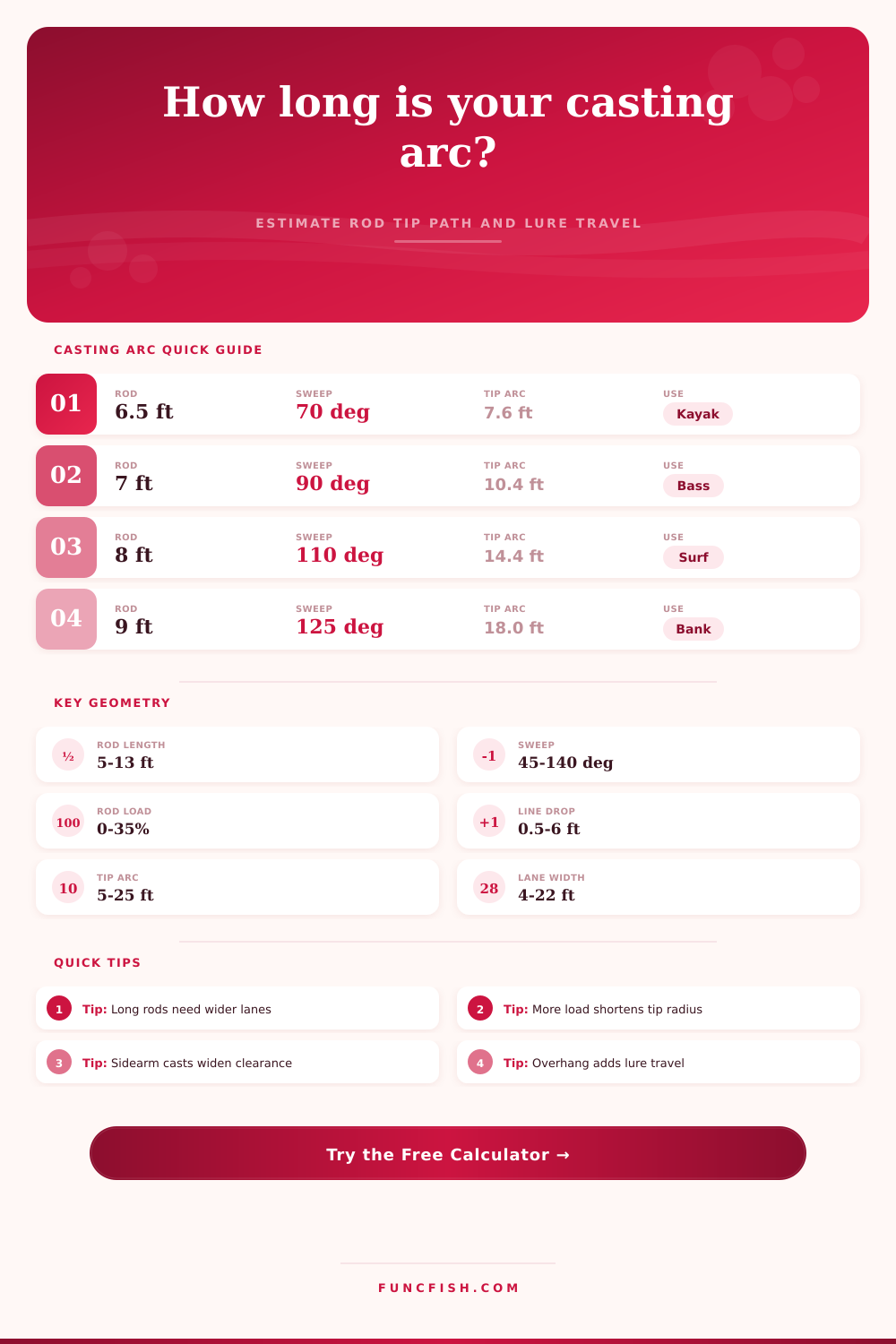
Estimate rod-tip travel, lure travel, and the clearance lane created by your rod length, casting sweep, rod load, and line overhang.
📌Casting presets
⚙Arc geometry inputs
Open overhead casts use a balanced clearance factor and a moderate release allowance.
Casting arc results
Formula breakdown
📋Rod action comparison grid
Ultralight Moderate
Medium Fast Graphite
Medium-Heavy Fast
Fiberglass Moderate
Surf Fast Taper
Fly Progressive
Heavy Composite
Compact Telescopic
📐Casting arc reference tables
| Sweep angle | Radians | What it means | Common use |
|---|---|---|---|
| 45° | 0.79 | Compact quarter sweep | Dock pitch |
| 70° | 1.22 | Controlled low swing | Kayak sidearm |
| 90° | 1.57 | Balanced casting arc | Bass overhead |
| 110° | 1.92 | Long loading stroke | Surf and bank |
| 135° | 2.36 | Wide power sweep | Distance cast |
| Rod length | Typical pivot offset | Usable radius | Best fit |
|---|---|---|---|
| 5.5 ft / 1.68 m | 6 in / 15 cm | 5.0 ft / 1.52 m | Close quarters |
| 6.5 ft / 1.98 m | 8 in / 20 cm | 5.8 ft / 1.78 m | Kayak casting |
| 7.0 ft / 2.13 m | 10 in / 25 cm | 6.2 ft / 1.89 m | All-purpose |
| 8.5 ft / 2.59 m | 12 in / 30 cm | 7.5 ft / 2.29 m | Bank control |
| 10.5 ft / 3.20 m | 15 in / 38 cm | 9.3 ft / 2.82 m | Surf distance |
| Line overhang | Lure radius effect | Control feel | Arc note |
|---|---|---|---|
| 0.5 ft / 15 cm | Small extension | Very direct | Short pitch |
| 1.5 ft / 46 cm | Moderate extension | Responsive | Spinnerbait cast |
| 3.0 ft / 91 cm | Large extension | Slower release | Surf plug swing |
| 4.5 ft / 137 cm | Wide extension | Needs timing | Pendulum cast |
| 6.0 ft / 183 cm | Very wide | Low precision | Open shoreline |
| Scenario | Suggested sweep | Clearance multiplier | Practical match |
|---|---|---|---|
| Open overhead | 80-105° | 1.00 | General casting |
| Sidearm bank | 65-95° | 1.18 | Low branches |
| Short pitch | 35-60° | 0.72 | Dock targets |
| Roll cast | 55-85° | 0.82 | Brush pockets |
| Surf swing | 100-140° | 1.28 | Distance loading |
| Fly false cast | 85-125° | 1.10 | Loop control |
💡Arc measurement tips
Tip: Treat the pivot as the point around your casting hand, not the rod butt. A long handle behind the hand reduces the usable tip radius.
Tip: Use a larger clearance lane than the chord result when wind, heavy lures, or a low sidearm path make the lure swing outside the rod-tip path.
I’ve seen anglers slam their buddies and rip off branches on pines while swinging a ten-foot surf rod to the left. Why? Because they underestimate how much room their rods takes up. Sure, the rod is just a stick, right? Not quite. Think about it as a lever with a big sweeping arc.
And that’s where the math comes in. The calculator factors in the length of the rod and the angle of the swing. It also factor in the blank bend to predict the trajectory of the tip. The takeaway is spatial awareness. If you’re holding a seven-foot medium-fast rod, the butt end isn’t the pivot point. It is usually several inches from your grip and that offset alters the swing radius. With a longer section behind the hand, the tip will swing farther then anticipated. And that little detail can be important when fishing in close quarters.
How to Cast Safely
The other variable is the action of the rod. The stiffer, faster-action the rod, the closer the tip radius will be to the full length because the rod will not bend as much. Conversely, the softer the rod and slower the action, the deeper the rod bend when loaded up. This shortens the lever arm and tightens the arc. So this takes all that into account with deflection percentages. For example, if you have a sensitive rod and are using a heavy lure, then the blank will bow more. This reduces the sweep distance a bit but makes it a more complex path. Before making a cast, do you want a rod set-up that behaves like a bent spring, or do you want one that behaves like a long lever?
Another consideration is line overhang. How much line is out there before your cast starts? That contributes to an effective casting radius. With a shorter rod and longer line, it’s a big, wild circle; with shorter line, it stays more direct and tight. Varying the overhang changes the width of the lane and also its feel. The reference tables illustrates this.
When sitting in a kayak, tackle boxes, gunwales, etc., limit your space and dictate that you make a tight arc. Making a large, overhanging cast up high in a small craft isnt smart. Obstacles and wind makes it more complex than geometry allows. Even with the same arc on the rod, a stiff crosswind will throw the line off course, making its footprint wider than calculated. The calculator provides you with the minimum amount of space required. In the real world, account for a buffer. Assume you’ll require seven feet when the tool tells you it’s only five in high wind. Better to have more room than not get your gear tangled up.
Knowledge of the cast allows us to fish safer and more efficienty. Knowing how we are about to make a cast helps us place the lure accurately. It also helps us avoid damaging ourselves, others, and our equipment. Selecting the appropriate rod for conditions becomes easier. A short flipping stick is accurate but has no sweep for distance; a long surf rod is heavy duty but unwieldy in a dense thicket.
Before grabbing the rod, imagine the cast and let that be the tool you should of used to help you picture the cast. Respect the space. Check your pivot point. Pay attention to the way you load on the back cast. Watch where the tip goes and doesn’t go. You’ll notice the arc prior to making it. You’ll have a good idea where the tip goes and where it doesn’t go. This separation will give you confidence as an angler versus frustration as a tangler.