Current Velocity by Flow Rate Calculator
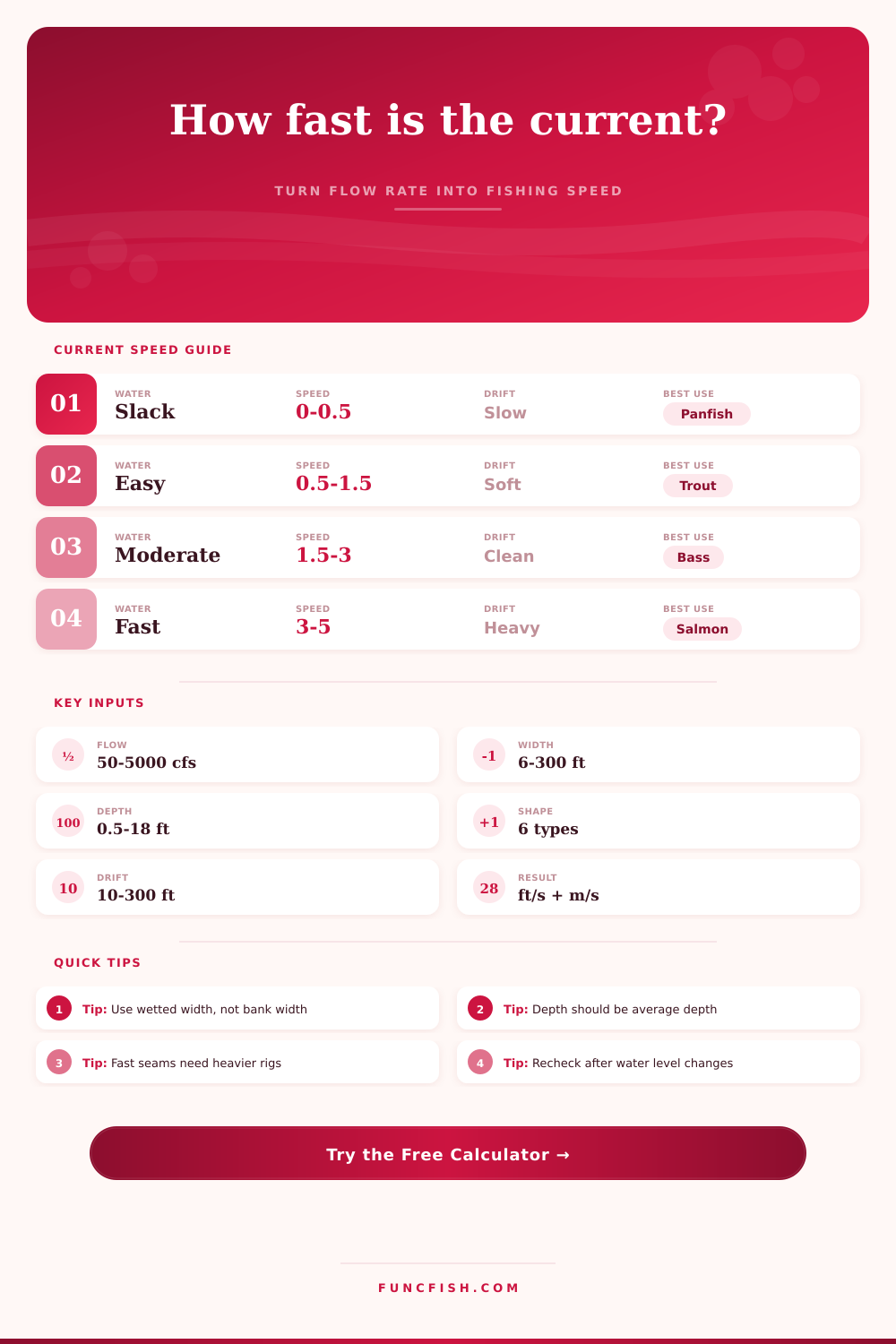
Convert flow rate into average current speed, strike-zone speed, drift timing, and fishable current class using width, depth, channel shape, and section type.
📌Scenario presets
⚙Flow settings
Current speed forecast
Full breakdown
📋Water section data grid
Gravel Riffle
Steady Run
Tailrace
Outside Bend
Weed Edge
Tidal Pass
Pool Tailout
Surf Inlet
📊Current reference tables
| Current class | Velocity range | Metric range | Fishing read |
|---|---|---|---|
| Slack / eddy | 0.0-0.5 ft/s | 0.00-0.15 m/s | Suspending bait, panfish pockets |
| Slow glide | 0.5-1.5 ft/s | 0.15-0.46 m/s | Float rigs, subtle plastics, light nymphs |
| Moderate run | 1.5-3.0 ft/s | 0.46-0.91 m/s | Jigs, spinners, crankbait seams |
| Fast chute | 3.0-5.0 ft/s | 0.91-1.52 m/s | Heavier jigs, salmon gear, short drifts |
| Heavy push | 5.0+ ft/s | 1.52+ m/s | High water, strong holding edges, limited wading |
| Cross-section shape | Area factor | Use when | Velocity effect |
|---|---|---|---|
| Measured rectangle | 0.95 | Canal, flume, straight channel | Near full width times depth |
| Trapezoid channel | 0.88 | Sloped banks with even bed | Slightly faster than rectangle |
| Natural uneven bed | 0.78 | River with bars, slots, and rocks | Faster because effective area shrinks |
| V-shaped creek | 0.58 | Small steep creek or drain | Much faster in the thalweg |
| Compound bankfull | 0.70 | Floodplain or shelf edges included | Main lane faster than total width suggests |
| Box culvert / flume | 0.98 | Engineered section with flat bottom | Closest to simple Q divided by area |
| Species / target | Comfort lane | Good presentation | Adjustment cue |
|---|---|---|---|
| Panfish | 0.2-1.0 ft/s | Tiny jig, float, micro bait | Fish inside weed or wood breaks |
| Trout | 0.8-2.8 ft/s | Dry dropper, nymph, spinner | Match drift speed before changing fly size |
| Smallmouth bass | 1.0-3.2 ft/s | Tube, swimbait, crankbait | Target the slower side of boulders |
| Walleye | 0.8-2.5 ft/s | Jig, slip float, live bait | Keep bottom contact without dragging |
| Catfish | 0.3-1.8 ft/s | Bottom rig or cut bait | Anchor just inside the main push |
| Salmon / steelhead | 1.2-4.0 ft/s | Float, spoon, drift rig | Shorten line in heavy tongues |
| Striped bass | 1.5-4.5 ft/s | Swimbait, bucktail, live bait | Swing across bait-moving seams |
| Flow example | Width x depth | Approx area | Average velocity |
|---|---|---|---|
| 120 cfs creek | 22 ft x 1.8 ft | 34.8 ft² | 3.45 ft/s in natural bed |
| 420 cfs run | 54 ft x 3.2 ft | 151.9 ft² | 2.77 ft/s in trapezoid bed |
| 950 cfs tailrace | 86 ft x 4.8 ft | 322.0 ft² | 2.95 ft/s in natural bed |
| 2600 cfs river | 150 ft x 7.0 ft | 924.0 ft² | 2.81 ft/s in trapezoid bed |
| 5000 cfs pass | 240 ft x 10.0 ft | 2280 ft² | 2.19 ft/s in measured channel |
💡Practical checks
Tip: Use the wetted width where water is actually moving, not the full bank-to-bank distance. Dry gravel bars and back eddies make velocity look slower than the main lane.
Tip: Average depth should come from several readings across the channel. A single deep slot can understate speed in the shallower current that carries your lure.
When you sense current pushing against your line, it won’t drift freely. You’ll then understand what I mean about the current being a factor. It’s unnatural; the lure comes off bottom or you hang the fly. That’s a dead giveaway to wary trout.
It happens because you don’t realy know how fast the water is moving, so you just make an educated guess. Measuring current is single most critical variable in river fishing but one of the most difficult to measure without costly equipment.
Why Water Speed Matters for Fishing
If you’re looking around for something that gives you an idea of current velocity, keep in mind that watching debris isn’t always reliable. Use information you have and apply it to your fly fishing with the calculator above.
It’s all about physics. Basically, flow rate = volume of water/second. It is typically expressed as cubic feet per second. And velocity = how fast that water moves. Speed are the volume divided by the container size.
That’s where people screw it up. They look at water that has a high flow rate and think it must be fast water. Or water in a narrow channel mean slow water. This is not always true. Water can move slowly even though there is tons of volume (wide shallow river). Or water moving down a steep narrow creek can churn like crazy, yet have very little water.
By factoring in both depth and width the tool fills that gap to find the average speed of the channel.
How Shape and Cross-Section Affect Flow Velocity But also keep in mind that shape makes a difference. A natural river channel with gravel bars and rock will flow different than a man-made canal with a rectangle cross-section. That is laid out in the reference table on the page. It illustrates how various shapes impact effective area.
Because nature throws you some irregularities and obstacles, the effective area in a natural bed is less than the product of width and depth. That means the same volume of water must travels at higher velocity. Fishing a riffle that has rocks as if it was a smooth-walled canal will lead you to make mistake of fishing too slow. Your presentation will drag.
With the right shape factor, you compensate for this fact of life and arrive at a strike-zone velocity that matches what the fish is actually seeing.
Where the theory meets the bank is in the drift time. Current speed will help, but drift time helps because it gives you a practical answer regarding how long it takes for your bait to reach the target zone. Let’s say I’m going to make a cast and plan on drifting down a sixty-foot run. The calculator will tell me exactly how many seconds my lure is in the water.
How much time do I have to show them the lure? I have enough time to present before the lure reaches the next eddy or far bank. That helps with timing. You can time your retrieves to match window of opportunity.
Is the drift time long? Then you have time to move subtly and even make some mends. Is it short? Then you need to go with a tighter line and more direct presentation. It turns a vague thought like this into a clear statement that you have twelve seconds.
Velocity changes as do water levels. As a river rises, it pushes more water through the same space, which increases the speed. If a river falls, it clears up and even though it may have a fair amount of flow, you think the current is not as strong. Those conditions are all accounted for in adjustment settings.
Then you throw in wind and tides that complicate things further particularly on tidal passes or nearshore waters like bays. They either help or hinder river flow and form complex current seams. Not accounting for them means missing opportunities. The fish will sit on the break where slow water meets fast. Finding those breaks depends on knowing what direction the net force is working on the lure.
Also keep in mind that surface speed is not the same thing as average velocity. Fish won’t typically be positioned in the absolute highest-speed section of current. Instead they’ll position themselves in the seam, adjacent to a piece of structure, off bottom, etc., where water flows just a little bit slower.
To account for this, results take into consideration your selected presentation’s type (i.e. Lane factor) when calculating strike-zone velocity. A fast drifting nymph will operate lower and more slowly compared to one on the surface. A bottom-hugging jig will move along with the friction of the bottom. Knowing this eliminates any guesswork around whether you’re overdrifting or underdrifting. Your lure will travel at the speed that the targeted species finds naturaly.
Lastly, make sure you measure your inputs properly. Bank-to-bank width ≠ wetted width. Vegetation and dry sand bars aren’t contributing to the main current. True average depth = average depth (i.e., don’t go for the deepest section you can find). Even slight measurement inaccuracies adds up fast. That’s where the complicated math comes in with this calculator. But without accurate inputs, the calculator has nothing to work with. You should of spent some time estimating your inputs correctly.
Throw a stick out or cast a line out to see how long it takes to drift by compared to what the calculator predicts. If they match, then you’re good to go fishing. Otherwise, revisit your understanding of the channel and tweak to match.
Get the speed correct and the rest is simply presenting the lure.