Fish Strike Distance Estimator
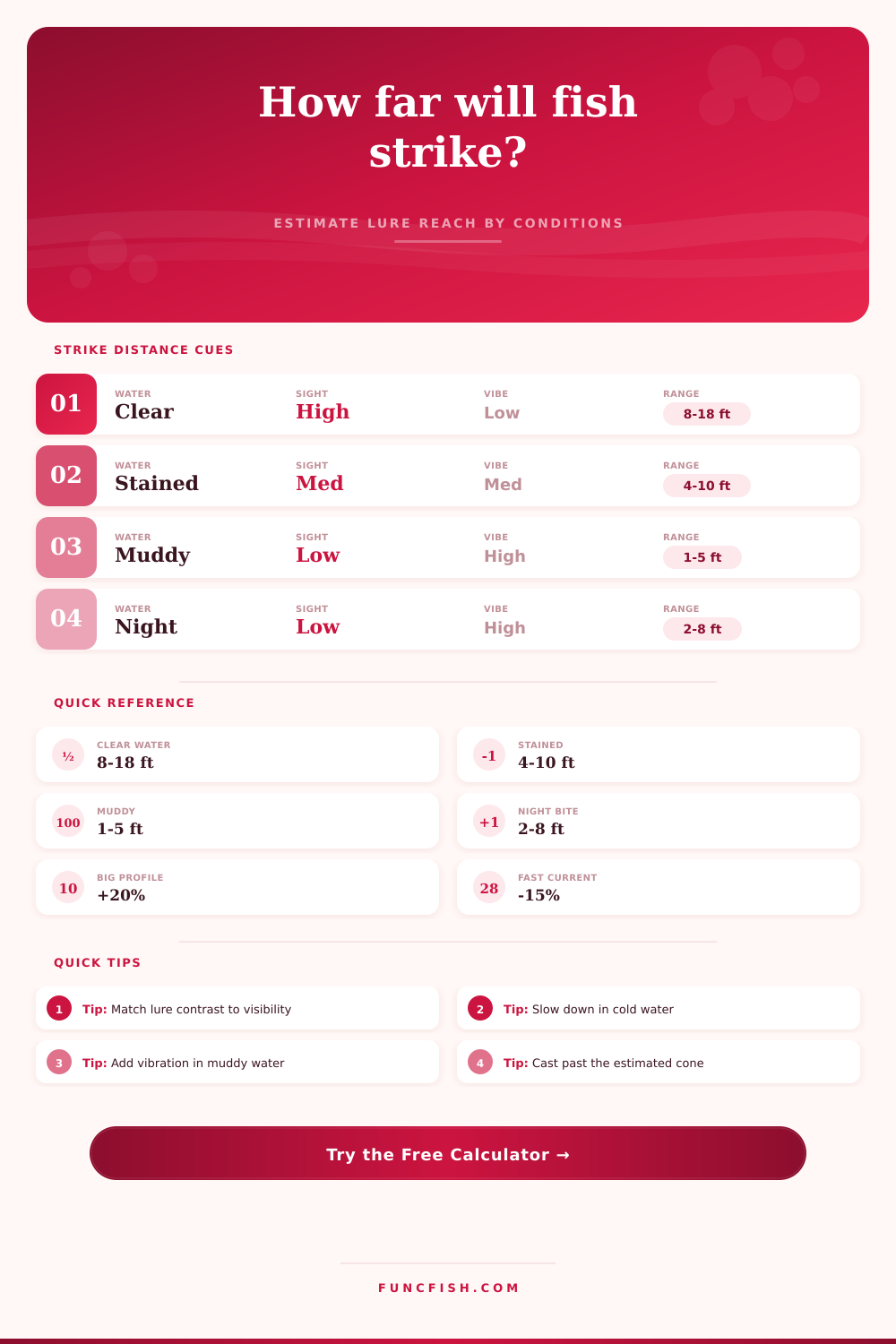
Estimate how far a fish is likely to move to hit your lure by combining water clarity, light, species behavior, lure profile, retrieve speed, current, depth, and temperature.
1Fast Fishing Presets
2Strike Inputs
Estimated Strike Window
Calculation Breakdown
3Cue Strength Grid
Vision Cue
Vibration Cue
Profile Cue
Chase Cue
4Strike Planning Cards
Cover Casting
1.2xCast beyond the estimated strike distance so the lure enters the fish's window naturally.
Search Baits
WideSpinnerbaits, crankbaits, and paddletails improve detection when fish are roaming.
Finesse Baits
TightSilent worms, flies, and small jigs need closer presentations in stained or deep water.
Night Water
SoundAt night, silhouette and vibration often matter more than detailed lure color.
5Reference Tables
| Species Group | Base Strike Habit | Strike Modifier | Typical Fishing Note |
|---|---|---|---|
| Largemouth bass | Ambush from cover | 1.00x | Short to medium burst, stronger around edges |
| Smallmouth bass | Open-water chase | 1.12x | Often tracks moving lures farther in clear water |
| Trout | Selective drift feeder | 0.78x | Short decision window unless hatch or current lane is strong |
| Walleye | Low-light stalker | 0.96x | Good night vision, moderate chase distance |
| Pike or musky | Long lunge predator | 1.28x | Large profile and side flash can pull fish from distance |
| Catfish | Scent and vibration | 0.82x | Strike range is short, but detection can extend with scent |
| Striped bass | Surf and current pursuit | 1.18x | Will chase farther in moving bait schools |
| Tuna or pelagic | High-speed visual chase | 1.45x | Clear water and speed expand the window sharply |
| Water Condition | Visibility Depth | Sight Multiplier | Better Lure Cue |
|---|---|---|---|
| Gin clear | 12+ ft / 3.7+ m | 1.25x | Natural shape, flash, long casts |
| Clear | 6-12 ft / 1.8-3.7 m | 1.10x | Contrast matched to sky and bottom |
| Light stain | 3-6 ft / 0.9-1.8 m | 0.95x | Moderate vibration and visible silhouette |
| Stained | 1.5-3 ft / 0.5-0.9 m | 0.72x | Thump, rattle, brighter edge |
| Muddy | Under 1.5 ft / 0.5 m | 0.45x | Strong displacement and short casts |
| Night | Light dependent | 0.58x | Silhouette, wake, rattle, dock-light edge |
| Lure Cue | Vision Reach | Vibration Reach | Best Use Case |
|---|---|---|---|
| Silent finesse bait | Low | Low | Clear water, pressured fish, exact casts |
| Small jig or fly | Low-medium | Low | Current lanes, panfish, trout, precise depth |
| Flash spoon | High | Medium | Clear to light stain with active fish |
| Crankbait | Medium | High | Cover contact, search casting, stained water |
| Spinnerbait | High | High | Wind, stain, shallow cover, aggressive bass |
| Rattle or chatter bait | Medium | Very high | Muddy water, grass edges, night casting |
| Retrieve Condition | Speed Choice | Strike Window Effect | Adjustment Rule |
|---|---|---|---|
| Cold water | Slow and steady | Fish move less far | Reduce speed 20-35 percent |
| Prime temperature | Moderate pace | Best balance of notice and catchability | Keep near baseline |
| Warm stress | Slower or reaction burst | Lower sustained chase | Pause, twitch, or burn briefly |
| Fast current | Lead upstream or up-current | Window compresses sideways | Cast farther ahead of target |
| Low light | Slow thump or wake | Detection relies on outline and vibration | Use steadier cadence |
6Calculation Tips
Use the result as a casting cone. The number is not a fixed boundary; it is the practical distance where a fish can notice, turn, and still intercept the lure before it leaves the window.
Separate detection from commitment. A loud lure can be detected beyond the strike distance, but cold, pressured, or neutral fish may still need the bait brought closer before they commit.
Strike distance is distance from where a fish sees a bait to where it decides to bite on it. That means this is not an absolute characteristic of a species. Strike distance changes according to water clarity, temperature and light. So you can throw at some cover, not get touched and think it’s your fault. But often, it’s just that you dropped the bait out of the active zone of fish.
Anglers typically considers strike distance as something static. It is something about a species. But in reality, strike distance are dynamic. It grows in low-light conditions with stained water and it contracts in high-sun conditions with clear water.
What Is Strike Distance?
What a fish can sees and feel defines its actual strike zone. It is not just about clarity; fish vision includes both angle and contrast. Glare happens when fish looks up in bright sunlight. Their eye structure allow for good visibility in low light but can also blurs detail under bright conditions.
Silhouette/Flash: When the sun is at its highest point, natural lures fail because they blend with the sky. A lure needs to cut through the noise and provide a clear shape or flash. You can’t get that from naturaly. Sight Multiplier Table shows a decrease in sight as water darkens. But that doesn’t mean they’ll commit to what they detect.
For example, a fish may be able to hear your bait from 10 feet away but if the water’s cold, it won’t chase it that distance. Metabolism is temperature dependent. Fish will save energy when the water get below fifty degrees. Without fuel they cannot sprint as far and their strike zone diminishes. Winter slow pulls are effective because bait is inside of their strike cone for a longer period of time.
Hot days in high summer make them erratic. They don’t necessarily see the bait, but they do feel it being displaced. It becomes a vibration signal in this situation. Pressure waves from a spinnerbait can go much further then what we visually perceive. You’re fishing with your lateral line in this case not your eyes in muddy water.
Distance matters. The further away a fish sees your lure, the larger it need to be. To get a fish close enough to investigate, you need something smaller like a finesse bait. Something big like a swimbait gets their attention from a distance. It is a choice between reach and stealth. Stealth wins when fishing pressured bass in clear water. Reach wins when covering water for active walleye at dusk.
You want them close enough to strike instinctively. You want them to see the bait coming before it arrives. Casting right to the fish is another common mistake for many anglers. Cast further than you think they will strike your lure. Let it come into the area naturaly. When you cast on top of a fish, you startle them. Cast several feet in front to lead the target. This lets the bait swim through their side vision at a comfortable angle. This is like prey coming through the water versus an intruder falling out of the sky.
Adding a current complicates the strike window. The faster the water, more the window is pressed from the sides. The source doesn’t use that analogy but it does say that in fast water, the strike window compresses laterally as the fish holds its position against the flow. If you cast across and just downcurrent, you’ll need to change your retrieve to keep lure in that lane longer. Drift speed is a factor the calculator consider, but feeling the line load is the tell.
Reading the environment helps estimate the strike distance. Sunny afternoons require precision. Cloudy days stretch out your casting reach. Match the conditions of water to the cues in your lure. Aligning the retrieval to the fish’s visual limits and its metabolic reality ends the blank stares. Hook sets occur. The planning begins for the next cast.
You should of used a better approach, but it’s fine.