Recovery Time After Release Calculator
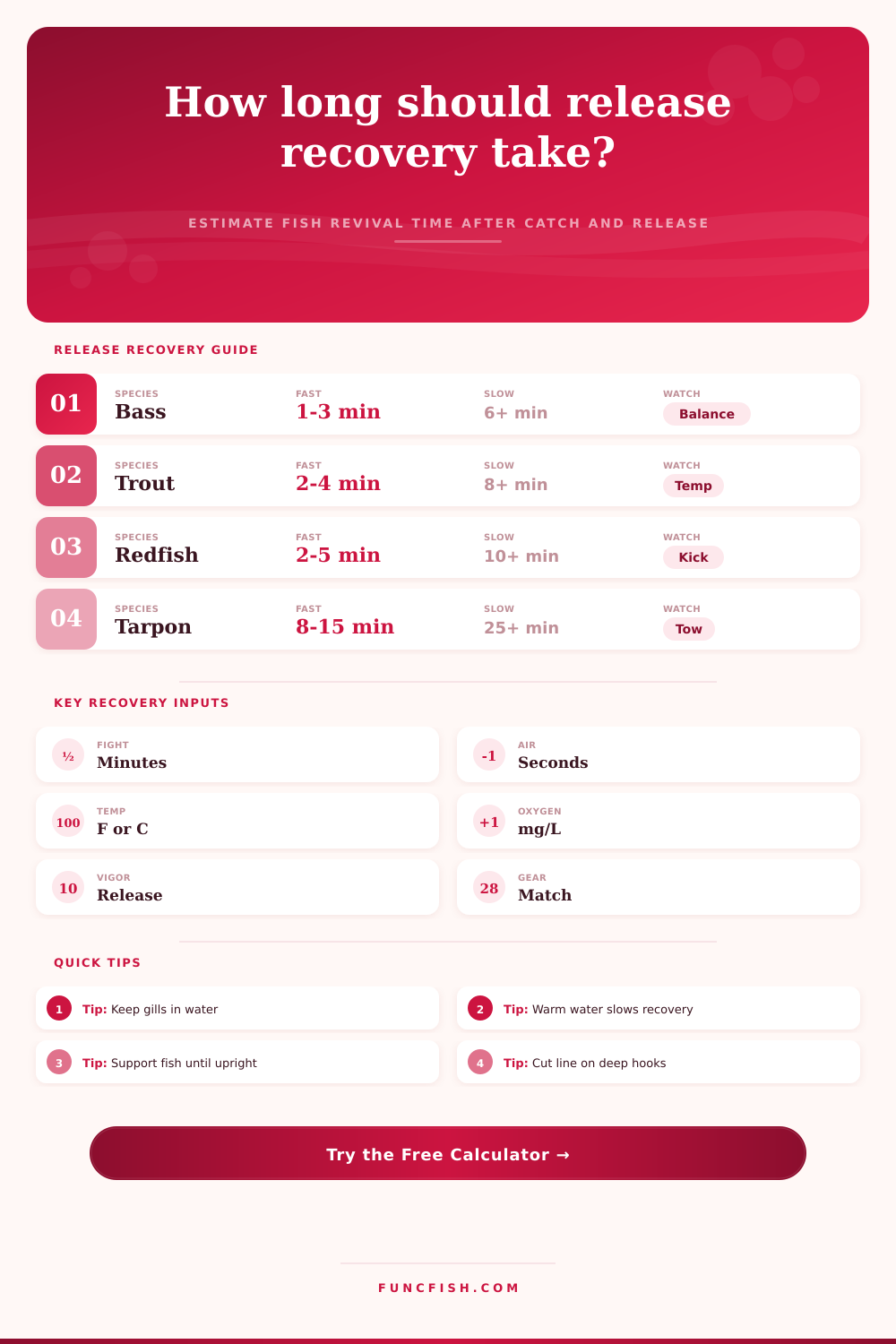
Estimate how long a released fish may need to regain balance and strong swimming from species tolerance, fight load, air exposure, water quality, gear fit, and handling support.
📍Fishing presets
⚙Release conditions
Recovery estimate
Calculation breakdown
🎣Species and gear recovery grid
Coldwater species recover slower when water is above their comfort range.
Moderate fight duration and quick handling usually keep revival time short.
Large pelagic fish often need boat-side support after high-power runs.
Multiple hook points raise handling time and tissue irritation.
Lip or corner hook placement improves quick unhooking and orientation.
Extended fight fatigue is a major driver of slow post-release recovery.
Below about 5 mg/L, the same fight can need much longer revival support.
Directed water movement across the gills can shorten visible recovery time.
📊Recovery reference tables
| Species group | Comfort temp | Base recovery | Typical signs |
|---|---|---|---|
| Largemouth bass | 60-80°F / 16-27°C | 2.5 min | Upright kick, steady fin movement |
| Rainbow trout | 45-64°F / 7-18°C | 3.5 min | Needs cool, oxygen-rich water |
| Walleye | 50-70°F / 10-21°C | 3.0 min | Often pauses before a strong swim |
| Striped bass | 55-72°F / 13-22°C | 4.0 min | Sensitive to warm water and long runs |
| Redfish or snook | 68-84°F / 20-29°C | 3.5 min | Strong tail kick once balanced |
| Tarpon | 72-86°F / 22-30°C | 10.0 min | Needs boat-side support after long fights |
| Muskellunge or pike | 55-72°F / 13-22°C | 5.0 min | Heavy body support prevents rolling |
| Channel catfish | 65-85°F / 18-29°C | 2.8 min | Hardy, but deep hooks change outlook |
| Stressor | Low range | High range | Recovery effect |
|---|---|---|---|
| Fight time vs species baseline | Under 1.0× | Over 2.0× | High fights can double recovery time |
| Air exposure | 0-15 seconds | 60+ seconds | Rapidly increases with warm water |
| Dissolved oxygen | 7+ mg/L | Below 5 mg/L | Low oxygen reduces recovery capacity |
| Hooking injury | Lip single | Gill or deep | Injury can dominate the estimate |
| Handling surface | Wet net | Dry deck or sand | Surface contact adds slime and balance stress |
| Release current | Gentle clean flow | Turbulent flow | Helpful flow becomes tiring if too strong |
| Readiness score | Recovery band | Visible cue | Field action |
|---|---|---|---|
| 85-100 | Fast | Fish holds itself upright | Release when it swims from support |
| 70-84 | Normal | Slow kick but stable balance | Hold in clean water a little longer |
| 50-69 | Guarded | Weak tail beats or short rolls | Extend revival and reduce handling |
| 30-49 | High stress | Cannot maintain orientation | Keep water moving over gills |
| 0-29 | Severe | No coordinated swim response | Use the fastest legal low-stress choice |
| Gear setup | Best use | Fight effect | Recovery note |
|---|---|---|---|
| Ultralight line | Panfish and small trout | Long on large fish | Use only where landing time stays short |
| Balanced spinning | Bass, walleye, inshore slot fish | Neutral | Best general release profile |
| Heavy cover tackle | Vegetation or structure | Shorter fight | May reduce exhaustion if drag is smooth |
| Light fly tackle | Small streams | Can extend fights | Warm trout water needs extra caution |
| Circle hook bottom rig | Catfish, redfish, bait fishing | Neutral | Often reduces deep-hook recovery penalty |
| Offshore heavy stand-up | Tarpon and large saltwater fish | Shorter but intense | Boat-side support remains important |
💡Calculation tips
Shorten the largest stressor first. If the output is high, air exposure and fight time are usually the fastest variables to improve on the next release.
Use the score with visible behavior. A fish that rolls, sinks, or cannot hold balance needs support even when the estimated time looks moderate.
Reel them in, slide the hook free, and push them back into the water. You got your picture and you saved the fish. Victory! But then your hands drop off the scales and it gets real. Biological reality meets immediate excitement, and this is where catch-and-release ethics get tricky: The fish can look alive in the boat but still be at risk of death when your hands let go.
The calculator above do all the math for you after you plug in your air exposure and fight time. You won’t have to guess how long you can safely pause the fish.
How to Keep Fish Alive After Catching Them
Pride: Most anglers is proud of tiring a fish out before landing it and focusing more on the fight itself. While that’s good for the sport, from a biological perspective, it causes lactic acid to build up in their muscle tissue during the struggle. That acid dissipates slow in warm water and if it’s a hot day with low oxygen, a fish might collapse and die shortly after being released due to the exhaustion from the fight. To account for this, the tool factors in both species tolerance and water temperature, since these vary greatly between fish like trout in warm water and bass in cool water.
Fish aren’t made to breathe air, which is why air exposure is a silent killer. If you leave your fish on a dry deck long enough, their gill filaments will stick together and all that surface area for breathing dissapears. They’ll suffocate in seconds, but they won’t if you keep them wet or in the water. It’s cumulative and often irreversible by the time you realize what happened. That’s why the calculator penalize air time pretty heavily.
Most folks don’t realize the importance of gear selection. Heavier gear gets it over with quickly so they don’t build up as much lactic acid for a quick recovery. Lighter gear produce longer fights and more drama while the fish is gasping. Below we have a reference table on the page explaining how tackle mismatch increases length of revival time. This demonstrates that proper rod power are also an act of mercy.
Circle hooks typically cause less trauma to the fish because they don’t hook as deep in the gut, and they are easier to remove quickly. Treble hooks mean more handling time and an increased risk of injuries. If the fish does come off, it has lost its slime coat, the natural protection from bacteria and parasites. The loss of the slime coat leaves an opening for infection that can happen weeks later, defeating the purpose of releasing this animal now.
The last indicator is vigor. If you’re going for a strong, vertical kick on the fish, it’s good to go; however, if they roll over, they’ll need some assistance. A gentle tug in clear water will often right a rolling fish as long as you give them time to flush their gills with oxygen.
This is more of an estimate, so take it as a guideline, but at least you have some idea how much stress you put the animal through. If it tells you he has a long recovery period, let him sit there in the water and give him respect. It requires patience, but if you don’t wait until the fish swims away with strength and purpose, then it didn’t survived at all. You caught it, but you didn’t win until you released it properly which is when it swam off under its own power.
You should of used better gear to keep them healthy naturaly. The fighting can be more harder than most people think, so pay attention to how they behave based off the water temperature. If a fishs gills gets clogged, they won’t survive. One might say that using lighter tackle is betterer for the fish. It could of been easier if you had used circle hooks from the start.