Safe Fish Consumption Per Month Calculator
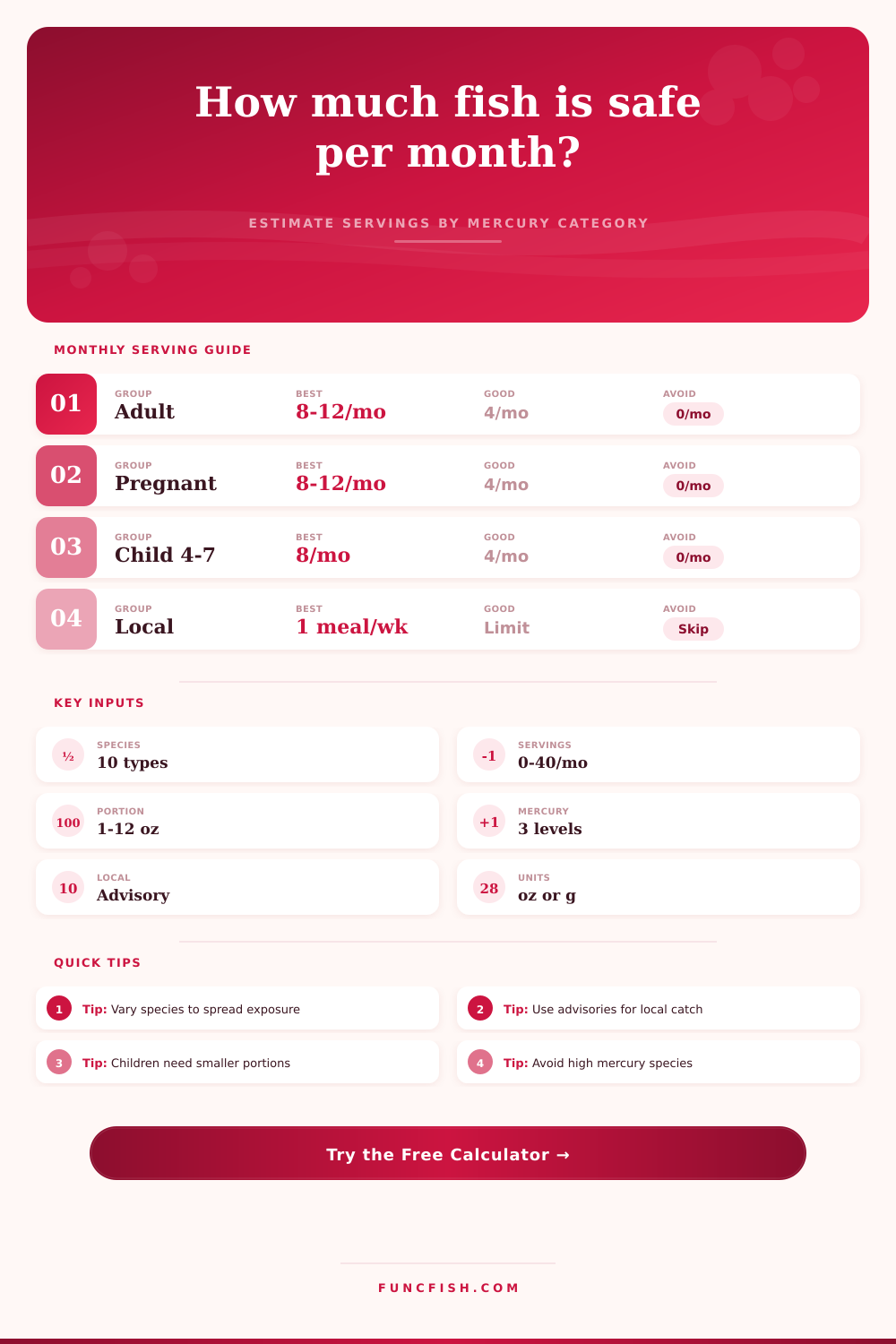
Estimate monthly fish meals from species mercury category, person group, portion size, planned servings, and local-catch advisory status.
📌Consumption presets
⚙Monthly serving inputs
Choose the closest species category. Local catch should follow the strictest posted advisory for that water; when no advisory exists, use the local-catch limit.
Monthly consumption estimate
Calculation breakdown
🐟Species and source grid
📊Reference tables
| Mercury category | Adult monthly servings | Pregnancy monthly servings | Child monthly servings |
|---|---|---|---|
| Best choice fish | 8.7 to 13.0 standard servings | 8.7 to 13.0 standard servings | about 8.7 age-sized servings |
| Good choice fish | 4.3 standard servings | 4.3 standard servings | about 4.3 age-sized servings |
| Avoid fish | 0 planned servings | 0 planned servings | 0 planned servings |
| Local catch, no advisory | 4.3 local meals | 4.3 local meals only with caution | 4.3 age-sized local meals |
| Common species | Default category | Serving pattern | Calculator note |
|---|---|---|---|
| Salmon, sardines, tilapia, cod | Best choice | 2 to 3 weekly adult servings | Good base for regular monthly rotation. |
| Canned light tuna, pollock, shrimp | Best choice | 2 to 3 weekly adult servings | Use cooked drained portion weight. |
| Albacore tuna, mahi mahi, halibut | Good choice | 1 weekly adult serving | Count other fish meals separately. |
| Bass, walleye, snapper | Good or local dependent | 1 weekly unless advisory is stricter | Local waterbody data can change category. |
| Swordfish, shark, king mackerel | Avoid | 0 planned servings | Especially important for children and pregnancy. |
| Age or group | Reference serving | Metric equivalent | Monthly use |
|---|---|---|---|
| Adult | 4 oz cooked | 113 g cooked | Use entered serving if different. |
| Child 1 to 3 | 1 oz cooked | 28 g cooked | Age-sized serving count. |
| Child 4 to 7 | 2 oz cooked | 57 g cooked | Age-sized serving count. |
| Child 8 to 10 | 3 oz cooked | 85 g cooked | Age-sized serving count. |
| Child 11 plus | 4 oz cooked | 113 g cooked | Often close to adult portion. |
| Serving adjustment | Lower limit | Higher limit | When it matters |
|---|---|---|---|
| Species category | Avoid or good choice | Best choice | Mercury category drives the first limit. |
| Body weight | Small adult or child | Average adult | Scales the ounce ceiling below 165 lb. |
| Local advisory | Limited or do-not-eat water | Specific current OK advisory | Local catch can override market guidance. |
| Variety | One species all month | Mixed lower-mercury fish | Variety affects buffer but not avoid species. |
| Preparation | Large predator steak | Trimmed edible portion | Used as a small caution factor. |
💡Calculator tips
This calculator estimates serving guidance only and does not replace local fish advisories or advice from a qualified health professional.
Yes, fish has some healthy nutrients. Omega-three fatty acids promote brain function, so yes, it’s good for you. Fish is lean with protein. The human body digest fish easly.
But as it happens, eating fish comes with its own set of risks too. Many of them has to do with mercury exposure. Mercury builds up in our bodies over time.
How to Eat Fish Safely
So here’s the thing: You don’t need to stop eating fish entirely. You just need to know what amount of fish per month will be safe for you. This is where calculator kicks in. This tool turns generic guidance into personalized action, specifically: how much fish you can safely eat every month.
This app takes into account the mercury categories of different types of fish. You can see how it’s calculated here. The app also accounts for mercury level and makes adjustments to match. For example, small shrimp is low in mercury while big sharks is high in mercury since they consume lots of other fish. The app calculates this for you.
When you pick your species of fish, it will then recommend how much to eat based off its mercury category. Since salmon is in the safe category, you’ll be able to consume them frequentley. Swordfish on the other hand, are high in mercury and thus you’re only supposed to eat as much than zero per week.
So this easy-to-understand guide explains a complicated biological problem in simple terms. It matters what goes in. For example, a serving of tuna contain more mercury then a serving of tilapia. But everyone thinks that all servings of fish are equal.
The tool asks about your person group because a developing fetal brain is more vulnerable to toxins than an adult brain. That’s why pregnant women and little kids gets stricter limits. It also takes into account your age. A teenager could eat an adult-sized serving; a toddler would need only a bite-sized portion.
Finally, where did you get your fish? Local-caught might be riskier than market-bought, which is regulated. And the reference table explains how local advisories trump national guidelines.
A second error is assuming that one type of tuna equals another. Smaller fish caught for canning typically has less mercury. Larger, older tuna like albacore and ahi tuna tend to contain more. The calculator takes this into consideration.
By varying what types of low-mercury species you eat (mixing up which tuna you choose), you disperse the risk. Concentrating contaminants by eating the same thing each day isn’t good. A basic solution is to mix things up when it comes to seafood. This won’t make anything taste bland, and will keep you safe.
Your safety limit also depends on body weight. The dose of mercury is calculated per kilogram of body weight. So a child or small adult will reach the safe level sooner then someone who is large. To account for that, the tool scales the monthly limit downward when the body weight is small. It’s a small adjustment, but still significant.
You may think you’re within a healthy range, but if you have low body weight, your exposure rate are above average.
The way the fish was prepared matters as well. Some contaminants can be reduced through trimming. Skin removal and fat trimming can remove some of them. Proper preparation won’t eliminate mercury since it bind to the muscle tissue. You can indicate how it was prepped on the calculator. That provides a bit more detail in the estimate.
Cooking method does matter to the safety equation. When eating fish, you want to enjoy the food and minimize the risks. Ideally, that means getting all the benefits of fish and staying below the monthly limit. Not sure? Be conservative. Remember, the calculator shows you a range, and the last variable is how much risk you’re comfortabley taking.
Mix up the species, track your servings, and eat fish regularly. There are plenty of healthful options in the ocean. You simply should of made wise choices about which ones to eat.