Pregnancy Safe Fish Calculator
Plan pregnancy, trying-to-conceive, or breastfeeding seafood meals by species, weekly serving size, mercury category, local catch status, and omega-3 contribution.
📌Pregnancy fish presets
⚙Fish meal inputs
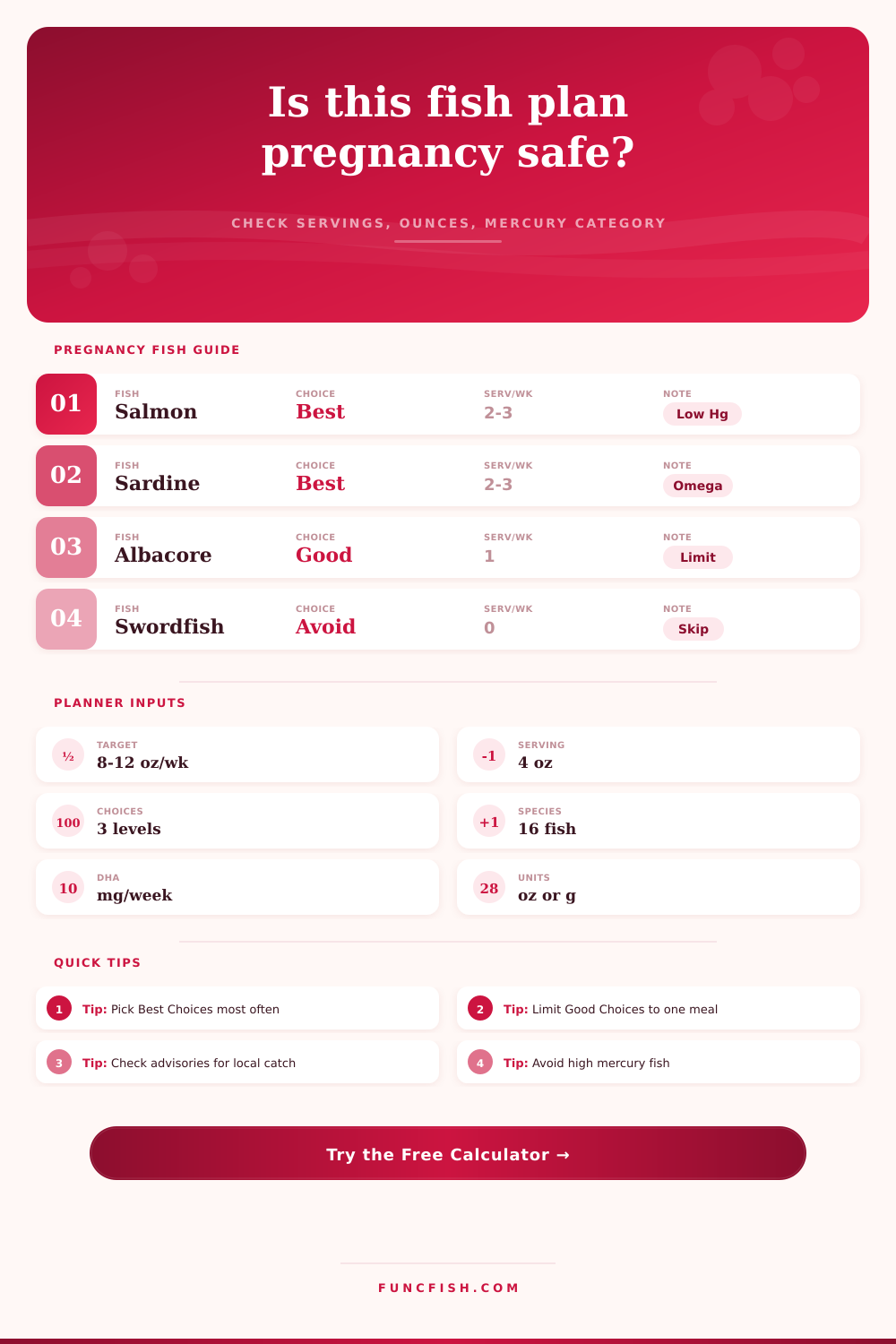
Pregnancy guidance commonly targets 8 to 12 oz per week from lower-mercury seafood. Use local fish advisories when they are stricter than the general fish chart.
Pregnancy fish plan results
Calculation breakdown
🐟Pregnancy species grid
📚Reference tables
| Choice category | Pregnancy serving pattern | Weekly ounces | Calculator rule |
|---|---|---|---|
| Best Choice | 2 to 3 servings per week | 8 to 12 oz cooked | Can fill the weekly seafood target. |
| Good Choice | 1 serving per week | About 4 oz cooked | Use alone for the week in this planner. |
| Avoid | 0 servings during pregnancy | 0 oz | Result changes to avoid regardless of ounces. |
| Local catch | Follow posted advisory | Advisory dependent | Advisory status can override the chart. |
| Species | Default category | Approx mercury ppm | Omega-3 profile |
|---|---|---|---|
| Salmon | Best | 0.02 | High DHA plus EPA. |
| Sardines | Best | 0.01 | High for a small fish serving. |
| Trout | Best | 0.07 | Strong when farmed or advisory-cleared. |
| Cod or pollock | Best | 0.03 to 0.11 | Lean fish; lower omega-3. |
| Albacore tuna | Good | 0.35 | Moderate omega-3; limit weekly. |
| Bigeye tuna or swordfish | Avoid | 0.69 plus | Not used for pregnancy meal plans. |
| Portion basis | Imperial | Metric | Planner use |
|---|---|---|---|
| Pregnancy serving | 4 oz cooked | 113 g cooked | Default serving size. |
| Weekly minimum | 8 oz cooked | 227 g cooked | Two standard servings. |
| Weekly upper target | 12 oz cooked | 340 g cooked | Three standard servings. |
| Monthly target range | 35 to 52 oz | 985 to 1474 g | Average month at 4.35 weeks. |
| Good Choice cap | 4 oz weekly | 113 g weekly | One standard serving. |
| Adjustment | Lower allowance | Higher allowance | When to use it |
|---|---|---|---|
| Local advisory | Limited or do-not-eat water | Current OK advisory | Sport-caught fish from lakes, rivers, and bays. |
| Variety | Mostly one species | Varied Best Choice seafood | Rotating fish avoids relying on one data point. |
| Preparation | Raw tuna or predator steak | Cooked lower-mercury portion | Used as a caution factor in the screen. |
| Planner goal | Mercury-first screen | Reach target range | Changes status wording and buffer. |
| Other fish | Good Choice meals already eaten | No other fish this week | Weekly totals include every seafood meal. |
💡Planner tips
This calculator is an educational planner only. It does not replace local advisories or personalized guidance from an obstetrician, dietitian, or other qualified clinician.
When pregnant, we’re balancing a double dose of health concerns: consuming enough DHA and other omega-3 fatty acids for a healthy baby brain while avoiding too much mercury from fish consumption. It’s stressful, so how can we gets both? We don’t want to eliminate fish from our diets altogether, just pick the best ones. And here’s the calculator to help.
According to health agencies, those who are pregnant should have between 8 and 12 ounces of low-mercury fish weekly. That way, you’re getting enough DHA, which your developing baby need for his brain development, but also within a safe margin from too much mercury.
How to Use the Fish Calculator
Here’s the catch: How do you know what goes into that total? A lot of folks forget about all the fish they consume away from their main meals. Shrimp in a stir-fry, a tuna salad sandwich at lunch. Those count too. In fact, if you’re only counting the fish you have on Fridays when you serve salmon, you’re probably underestimating your intake. Every serving must be tallied. Where you eat the fish and how you prepare it don’t matter.
Once you know how much of each kind of seafood you’re eating, and what species you are eating, it calculate the numbers for you with this tool above. It takes away all the guesswork from combinations of mixed seafood items. It identifies the best choices, such as sardines. It identifies the best choices, like sardines and salmon, versus good choices like albacore tuna. Best choice are safe to have two to three times a week. Good choices can only be had as one serving.
This is significant because mercury builds up in predator fish that live longer and grows larger. Swapping one for another can change the safety profile of your plan. A steak of swordfish isn’t simply a larger serving of the same risk. It’s an entirely different class of exposure risk, which the reference table on the page illustrate well. You’ll see why switching one type of high-mercury fish for a lower-mercury fish changes how safe your meal plan are for the entire week.
But the details of where you live add depth missed by general charts. Federal guidelines might not be as stringent than state advisories, which may differ from local catches. While some waters may be okay for weekly eating, others have high concentrations of mercury and/or industrial runoff with much stricter limits. You can enter those local factors into the calculator so your plan takes into account what’s really going on at your own source instead of a national average. A common mistake people make is ignoring their local advisories. Unless you check them, you don’t know whether the fish you caught this weekend was safe to eat.
There’s also the issue of variety when eating seafood. Sure, grabbing whatever looks good each week may be convenient. But if one particular type of fish tend to have more mercury relative to others, you increase your risk. Sardines, pollock, shrimp and salmon provide variety. They spread out contaminants while offering a wider variety of nutrients. By allowing you to add multiples, the planner makes variety easy (and even nudges you in that direction). It will then compute how they all impact your overall limit for the week.
This is a simple change in your buying behavior. But it makes your seafood diet far more nutritionally balanced and safe. You can get rid of the fear about eating fish by filling that void with information. Because now you don’t need to guess, all you need to know is how much.
How close are you to your goal of having eight to twelve ounces per week? Do you know what number you want to be at? Now you can confidently eat seafood knowing exactly where you are in relation to your goal. One of the best things you can eat when you’re trying to help your baby develop properly is the right kind of seafood in the correct quantity. When you get a grip on those numbers then you’ll lose the worry and could of go right back to being able to enjoy your meal.