Skin-On vs Skinless Yield Calculator
Compare edible yield when fish are kept skin-on or trimmed skinless, using species recovery rates, batch weight, dressing state, cut style, trim intensity, moisture shrink, and serving size.
📌Yield presets
⚙Batch and yield inputs
Use the actual starting weight you have. If the fish are already gutted or headed, choose that dressing state so the calculator does not subtract the same waste twice.
Yield comparison
Calculation breakdown
🐟Species yield grid
Bass
Trout
Salmon
Walleye
Catfish
Redfish
Snapper
Halibut
📊Reference tables
| Species profile | Skin-on yield | Skinless yield | Skin difference | Best calculator use |
|---|---|---|---|---|
| Black bass | 38% | 34% | 4% | Small to medium freshwater fillets |
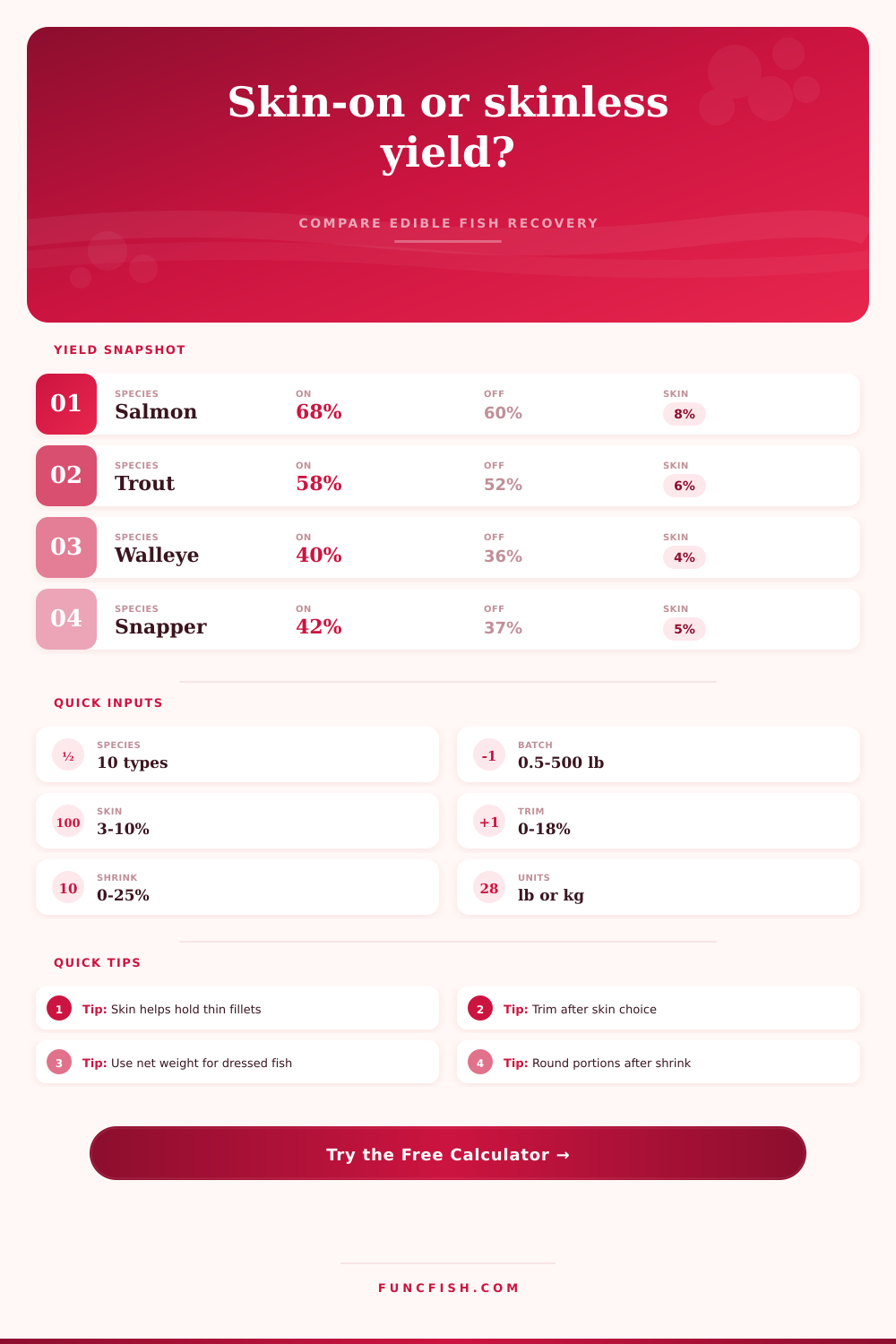
| Trout or char | 58% | 52% | 6% | Pan fish, butterflied fish, small sides |
| Salmon | 68% | 60% | 8% | Large sides and portion blocks |
| Walleye | 40% | 36% | 4% | Boneless shore-lunch fillets |
| Catfish | 42% | 36% | 6% | Skinned fillets, strips, nuggets |
| Redfish or drum | 44% | 38% | 6% | Half-shell or skinless fillet planning |
| Snapper | 42% | 37% | 5% | Whole-catch table fish recovery |
| Mackerel | 60% | 52% | 8% | Skin-on oily fish portions |
| Halibut | 52% | 48% | 4% | Large firm portion blocks |
| Pike or pickerel | 36% | 31% | 5% | Y-bone removal and high trim plans |
| Starting state | Meaning | Weight basis | Yield adjustment | Use when |
|---|---|---|---|---|
| Whole round fish | Fish as landed | Whole body | 1.00x | The batch has head, guts, frame, and skin |
| Gutted, head on | Viscera removed | Dressed body | 1.10x | You weighed fish after gutting |
| Headed and gutted | Head and viscera removed | Clean dressed body | 1.22x | Processor or boat trimmed before weighing |
| Skin-on fillet sides | Frames already removed | Fillet sides | Direct | You are deciding whether to skin fillets |
| Skinless fillets | Skin already removed | Finished fillets | Direct | You only need portions and shrink |
| Cut style | Skin effect | Trim effect | Shrink note | Planning note |
|---|---|---|---|---|
| Standard boneless fillets | Neutral | Normal | Moderate | Default for most table fish |
| Skin-crisp portions | Retain more | Low | Lower breakage | Useful for trout, salmon, mackerel |
| Half-shell grilling | Retain most | Low | Skin protects flesh | Common for redfish and drum |
| Steaks or crosscuts | Variable | Low | Bone-in portions | Not directly comparable to boneless fillets |
| Strips or nuggets | Usually removed | Higher | More exposed edge | Raises trim and handling loss |
| High-trim boneless | Usually removed | Highest | Cleaner portion blocks | Use for pike, bloodline, or belly trim |
| Serving size | Imperial | Metric | Skin-on fit | Skinless fit |
|---|---|---|---|---|
| Small plate | 4 oz | 113 g | Thin fillets stay intact | Good for tacos and bowls |
| Standard main | 6 oz | 170 g | Works for most fillets | Clean plate presentation |
| Hearty portion | 8 oz | 227 g | Best with larger sides | Good for firm white fish |
| Fish fry | 7 oz | 198 g | Less common | Best for strips and nuggets |
| Steak cut | 10 oz | 283 g | Useful for large species | Use only if bones are removed |
💡Yield planning tips
Match the weight basis: A skin-on side is already past whole-fish yield loss, so use the fillet-side starting state when comparing only skin removal.
Separate skin from trim: Skin percentage is not the same as belly, bloodline, pin-bone, or Y-bone trim. Set both so the comparison stays honest.
This is a familiar scenario on family fish fries and shore lunches. Somebody purchases an additional ten pounds of walleyes out of precaution, only to have the ice bucket overflowed with raw potential while dinner pl remains conspicuously void of protein.
Most kitchens loses money on the gap between weight of a whole fish and the amount of fillet that actualy makes it to the plate. Knowing the difference between skinless vs. Skin-on yield isn’t just about personal taste, it’s simple arithmetic, the difference between a full stomach and skimpy snack.
Why You Should Keep Fish Skin On
Once you know what kind of fish you’re working with and how many are included in a batch, the rest is left to the calculator (above). No need for conversion factors or coefficients.
Here’s something you must understand: Trim isn’t skin. Many folks don’t realize this; they think if you’re trying to save money, you should of just remove all the skin. Wrong move. Think of skin as a very thin membrane. Think of trim as the odd-shaped edges you don’t want to see on your dinner plate, the bloodied belly lining, the pin bones, and any dark muscle along the spine.
Keeping the skin intact hold all those thin fillets in place. It’s nature’s binder. Without it, things tend to separate while cooking, resulting in more waste on your plate.
This tool shows you exactly how much each choice cost. The fish itself matter too. A bass will have a different yield profile than a catfish does. And salmon vs trout? They is different again.
Skinless & boneless salmon weighs much less (the thick layer of fat beneath the skin comes off) and the texture change as well. A trout is even lighter. You can cook a trout skin-on where the skin remains delicate and crisp. Leave that skin on your trout and you retain more of the original weight. The quick comparison chart on the page makes this clear.
Even the species is not as important as where you start. Your yield percentage will be awful if you weigh a whole fish, including head and guts. You’re carting around some dead weight that won’t make it to the table. But once you’ve removed the head and guts of the fish, your starting weight decreases and your yield percentage increase. The calculator wants to know exactly how you’re weighing the fish. Lying to the tool will result in getting precise but useless numbers.
Shrinkage is the silent killer in portion planning. When fish cooks, moisture leaves the fish. What was that nice looking 6 ounce fillet? Now it’s a 4 ounce fillet that shrank because of cooking. You can enter a shrinkage allowance into the calculator. And most folks don’t. They take out their fish and think “I have 6 ounces” (in raw form). They toss it on the grill. Cook it. And they’re left with 4-ounce portions. Sounds like a small thing, but if you’re feeding 30 people; it adds up.
The other variable that changes this dynamic is portion size. It’s simple enough to grab a four ounce serving off of a small fillet. You need a bigger fish; or combine two pieces, for an eight ounce serving. For tacos, you’re willing to take more trimming loss because it’s more convenient to eat. On a whole fish, like a half-shell redfish, you leave on the skin so the flesh doesn’t get banged up.
There is always a trade-off between yield and ease of eating. But it’s also about psychology. Throwing away the skin feels wasteful. Leaving it on thin fish, however, makes meat hard to cut and chew. It’s better to have a smaller piece that cooks evenly than a larger piece that falls apart on your fork. The calculator lets you visualize that waste before cutting into it.
The bottom line is that you should try to make the yield fit the menu. Don’t over-process something for the sake of increasing yields when it’s better with some skin intact. Let the numbers be your shopping guide, not your justification for wasting food. Nobody leaves hungry after a well-thought-out fry.