Possession Limit Calculator
Estimate remaining possession room from your entered local limits, kept fish, frozen or processed fish, trip length, and party size. This is a planning aid, not legal advice.
📌Scenario presets
⚙Possession inputs
Possession allowance estimate
Full breakdown
📊Quick count indicators
Possession cap
Daily cap
Stored fish
Buffer
📋Reference tables
| Planning count | Calculator input | What it represents | Common mistake |
|---|---|---|---|
| Possession limit | Local possession limit | Maximum held at one time | Using daily number twice |
| Daily limit | Local daily limit | Maximum retained in one day | Ignoring today count |
| Trip kept | Fish kept during trip | Fresh fish from current outing | Counting only one angler |
| Stored fish | Processed or frozen fish | Fish still controlled by party | Leaving freezer count out |
| Transfers | No longer possessed | Documented fish removed from party | Subtracting informal shares |
| Trip pattern | Daily check | Possession check | Calculator focus |
|---|---|---|---|
| Single day | Today limit dominates | Usually same or higher | Daily room today |
| Weekend | Two daily periods | Stored fish may bind | Remaining possession |
| Cabin trip | Multiple daily periods | Freezer count matters | Counted possession |
| Shared camp | Angler logs vary | Cooler ownership matters | Party allocation |
| Near cap | Small daily room | Small possession room | Buffer result |
| Buffer setting | When useful | Effect on allowance | Planning note |
|---|---|---|---|
| 0% | Exact count log | No extra subtraction | Requires tidy records |
| 5% | Small party | Light margin | Good for short trips |
| 10% | Mixed storage | Moderate margin | Useful default |
| 20% | Shared coolers | Large margin | Conservative planning |
| Status band | Remaining room | Interpretation | Next check |
|---|---|---|---|
| Open | More than 25% | Plenty of count space | Review daily cap |
| Tight | 10% to 25% | Count carefully | Check storage log |
| Full | 0 to 10% | Possession nearly filled | Use a buffer |
| Over | Below zero | Entered count exceeds cap | Verify every entry |
🎣Gear and species comparison grid
| Species category | Typical gear pace | Count pressure | Log detail to watch |
|---|---|---|---|
| Panfish group | Family mixed gear | Fast bag filling | Shared bucket totals |
| Trout or char | Fly or finesse | Medium count pace | Individual creel count |
| Walleye family | Jigging or trolling | Steady trip storage | Freezer packages |
| Black bass | Finesse casting | Often selective | Kept versus released |
| Catfish group | Bait soaking | Large cooler swings | Cleaned fish count |
| Pike or muskie | Trolling or casting | Low count, bulky fish | Tagged whole fish |
| Inshore saltwater | Surf or pier | Mixed bag complexity | Species-separated totals |
| Mixed legal bag | Multiple methods | Highest confusion risk | Category-by-category log |
💡Two count tips
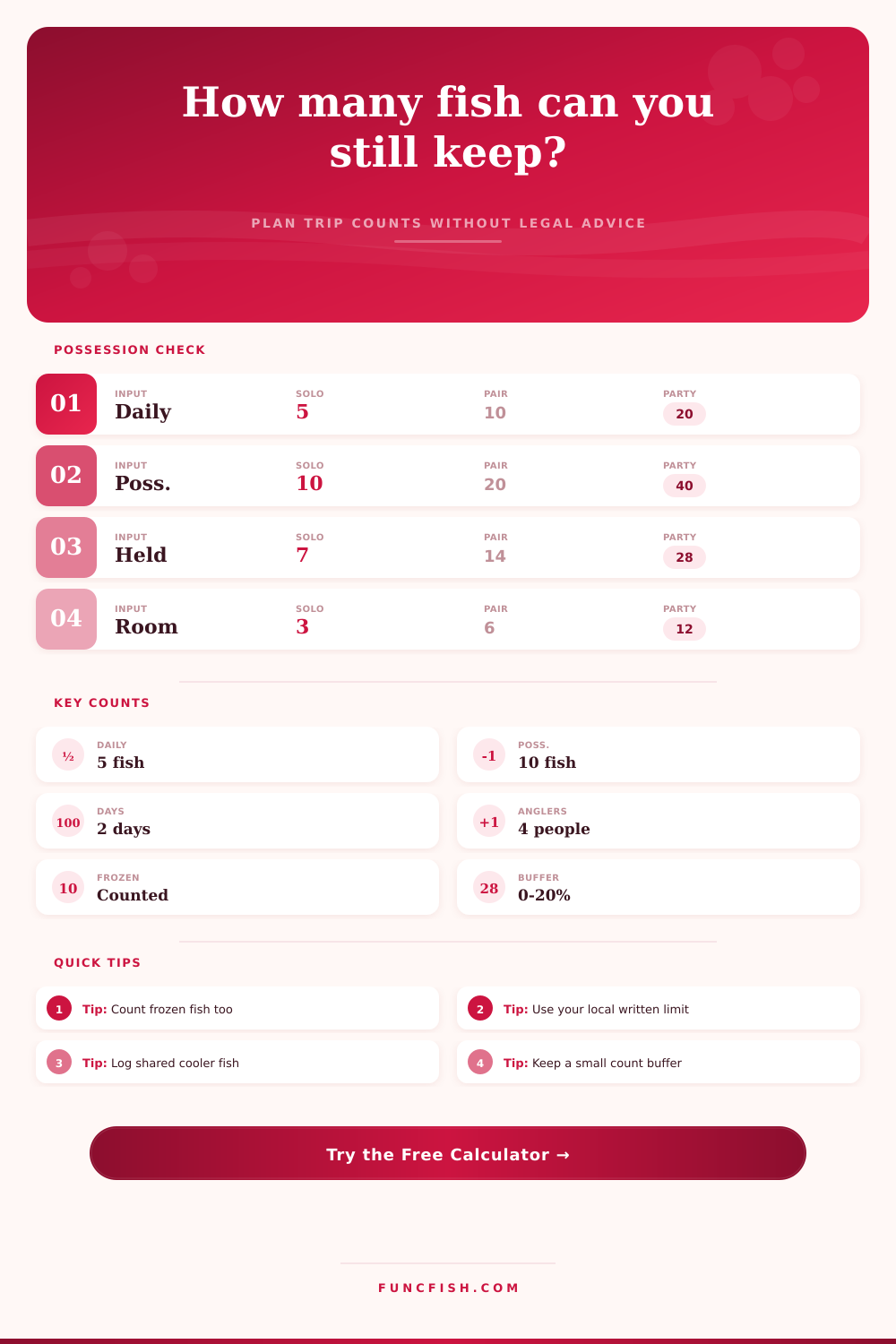
Tip: Count fish that remain under your party control, including processed packages and frozen fish, before estimating any new keep room.
Tip: Treat the calculator as a trip ledger. For final decisions, compare the result with the exact written rule for your water and species.
There it is: a cooler of fish sitting by your feet. As you stand on the shore of the lake looking down, you suddenly start second-guessing yourself. The creel on the boat are heavy. The coolers are full too, but those aren’t the same limits as for catching them during the day.
Catching one limit is what you can possess immediately; while catching another is what you’ll be able to keep once the sun sets. Mixing these two things up is how you go from a good weekend trip to an expensive lesson.
Why You Should Use the Fish Limit Calculator
Using the calculator above, simply input your state’s rules and the rest will work out. You won’t have to worry about counting back all those fillet or wondering if you’ve kept one too many.
I think most of us just think about our daily limit. That’s easy enough; we see that on our license. But then there’s possession limits. And a possession limit include all the fish you’ve caught over several days. When you’re on a three-day trip, those catches add up. They stack up. And that’s where things get tricky. You could go fishing each day and remain far below daily limit each time, and still find yourself over the maximum allowable at the end of day three. That’s where this tool can help.
It allows you to input how many days you fished and how many fish you now has in hand. Be honest in the input fields. Generally, there will be a limit based off the number of anglers in your group, so you must specify that. A single angler‘s limit is different than a family of four‘s limit.
Also, consider processed fish. This is where most folks screw up. If you catch a fish and freeze it, fillet it or package it in any way, that doesn’t mean it no longer exists in your possession. That fish still counts. The calculator considers processed fish as equal to whole fish and it should; an enforcement officer see it the same way. Whether it’s on the ice or in the freezer doesn’t matter, but whether it’s yours matters.
What you’re carting around is different than what you caught today Your haul totals up against the possession limit while the amount you caught today total up against the daily limit. That means that the calculator double-checks them both at once so that the fact that you’ve reached your total doesn’t mean you can stuff anymore fish in boat today. It is easy to think “oh well I’m not done for the day yet” but then get stopped when you reach your total volume.
It’s a good idea to use a buffer. You might count wrong. Rules vary. Or they may get complicated with shared coolers at a campground or cabin. When you’re swapping fish or your cooler contains your neighbor’s catch too, who owns what? With the calculator, you can input an optional buffer percentage. That puts you in the safe zone in case you do miscalculate by a fish or two. Better to give back than take a ticket.
For example, this breaks down those situations in the reference tables on the page. What does that mean? Well, depending on what species group you’re fishing (walleye vs panfish) or what method you’re fishing (bait vs lure), it will affect your count pressure. For instance, the walleye may occupy multiple count units per fish whereas the panfish may only require one or two units to fill out a bag. Knowing this allows you to plan your day better.
If you are chasing a lower limit species, you know you have to keep better track of what is going on. That means you’ll log more carefuly. The calculator isn’t a substitute for the actual laws, but it is a handy tool to help you plan your trip and make the rules real and tangible for you to wrap your mind around.
At the end of the day, fishing isn’t about catching them, it’s about enjoying the experience. But remaining within the law protects the experience for all of us. It protects the resource so that it may remain healthy. And it also ensures that your access to that resource is not compromised by a preventable mistake.
Taking a few minutes to crunch some numbers before heading out eliminates the anxiety from that trip. Now you can concentrate on the catch, the weather, and the water. You will also know right where you’re at. The peace of mind is priceless. It would of been worth more than those few extra fish you could have potentially been tempted into keeping.