Species Substitution Limit Calculator
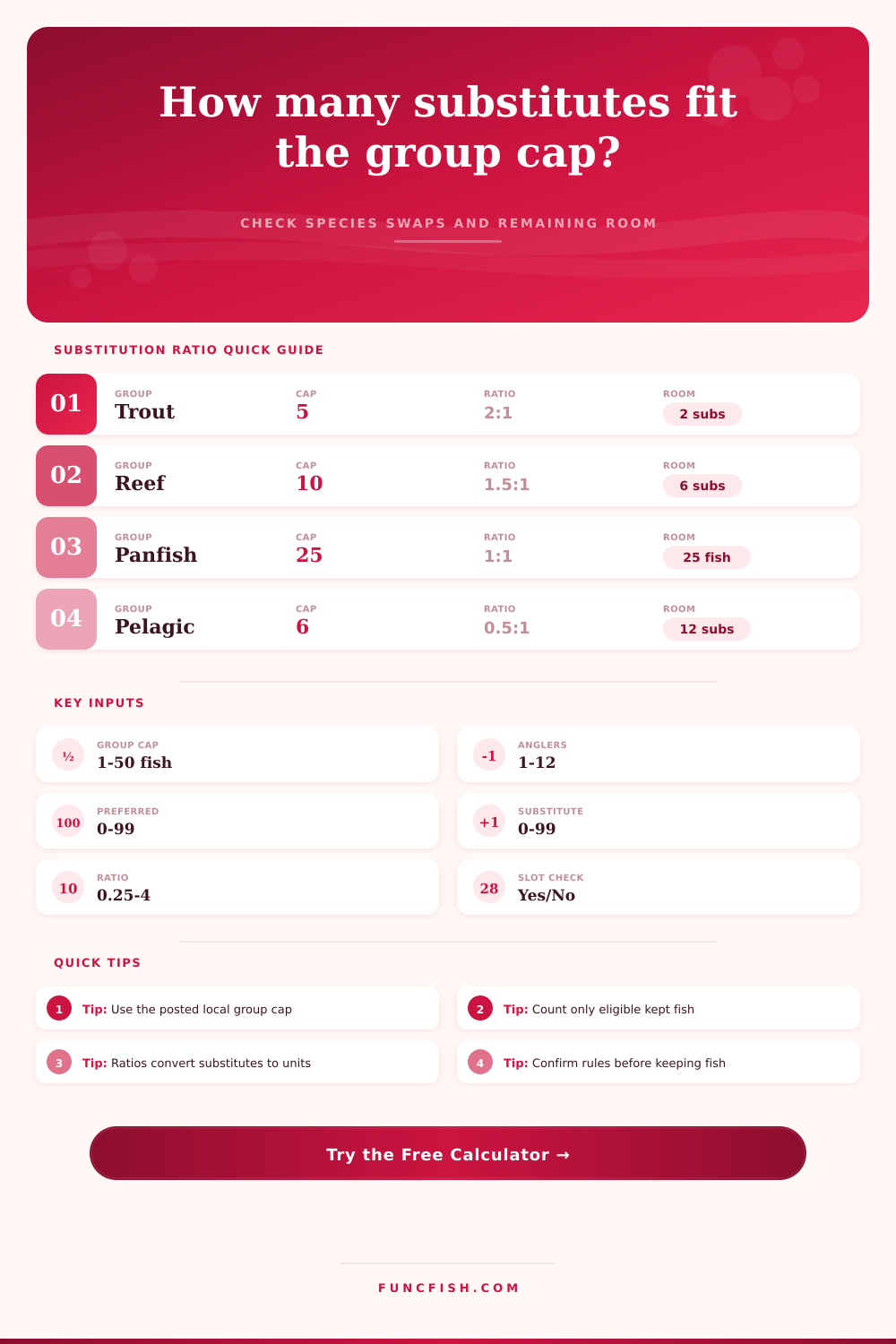
Compare a local group cap with preferred fish, substitute fish, equivalency ratio, slot eligibility, angler count, and remaining allowance for planning only.
📌Species-group presets
⚙Substitution settings
Substitution limit summary
Full breakdown
📋Gear/species comparison grid
Measure Board
Counter Clicker
Cooler Tags
Rule Card
Photo Log
Length Tape
Trip Sheet
Scale Bag
📚Reference tables
| Ratio wording | Enter as | Meaning | Example within 5 units |
|---|---|---|---|
| One substitute equals one preferred | 1.00 | Same group weight | 5 substitutes |
| Two substitutes equal one preferred | 0.50 | Half unit each | 10 substitutes |
| One substitute equals two preferred | 2.00 | Double unit each | 2 substitutes |
| Three substitutes equal two preferred | 0.67 | Two-thirds unit | 7 substitutes |
| Eligibility setting | Calculator effect | Use when | Planning note |
|---|---|---|---|
| All eligible | Counts all entered fish | Every fish fits slot | Cleanest count |
| About 75% eligible | Flags 25% outside slot | Mixed measured catch | Review fish by fish |
| About half eligible | Flags 50% outside slot | Uncertain size mix | Use conservative room |
| Not eligible | All entered fish flagged | Outside size window | Do not treat as retained room |
| Species group | Preferred example | Substitute example | Common planning ratio |
|---|---|---|---|
| Salmonid group | Trout | Char | 0.5 to 1.0 |
| Reef group | Snapper | Grunt | 0.5 to 1.5 |
| Panfish group | Crappie | Perch | 1.0 to 1.0 |
| Predator pair | Pike | Musky | 1.0 to 2.0 |
| Planning case | Cap input | Remaining input | Best use |
|---|---|---|---|
| New trip | Full cap per angler | Same as group total | Before any fish are kept |
| Mid-trip check | Full cap per angler | Room left now | After part of the catch |
| Shared cooler | Cap times anglers | Shared group room | Multiple anglers together |
| Conservative pass | Local cap | Leave reserve | When identity is uncertain |
💡Calculation tips
Tip: Enter the local group cap and substitution ratio exactly as posted for the water you are fishing. This calculator compares quantities only and does not replace official local rules.
Tip: Keep slot and size eligibility separate from the ratio. A fish that is outside the entered size window is flagged before the remaining allowance is calculated.
Before you even begin, though, you notice the cooler is half full, and that nasty-looking grunt will suffice as a replacement for the snapper you intended to catch. Loophole? Nope. That’s accounting, pure and simple, and it’s strictly enforced by wildlife agencies seeking to keep certain populations while still giving anglers a bit of wiggle room in regard to their catches.
Trouble is, doing the mental math on the fly while leaning over in a rocking boat isn’t so easy. How many subs will fit into that group cap? Is it worth throwing one back or not? A limit is just a number for most folks; five fish, keep five fish… if they say five fish. A substitution makes it a currency exchange. Each fish have an economic value and you’re exchanging living things at different prices. One grunt may be worth half a unit while another snapper may be worth a full unit.
Why You Need a Fish Limit Calculator
What does that mean? Everything. If each fish is equal in your mind, you’ll likely exceed the legal limit by the time you get your fish cleaned. The calculator above takes care of the conversion math for you so you don’t need to guess on which mix of fish is legal.
First and foremost, you need to understand what the equivalency ratio means. The equivalency ratio is the number that describes the amount of substitute fish required to be equivalent to one preferred fish. So if the ratio is 0.5 then two substitutes = one preferred fish. The regulator will use this ratio to cap the overall impact/total biomass of the species without outright prohibiting the species. By entering the ratio into the calculator you’re basically establishing the exchange rate for your trip. Get the rate wrong and everything crumble.
Another wrinkle that surprises most anglers is slot limits. Just because you catch a fish that counts toward your substitution allowance doesn’t mean it is actualy legal to keep. For example: Let’s say you have room for more substitutes under your group cap, so more fish will go into your cooler. Half of those fish may be too small to retain. So what? Well they don’t count. They simply become illegal catches.
The calculator use averages to help you see how many fish will fit in your cooler. This shows you different sizes of your catch instead of just focusing on the number.
The other thing that throws folks off, especially when they share a cooler with some buddies is the angler count. You can mix limits on certain bodies of water. Other places has limits per angler. You must also adjust for the number of angler. That’s important if you are taking a trip with multiple anglers who want to catch fish and then swap them for larger fish if someone hooks a big one. If you don’t account for the pooled limit, someone in the boat is going over the line.
This leaves the other fields for your allowances; which is where you plan things out. Usually this doesn’t begin with a clean slate. Perhaps you’ve caught two bass and a trout already. Well, the calculator will subtract those from the total limit and show how much you have left. Then it splits up your leftover between preferred fish and substitute fish. Why? Because sometimes you don’t get to switch at will. If you exhaust your substitute room, you’re no longer able to use any of those species towards your total, even if you still have room left in your preferred fish slot.
To help explain these ideas, there are reference tables on the page to show what each set of ratios will mean for your total count. For example, it illustrates how every unit of substitute means two units; so, seeing that ratio-of-two equates to two means you’ll get twice as many by keeping your preferred species. This makes an otherwise confusing regulation into a simple resource management game. You’ve got a budget of units. Your preferred fish cost lots of units. Substitutes costs few units. How can you best use your budget?
Remember. Don’t count on memory to get these numbers right. They change all the time. They aren’t reliable when you’re stressed out during a busy day of fishing. Using a system to double-check your limit will help you keep only the fish you need and help you release those you should of.
The bottom line is leaving the dock knowing you have a full cooler and a clear conscience about keeping what’s legal. Know your substitution limits before getting on the water. This will help you make good decisions on the water instead of making rash decisions on the bank. It converts guessing into a plan.