🎣 Casting Distance Calculator
Estimate your maximum casting range based on rod, line, lure, and technique variables
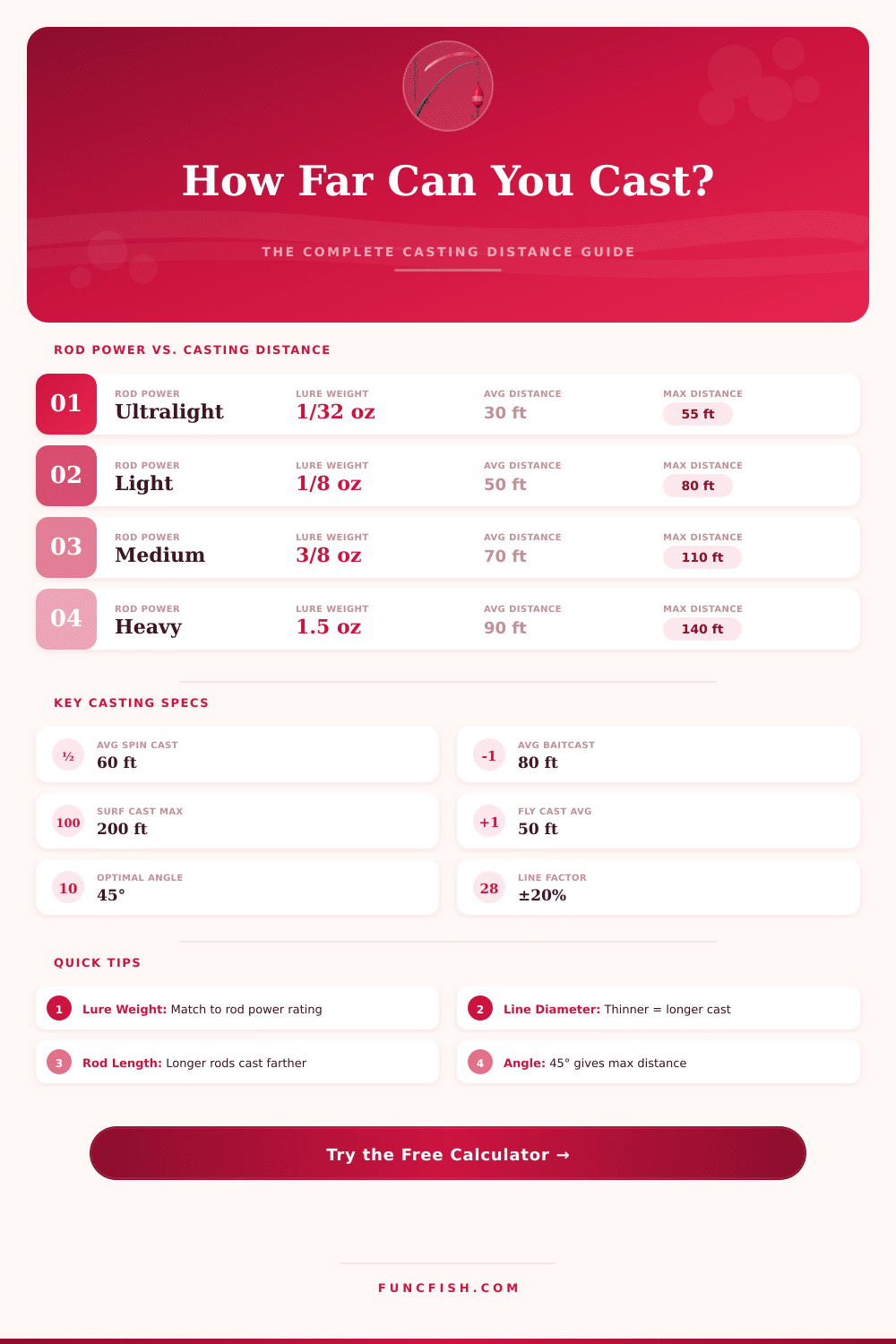
| Rod Power | Optimal Lure Wt | Avg Distance (ft) | Avg Distance (m) | Max Distance (ft) |
|---|---|---|---|---|
| Ultralight | 1/32–1/8 oz | 30–45 | 9–14 m | 55 ft |
| Light | 1/8–1/4 oz | 45–65 | 14–20 m | 80 ft |
| Medium-Light | 3/16–3/8 oz | 55–75 | 17–23 m | 95 ft |
| Medium | 1/4–5/8 oz | 65–90 | 20–27 m | 115 ft |
| Medium-Heavy | 3/8–1 oz | 75–100 | 23–30 m | 130 ft |
| Heavy | 3/4–1.5 oz | 85–115 | 26–35 m | 145 ft |
| Extra-Heavy | 1–4 oz | 90–130 | 27–40 m | 170 ft |
| Species | Typical Weight | Rec. Cast Distance | Technique | Line Weight |
|---|---|---|---|---|
| Largemouth Bass | 1–8 lb | 50–80 ft | Spinning / Baitcast | 10–17 lb |
| Rainbow Trout | 0.5–5 lb | 30–60 ft | Spinning / Fly | 4–8 lb |
| Striped Bass | 5–30 lb | 80–150 ft | Surf / Spinning | 15–30 lb |
| Walleye | 1–10 lb | 50–90 ft | Spinning / Jig | 8–14 lb |
| Pike / Muskie | 5–30 lb | 60–100 ft | Baitcast | 20–50 lb |
| Catfish | 2–40 lb | 60–110 ft | Bottom / Overhead | 20–50 lb |
| Crappie / Panfish | 0.25–2 lb | 20–45 ft | Ultralight Spin | 2–6 lb |
| Redfish / Inshore | 2–15 lb | 50–90 ft | Spinning / Kayak | 10–20 lb |
| Line Type | Distance Factor | Diameter | Best Use | Stretch |
|---|---|---|---|---|
| Monofilament | Baseline (1.0x) | Medium | All-around | 25–30% |
| Fluorocarbon | −5% (0.95x) | Medium | Clear water | 15–20% |
| Braided Line | +20% (1.20x) | Very thin | Distance & sensitivity | <5% |
| Fused Line | +10% (1.10x) | Thin | Distance casting | |
| Copolymer | +5% (1.05x) | Medium-thin | General freshwater | 18–22% |
| Lead Core | −25% (0.75x) | Very thick | Trolling depths |
Whether you succeed to reach big Casting Distance during fishing depends mainly on that, as well as all parts of your gear. The weight of the bait, the thickness of the line, kind of wrapping that you use, and the length of the rod (everything plays a big role). Basically you always struggle against friction when the line unwinds from the spool and slips through the guides.
Every contact of the line with something on its way slows it a bit. The more strongly it strikes against a guide or the more lightweight the bait is, the less long it will fly.
How to Cast Far When Fishing
Length of the rod really affects, when one fishes from the coast, the truth is. Long rods help to reach bigger Casting Distance, if you stand beside the river bank. Rods between 10 and 12 feet, that fit to work with baits of 1 until 8 units, work well for such setups.
From a ship the situation changes, short rods move more easily in tight spaces, and Casting Distance like this anyhow is not the main cause. Eight-foot rods however give nice benefit, when you cast hooks or jigs nearby.
The main point is: choose a rod according to its action, not only according to length or curve. Every rod has ideal weight, for that it casts most effectively than any other. If you find that limit, your Casting Distance quickly drops, whether the bait is too lightweight or two heavy for your gear.
Must match the strength of the rod with weight of the bait, so that everything works well. Try to cast little bait by means of medium rod with tight brake reel? Here you will not succeed a lot.
Spinning reels help to reach bigger Casting Distance, especially if you use lightweight line. Take long and stiff spinning rod with heavy bait and you will be amazed, how far long it will fly. Bait casters well handle heavy baits, but with lightweight they have troubles.
Big spools are useful, they less tangle and less friction means smoother, longer casts. Many forget that: keep your reel clean and well oiled, everything adds to Casting Distance. A good reel with nice oil and regular care makes a big difference.
Weight of the line changes everything. Take the same bait on same gear, cast it by means of 12-pound test instead of 20-pound; it will fly clearly more long. Lightweight lines give advantage.
Too lightweight line however risks to break. Shock leader well helps, we say around 10 pounds for unit of bait weight. Heavier main line kills Casting Distance because of extra thickness and mass, that it adds.
For better Casting Distance really matters practice, simply and clearly. Work to slowly extend your casts and also accuracy at various distances; that builds real skill. Aim at a similar place many times, later move it a bit more away each time.
Interesting detail: a spiral wrapped rod can expand Casting Distance by around 20 percent. Load the rod by means of a back-and-forth swing before the cast, everything adds flexible energy, thatgives more Casting Distance.
At end of the day accuracy beats raw Casting Distance almost always. Lay the bait exactly where it needs to be is more useful than simply cast it as far as possible.