⚡ Trolling Motor Size Calculator
Find the right thrust, voltage & shaft length for your boat — instantly
| Boat Weight (lb) | Boat Weight (kg) | Min Thrust (lb) | Rec. Thrust (lb) | Voltage |
|---|---|---|---|---|
| Up to 500 | Up to 227 | 18 | 30 | 12V |
| 500–1,000 | 227–454 | 20 | 36 | 12V |
| 1,000–1,500 | 454–680 | 30 | 45 | 12V |
| 1,500–2,000 | 680–907 | 40 | 55 | 12V |
| 2,000–2,500 | 907–1,134 | 50 | 70 | 24V |
| 2,500–3,000 | 1,134–1,361 | 60 | 80 | 24V |
| 3,000–3,500 | 1,361–1,588 | 70 | 101 | 36V |
| 3,500–4,500 | 1,588–2,041 | 80 | 112 | 36V |
| Deck / Bow Height (in) | Deck / Bow Height (cm) | Min Shaft Length (in) | Rec. Shaft Length (in) | Shaft Length (cm) |
|---|---|---|---|---|
| 0–8 | 0–20 | 36 | 42 | 91–107 |
| 8–12 | 20–30 | 42 | 48 | 107–122 |
| 12–18 | 30–46 | 48 | 54 | 122–137 |
| 18–24 | 46–61 | 54 | 60 | 137–152 |
| 24–30 | 61–76 | 60 | 72 | 152–183 |
| 30+ | 76+ | 72 | 72+ | 183+ |
| Scenario | Boat Type | Loaded Weight (lb) | Rec. Thrust (lb) | Voltage |
|---|---|---|---|---|
| Bass Tournament | Bass Boat | 2,000–2,800 | 80 | 24V |
| Walleye Trolling | Aluminum 16–18 ft | 1,500–2,000 | 55 | 12/24V |
| Kayak Fishing | Fishing Kayak | 400–700 | 30–36 | 12V |
| Crappie/Panfish | Jon Boat 12–14 ft | 600–1,000 | 30–36 | 12V |
| Pike / Muskie | Aluminum 18–20 ft | 2,000–3,000 | 80 | 24V |
| Pontoon / Family | Pontoon 22–24 ft | 3,500–5,000 | 112 | 36V |
| Catfish River | Flat Bottom 16 ft | 1,500–2,200 | 55–70 | 12/24V |
| Saltwater Bay | Bay / Flats Boat | 2,500–3,500 | 80–112 | 24/36V |
| Canoe / Small Craft | Canoe / Inflatable | 300–500 | 18–30 | 12V |
| Trout Drift Boat | Drift Boat 16 ft | 1,200–1,800 | 45–55 | 12V |
| Battery (Ah) | Thrust (lb) | Voltage | Amps at Full | Est. Runtime (hrs) @ 50% |
|---|---|---|---|---|
| 60 Ah | 30 lb | 12V | 30A | 4.0 hrs |
| 100 Ah | 36 lb | 12V | 42A | 4.8 hrs |
| 100 Ah | 55 lb | 12V | 52A | 3.8 hrs |
| 100 Ah x2 | 80 lb | 24V | 56A | 7.1 hrs |
| 100 Ah x3 | 112 lb | 36V | 52A | 11.5 hrs |
| 200 Ah | 55 lb | 12V | 52A | 7.7 hrs |
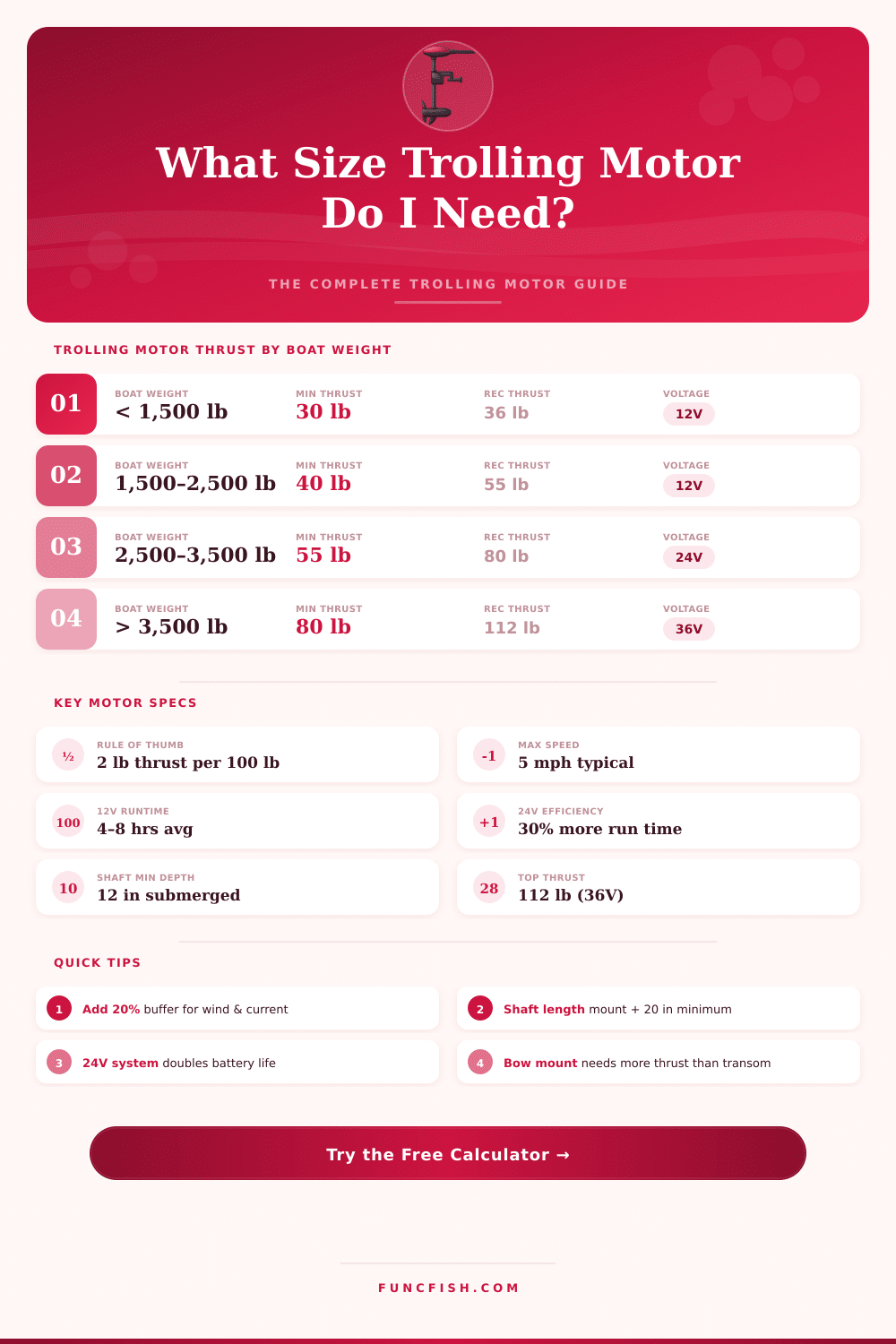
Election of the right size for Trolling Motor is genuinely important. For start, count the needed power, what requires to mind the force of push, the voltage and the length of the pole. Practical advice says that one requires 5 pounds of push for every 200 pounds of dry weight of the boat.
One also can think that way: at least 2 pounds of push for 100 pounds of weight of the boat.
How to Choose the Right Trolling Motor
Widely value to choose a motor stronger than the minimal need. Such motors work more well in low speeds and provide safe reserve against wind, waves and flows. None always suffers because of too much force in Trolling Motor.
A motor that seems good in calm conditions, can quickly become poor, when wind and waves start.
For boats with V-shaped hull, motors of 40 to 80 pounds of push are the most liked. Little such boats usually use motors mounted on the back and controlled by hand. For little jon-boats, a motor with 55 pounds of push works well.
Even so for bigger boats in the gulf, long around 20 feet, a 55-pound motor simply does not suffice. Setup with 80 pounds of push and 24 volts helps in most cases four those boats. A normal Trolling Motor gives 40 to 60 pounds of push, what suffices for moving more than a ton of boat in calm water with a bit of flow.
Easy mode to figure power to batteries is this. One battery bears motor of 55 pounds. Two batteries bear motor of 80 pounds.
Three batteries bear motor of 112 pounds. Course of 24 to 36 volts add power, what genuinely helps in many cases. Batteries of deep cycle, group 31, with high back-up capacity, work best for Trolling Motor.
Because canoes are much more little and more light than bass-boats, motor of 20 to 30 pounds of push works for them. Little and simple Trolling Motor cost little and well serve for light boats, kayaks and canoes. Think about push of Trolling Motor the same as horsepowers for outboard motor.
Length of the pole is other important spot. For find the right length of pole, measure from the mount spot on the bow or back down to the waterline. Later add 20 inches to that measure.
For most bass-boats, a pole between 42 and 50 inches is advised. Some companies now produce poles to 84, 87 or even 96 inches long, for boats around 40 feet with bows more than 6 feet above the waterline. Windy conditions can lift short poles from the water, hence long poles help in bad conditions.
Trolling Motor of 36 volts with 84-inch pole suits boats to 35 feet and 15,000 pounds.
Trolling Motor of 80 pounds and 24 volts on boat of 22 feet, weighing about 3,000 pounds, reach only 2.8 miles each hour. That is typical, because Trolling Motor usually tops around 5 to 6 knots, regardless ofits size.