🎣 Fishing Rod Length Calculator
Find the ideal rod length for your technique, species, and fishing environment
1/64–1/8 oz
1/8–5/8 oz
3/8–1.5 oz
1–4 oz
| Technique | Recommended Length (ft) | Length (m) | Best Action | Best Power |
|---|---|---|---|---|
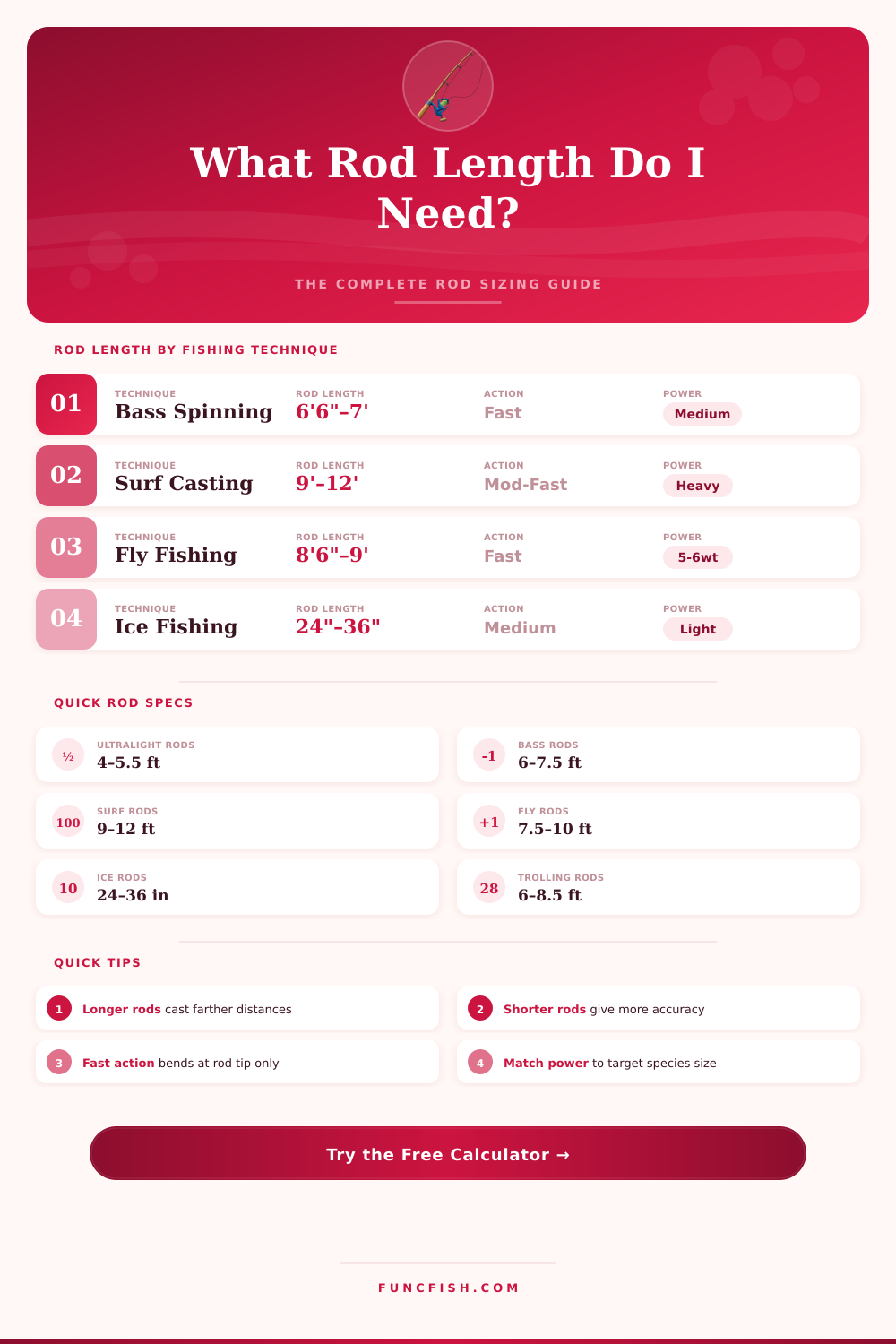
| Bass Spinning | 6’6"–7’6" | 1.98–2.29 m | Fast | M–MH |
| Trout Stream | 5’6"–7’ | 1.68–2.13 m | Fast | UL–L |
| Surf Casting | 9’–12’ | 2.74–3.66 m | Mod-Fast | MH–H |
| Fly Fishing | 7’6"–9’6" | 2.29–2.90 m | Fast | 3–8 wt |
| Walleye Jigging | 6’–7’ | 1.83–2.13 m | Fast | M |
| Pike / Muskie | 7’–8’ | 2.13–2.44 m | Fast | H–XH |
| Offshore Trolling | 6’–8’6" | 1.83–2.59 m | Moderate | H–XH |
| Panfish / Crappie | 4’6"–6’ | 1.37–1.83 m | Mod-Fast | UL–L |
| Ice Fishing | 24"–36" | 0.61–0.91 m | Medium | L–M |
| Kayak Inshore | 6’6"–7’6" | 1.98–2.29 m | Fast | M–MH |
| Species | Typical Weight | Rod Length (ft) | Rod Power |
|---|---|---|---|
| Bluegill / Panfish | 0.25–1 lb (0.1–0.45 kg) | 4’6"–5’6" | Ultralight |
| Trout (Stream) | 0.5–4 lb (0.23–1.8 kg) | 5’6"–7’ | Light |
| Largemouth Bass | 2–10 lb (0.9–4.5 kg) | 6’6"–7’6" | Med–Med Heavy |
| Walleye | 2–8 lb (0.9–3.6 kg) | 6’–7’ | Medium |
| Pike / Muskie | 5–40 lb (2.3–18 kg) | 7’–8’ | Heavy |
| Catfish | 5–50 lb (2.3–22.7 kg) | 7’–8’6" | Heavy–XH |
| Striped Bass (Surf) | 10–40 lb (4.5–18 kg) | 9’–12’ | Heavy |
| Redfish / Snook | 5–20 lb (2.3–9 kg) | 7’–7’6" | Med Heavy |
| Salmon | 10–30 lb (4.5–13.6 kg) | 8’6"–10’ | Medium Heavy |
| Tuna / Offshore | 20–200 lb (9–90 kg) | 6’6"–7’6" | Extra Heavy |
| Action | Bend Location | Best For | Cast Distance |
|---|---|---|---|
| Extra Fast | Top 10% of rod | Jigs, worms, precise casts | Medium |
| Fast | Top 25% | Most lures, single hooks | Medium–Long |
| Moderate Fast | Top 33% | Crankbaits, spinnerbaits | Long |
| Moderate | Top 50% | Treble hook lures, live bait | Very Long |
| Slow | Parabolic bend | Ultra-light, trout, panfish | Short |
Each additional foot of rod length adds roughly 5–10% to your maximum cast distance. A 7’ rod casts approximately 10–15% farther than a 6’ rod with the same technique. For surf casting, every extra foot matters — a 12’ rod can reach 30–40% farther than a 9’ rod.
Taller anglers can effectively leverage longer rods. A good baseline: your ideal rod length is roughly 1.1–1.4x your height for spinning, or 0.5x your height for ice fishing. Beginners should subtract 6 inches from the recommended length for easier handling and accuracy.
Most fishers do not notice how the length of the fishing rod truly affects their fishing. The length that you choose affects the cast distance, the accuracy and the feeling of your hands after long hours on the water. There are many options from short 4-foot to big 14-foot, and each has its pros and cons.
The secret is to match what you keep to the kind of fishing that you do.
Choose the Right Fishing Rod Length
Short fishing rods, everything under 7 feet… Shine in situations where accuracy matters or the space is tight. Try casting with a 6-foot fishing rod between bridge posts or stick the bait under the dock between hanging branches, and you will quickly see the difference.
For river fishing in narrow places even a 5-foot fishing rod often works. They also are more comfortable for your hands during long sessions and more easily handled when you must cast the bait now and then.
Long fishing rods help to reach bigger distance. Those extra feet allow more distant casts and stronger hook sets, even if the fish resists. The wind bothers less, because the bait stays low and more stable instead of floating upward.
When you reach 7 feet and 3 inches or more, heavy lines load better. The weight of the bait turns into useful force, not into useless wobble. The downside?
They become hard to carry, and the branches seem to grab every extra inch that you bear.
Bass fishing usually needs a fishing rod between 6 and 8 feet. For bait fishing from 6 feet to 6-foot-8 works well. From a boat on a lake, medium-fast fishing rod of 6 to 7 feet works for most cases that you meet.
Truly it is the workhorse in basic fishing.
Boats complicate things. Fishing rods above 7 feet start feeling awkward in that small space. Even so, a long fishing rod with an angled handle works like a built-in outrigger.
Kayak fishing is another case, between 7 and 7 feet 6 inches helps for casting and moving around your boat.
Bank fishing and wade fishing have another style. Here fishing rods usually stretch from 8 to 14 feet. For surf casting the ideal is 10 to 12 feet, a longer fishing rod often causes visible mistakes.
Tournament fishers often use 13 to 14 foot ones. Around 14 feet gives good distance, although some struggle with something near too 16 feet, depending on their body build.
Fly rods follow totally different rules. Most on land are 9 feet long, because that length makes the pitching, roll casting and line control natural. In strong water short fishing rods are more useful.
For open water with distance needed, long ones work better. Here the point, the line can reach almost three times thelength of your fishing rod. For basics something between 8 and 9 feet works.
Remember also, that the length of the fishing rod and its power are totally separate things.