🎣 Fishing Rod Casting Weight Calculator
Match your lure weight to your rod power rating — get optimal casting performance in any scenario
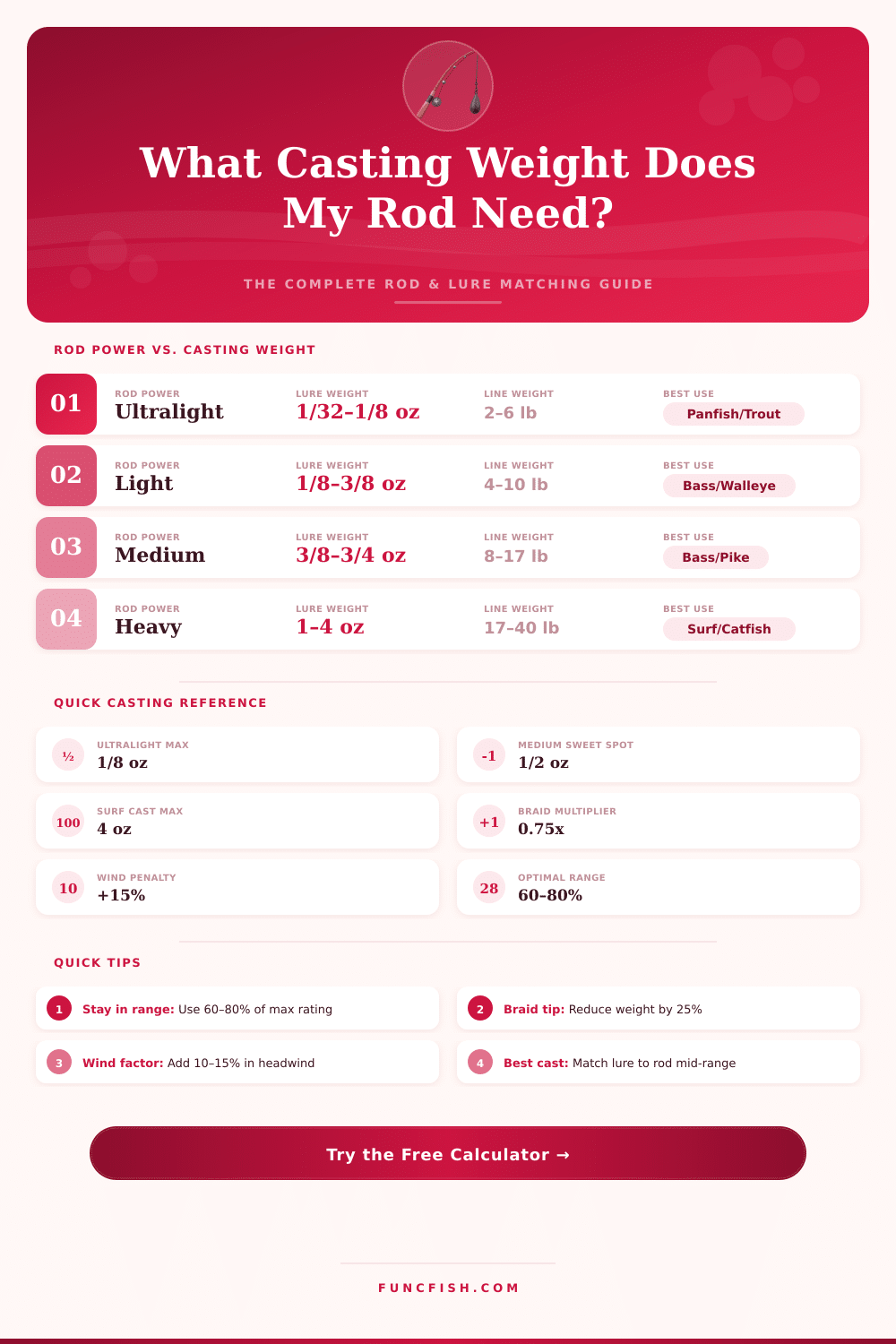
| Rod Power | Lure Weight (oz) | Lure Weight (g) | Line (lb) | Line (kg) | Rod Action |
|---|---|---|---|---|---|
| Ultralight | 1/32 – 1/8 | 0.9 – 3.5 | 2 – 6 | 0.9 – 2.7 | Fast/Moderate |
| Light | 1/8 – 3/8 | 3.5 – 10.6 | 4 – 10 | 1.8 – 4.5 | Fast/Moderate |
| Medium-Light | 3/16 – 1/2 | 5.3 – 14.2 | 6 – 12 | 2.7 – 5.4 | Fast/Mod-Fast |
| Medium | 3/8 – 3/4 | 10.6 – 21.3 | 8 – 17 | 3.6 – 7.7 | Mod-Fast/Fast |
| Medium-Heavy | 1/2 – 1.5 | 14.2 – 42.5 | 12 – 25 | 5.4 – 11.3 | Fast |
| Heavy | 1 – 3 | 28.3 – 85 | 17 – 40 | 7.7 – 18.1 | Fast |
| Extra Heavy | 2 – 6 | 56.7 – 170 | 25 – 65 | 11.3 – 29.5 | Fast |
| Surf / Specialty | 2 – 8+ | 56.7 – 226+ | 20 – 80 | 9.1 – 36.3 | Moderate |
| Species | Avg Weight | Lure Weight (oz) | Lure Weight (g) | Rod Power |
|---|---|---|---|---|
| Bluegill / Crappie | 0.25–1 lb | 1/64–1/16 | 0.4–1.8 | Ultralight |
| Rainbow Trout | 1–5 lb | 1/16–3/8 | 1.8–10.6 | Ultralight–Light |
| Largemouth Bass | 2–8 lb | 3/8–1 | 10.6–28.3 | Medium–Hvy |
| Walleye | 2–10 lb | 1/4–3/4 | 7.1–21.3 | Med-Light–Med |
| Northern Pike | 5–20 lb | 1/2–2 | 14.2–56.7 | Medium-Heavy |
| Catfish | 5–50 lb | 1–4 | 28.3–113 | Heavy–X-Hvy |
| Striped Bass (Surf) | 5–40 lb | 1.5–6 | 42.5–170 | Heavy–Surf |
| Offshore Tuna | 20–200+ lb | 3–12 | 85–340 | Heavy–Surf |
| Line Type | Weight Multiplier | Best Weight Range | Sensitivity | Best Use |
|---|---|---|---|---|
| Monofilament | 1.0x (baseline) | 1/8–4 oz | Moderate | All-around |
| Braided Line | 0.75x (go lighter) | 1/4–8 oz | High | Heavy cover, distance |
| Fluorocarbon | 0.9x (slightly lighter) | 1/8–3 oz | High | Clear water, finesse |
| Copolymer | 0.95x | 1/8–2 oz | Moderate | Versatile freshwater |
| Wire Line | 1.2x (heavier needed) | 2–12 oz | Low | Deep trolling |
| Fly Line | Fly weight system | WF3–WF12 | N/A | Fly fishing only |
Casting Weight is one of those topics, that seems simple but can become a bit complex. Each Fishing Rod bears a Casting Weight rank printed on it, that tells the angler about the weight of bait or sinker, that the rod is designed for. Even so here is the main spot (there is no universal rule about that), as rod makers set those ratings.
Rods of different kinds, for instance spinning, casting and for crankbait, with same power rating, perform entirely otherwise.
What Casting Weight Means for Your Fishing Rod
Casting Weight ratings should serve as a guide. They ease the comparison of rods in the same range. When one rod shows 40 g and another 80 g, the second rod is clearly stronger.
Such comparison helps, however the numbers are not strict laws.
Fishing Rods best cast baits heavy from the center to the upper part of their Casting Weight range. Some rods even point out the best Casting Weight. For instance, a rod rated at 12-35 g could have its best at 30 g. This ideal is the place, where the rod gives its best output.
A rod raetd for 40 g can handle 45 g with light activity, but casting it hard with full force could hurt the rod.
Many anglers commonly pass the Casting Weight rating of their rod. A nine-foot lure rod rated at 30 to 75 g can handle 100 g jerkbait without any troubles. Even so staying inside the rated range ensures, that the rod works at its peek and avoids risk of damage.
Always using the upper limit of the Casting Weight is not the best idea. A rod does not reach its real best, when one always pushes it to the upper bar.
Also the weight of the bait itself matters, not only that of the sinker. Big hooks with heavy baits change the whole right weight quite a lot. When the best Casting Weight is marked as 6 ounces, worth asking, whether it includes the bait or not.
Switching to a rod with lighter Casting Weight can give a great experience. A nine-foot rod rated at 5 to 20 g feels nearly fun to use, especially for folk, that never really cast baits above 20 g. On the other hand, expert anglers usually own several rods, that cover various weight ranges, from light setups of 1/16 to 1/4 ounces to heavy rods of 2 to 8 ounces.
A ten-foot rod rated at 15 to 50 g even so can cast lighter lures quite far to catch fish. And a rod, that handles 18-gram plugs, can launch them much more far than really needed, while it still handles big fish without problems. The Casting Weight range gives a good start, but in actual fishing one commonlytests those limits a bit more.