⚡ Trolling Motor Run Time Calculator
Calculate exactly how long your trolling motor battery will last based on amp draw, capacity, and usage
| Thrust (lbs) | Voltage | Full Speed (A) | Half Speed (A) | Slow Troll (A) |
|---|---|---|---|---|
| 30 lbs | 12V | 30A | 10A | 5A |
| 40 lbs | 12V | 42A | 14A | 7A |
| 55 lbs | 12V | 52A | 18A | 9A |
| 70 lbs | 24V | 42A | 14A | 7A |
| 80 lbs | 24V | 56A | 19A | 10A |
| 101 lbs | 24V | 46A | 16A | 8A |
| 112 lbs | 36V | 52A | 18A | 9A |
| 80 lbs | 36V | 44A | 15A | 8A |
| Scenario | Typical Speed | Conditions Factor | Rec. Battery (Ah) |
|---|---|---|---|
| Bass Tournament | 50–75% | +15% draw | 100+ Ah |
| Walleye Trolling | 40–60% | +10% draw | 90+ Ah |
| Crappie / Panfish | 25–40% | Standard | 70 Ah |
| Saltwater Flats | 50–65% | +25% draw | 120+ Ah |
| Kayak / Small Craft | 25–50% | 50–70 Ah | |
| Pontoon / Large Boat | 65–100% | +30% draw | 200+ Ah |
| Stream / River | 60–90% | +35% draw | 100+ Ah |
| Ice-Out Spring | 40–60% | +10% draw | 80 Ah |
| Motor Thrust | Voltage | Min. Battery (Ah) | Recommended (Ah) |
|---|---|---|---|
| 12–30 lbs | 12V | 35 Ah | 50–70 Ah |
| 30–55 lbs | 12V | 60 Ah | 80–100 Ah |
| 55–80 lbs | 24V | 80 Ah each | 100–120 Ah each |
| 80–101 lbs | 24V | 100 Ah each | 120+ Ah each |
| 101–112 lbs | 36V | 80 Ah each | 100–120 Ah each |
| Boat Weight (lbs) | Boat Weight (kg) | Min. Thrust (lbs) | Recommended Thrust |
|---|---|---|---|
| Up to 1,000 | Up to 453 kg | 20 lbs | 30–40 lbs |
| 1,000–1,500 | 453–680 kg | 30 lbs | 40–55 lbs |
| 1,500–2,000 | 680–907 kg | 40 lbs | 55–70 lbs |
| 2,000–2,500 | 907–1,134 kg | 50 lbs | 70–80 lbs |
| 2,500–3,000 | 1,134–1,361 kg | 60 lbs | 80–101 lbs |
| 3,000+ | 1,361+ kg | 80 lbs | 112+ lbs / 36V |
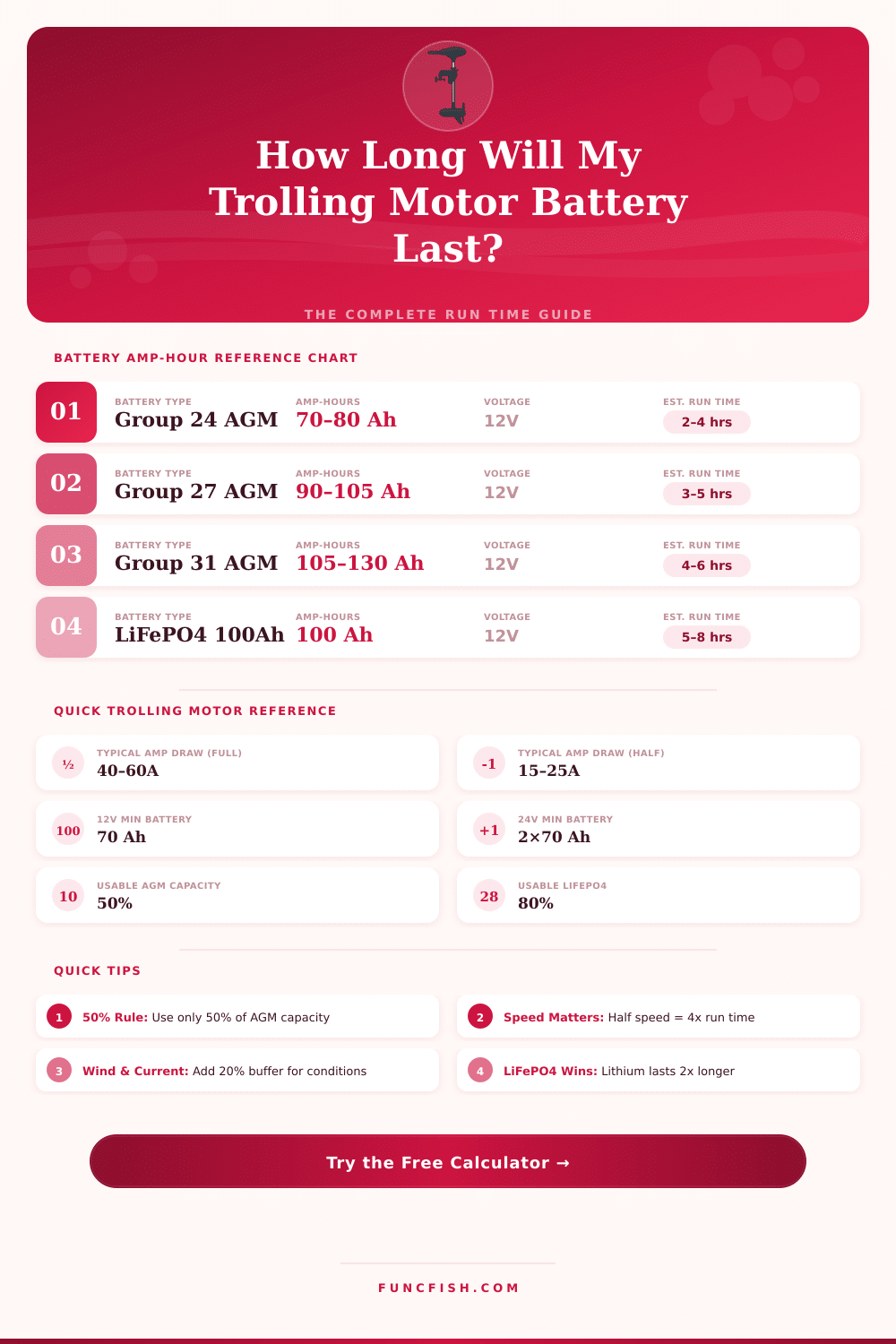
Count how many hours will last the trolling motor comes down to a pretty simple equation. One takes the amp-hour capacity of the battery and divides it by the amp draw of the motor. Like this one gets rough run time in hours.
For instance if the battery has 100 amp-hours and the motor draws 20 amps, result is around 5 hours. Really simple math.
How Long Will a Trolling Motor Run
In real life the results always differ a bit. Such math does not consider things like wind, water resistance or weight of the boat. On a calm day without wind, the run time can stretch nicely.
Fighting waves and strong breeze however drains the battery much more quickly. In one case, a 50-pound trolling motor on a 16-foot boat working at 50% power gave around 3 hours from a 100 amp-hour AGM battery on a good day. On a bad weather day it lasted less.
Running at full speed drains the battery energy very quickly. A 55-pound trolling motor that draws 50 amps from a 100 amp-hour battery gives around 2 hours at full speed. Similarly, a 24-volt 80-pound trolling motor at top speed with a 100 amp-hour battery gave also around 2 hours of run time.
Even so nobody really trolls at full speed the hole time. Running at half or third of the power can stretch it to 6 to 8 hours from one charge.
The age of the battery plays a role too. A Group 27 deep-cycle battery with a 55-pound 12-volt trolling motor can last a whole day of fishing, but after 4 to 5 years it starts to fail early. Removing the old battery and replacing it can stretch the run time a lot.
Lithium batteries offer an option. They allow you to use a bigger part of the rated capacity. A 100 amp-hour lithium battery, drawing 50 amps at full speed, lasts around two hours, but you can pull more useful energy than from lead-acid types.
Pro testing shows that a 24-volt 54 amp-hour lithium pack, powering a 24-volt 80-pound trolling motor, lasted 14 hours in a tournament setting on a calm lake.
To avoid draining the batteries too deep, you must be careful. One method is to consider 60% of the planned run time as a safe guess. Bigger amp-hour batteries do not boost the push, but they stretch the access to power.
Features like the Digital Maximizer from Minn Kota use pulse-width control to run the motor better, promising up to five times longer run time compared to standard 5-speed switches. Choosing a 24-volt system instead of 12-volt also helps tostretch the time on the water.