🐟 Trolling Depth Calculator
Calculate exactly how deep your lure is running based on line type, amount out, trolling speed & diver/weight setup
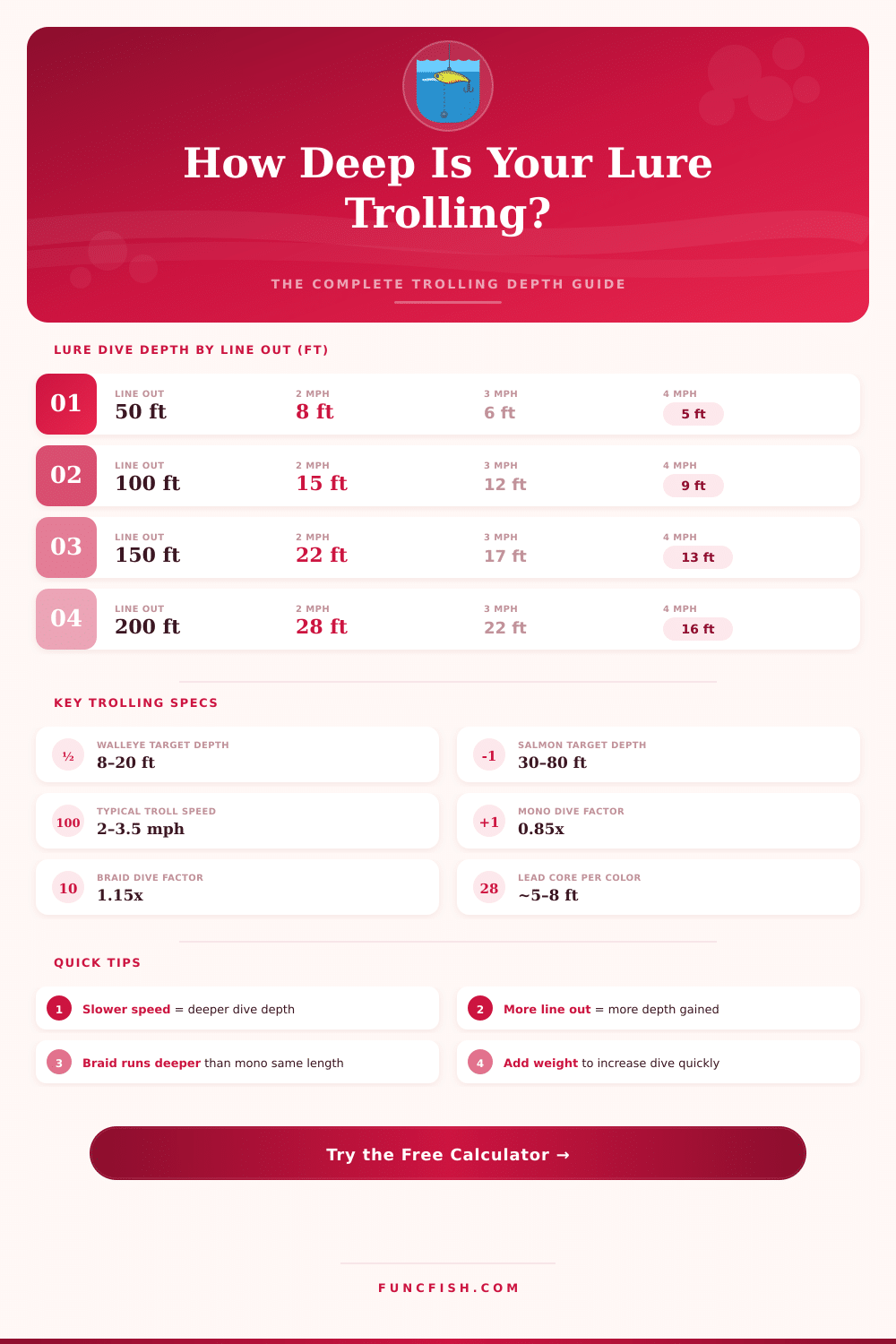
| Line Out | 2.0 mph | 2.5 mph | 3.0 mph | 3.5 mph | 4.0 mph |
|---|---|---|---|---|---|
| 50 ft (15.2 m) | 7 ft | 6 ft | 5 ft | 4.5 ft | 4 ft |
| 75 ft (22.9 m) | 11 ft | 9 ft | 8 ft | 7 ft | 6 ft |
| 100 ft (30.5 m) | 15 ft | 13 ft | 11 ft | 9 ft | 8 ft |
| 150 ft (45.7 m) | 22 ft | 19 ft | 16 ft | 14 ft | 12 ft |
| 200 ft (61 m) | 29 ft | 25 ft | 21 ft | 18 ft | 15 ft |
| 250 ft (76.2 m) | 35 ft | 30 ft | 26 ft | 22 ft | 18 ft |
| Species | Target Depth | Target Depth (m) | Troll Speed | Recommended Line |
|---|---|---|---|---|
| Walleye | 8–22 ft | 2.4–6.7 m | 1.5–2.5 mph | 10–14 lb mono |
| Chinook Salmon | 40–120 ft | 12–36.6 m | 2.0–3.0 mph | 20–30 lb mono/braid |
| Coho Salmon | 20–60 ft | 6–18.3 m | 2.5–3.5 mph | 15–20 lb mono |
| Rainbow Trout | 10–30 ft | 3–9.1 m | 1.5–2.5 mph | 8–12 lb mono/fluoro |
| Lake Trout | 50–150 ft | 15–45.7 m | 2.0–3.0 mph | Lead core / copper |
| Striped Bass | 20–50 ft | 6–15.2 m | 3.0–5.0 mph | 20–40 lb braid |
| Kokanee | 20–50 ft | 6–15.2 m | 1.0–1.8 mph | 6–10 lb mono |
| Muskie / Pike | 8–25 ft | 2.4–7.6 m | 3.0–6.0 mph | 65–80 lb braid |
| Largemouth Bass | 5–20 ft | 1.5–6 m | 2.0–4.0 mph | 10–17 lb fluoro |
| Mahi-Mahi | 0–10 ft | 0–3 m | 5.0–9.0 mph | 20–30 lb mono |
| Colors Out | Line Out (ft) | 2.0 mph Depth | 2.5 mph Depth | 3.0 mph Depth |
|---|---|---|---|---|
| 1 color | 27 ft | 5 ft | 4 ft | 3 ft |
| 2 colors | 54 ft | 8 ft | 7 ft | 6 ft |
| 3 colors | 81 ft | 13 ft | 11 ft | 9 ft |
| 4 colors | 108 ft | 18 ft | 15 ft | 13 ft |
| 5 colors | 135 ft | 24 ft | 20 ft | 17 ft |
| 6 colors | 162 ft | 30 ft | 25 ft | 21 ft |
| 7 colors | 189 ft | 36 ft | 30 ft | 25 ft |
| 8 colors | 216 ft | 42 ft | 35 ft | 29 ft |
| Added Weight | Added Weight (g) | Depth Gained | Best Use |
|---|---|---|---|
| 0.5 oz | 14 g | +2–3 ft | Light snap weight, trout |
| 1 oz | 28 g | +4–5 ft | Standard crankbait boost |
| 2 oz | 57 g | +7–9 ft | Walleye, bass deep |
| 3 oz | 85 g | +11–13 ft | Salmon, trout |
| 4 oz | 113 g | +14–17 ft | Deep trolling, lake trout |
| 6 oz | 170 g | +20–24 ft | Heavy deep rigs |
| 8 oz | 227 g | +26–30 ft | Great Lakes salmon deep |
Trolling depth is simply how deep your lure sits in the water when you drag it behind your motor boat. The secret for catching fish while trolling comes down to one thing: get the lure down where the fish actually are. It seems easy but finding the right depth is more important than most anglers assume, and luckily there are some reliable ways to do that.
Many believe that you can count it using simple high school geometry, measure the total line length and the angle where it hits the water, and boom, you know the depth. Sounds logical, right? Problem is that the line during trolling almost never stays straight.
How to Find the Right Trolling Depth
Add weight to go deeper and all that math faials. Even with weights the depth does not grow a lot, and simply letting out more line helps less than you hope.
Here is a formula that works quite well: at around 30 degrees the line depth is around half of what your counter shows. If it reads 44 feet with a 30-degree angle, the lure probably sits around 22 feet under the surface. Dump every formula however if you fish in an area full of people and other boats.
Practical tactics help more than pure calculations. One method is cast the rig to a certain distance, then troll slowly up a shelf or ridge until you feel it hit the bottom. Mark that depth and reel in before it snags.
Another way is set a fixed line amount at a steady speed, then find a spot with a flat or slope on your fishfinder to see what happens.
Here is the kicker though, current messes everything up. Most people overlook it. The speed in your calculations is not the GPS speed; it is the real move of your lure through the water.
In a river or sea add the flow to your GPS speed for the actual speed.
Currently apps allow you to choose your line type, lure, weights, divers and combine them however you want. The best use physical math that considers line diameter, length, leader, trolling weight, your speed, lure weight and size to count the trolling depth. They even include water resistance and how different lures and lines sink.
Want to go deeper? Add sinking aids.
So here is Precision Trolling Data, a company that catalogs exactly how deep popular crankbaits, diving planers and sinking lines actually reach. Lead core line gives around 5 feet for 30 feet let out. Crankbaits like Reef Runners reach 30 feet without weights, and Dipsy Divers?
Those can go until 100 feet according to size and howyou have them set.