⛵ Boat Propeller Efficiency Calculator
Calculate prop slip, thrust, efficiency, and theoretical vs. actual speed for any boat and engine combination
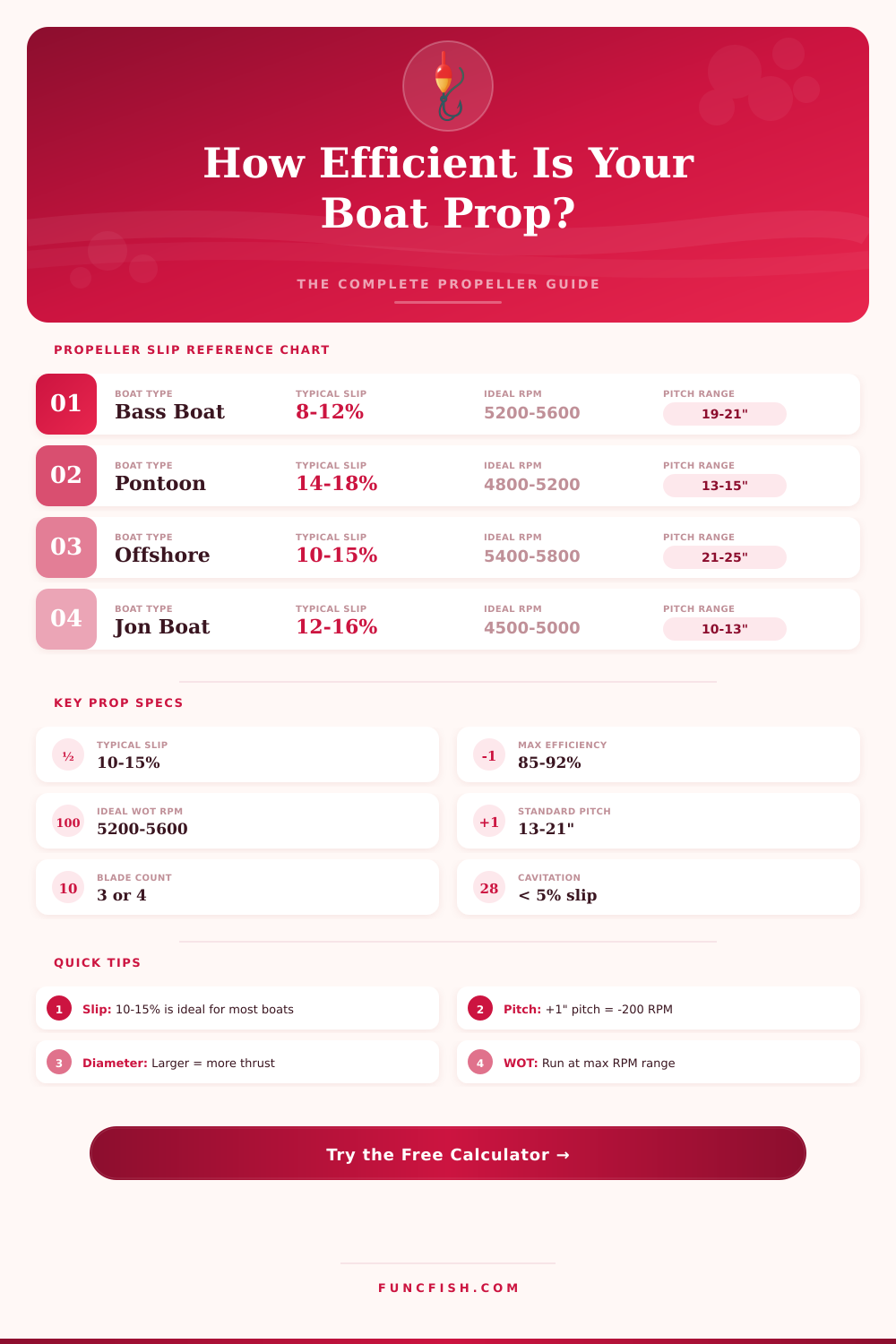
| Boat Type | Typical Slip % | Ideal WOT RPM | Pitch Range (in) | Pitch Range (cm) |
|---|---|---|---|---|
| Bass Boat | 8–12% | 5,200–5,600 | 19–21" | 48–53 cm |
| Pontoon | 14–18% | 4,800–5,200 | 13–15" | 33–38 cm |
| Offshore Fishing | 10–15% | 5,400–5,800 | 21–25" | 53–64 cm |
| Jon Boat | 12–16% | 4,500–5,000 | 10–13" | 25–33 cm |
| Ski / Wake | 9–13% | 5,000–5,400 | 18–21" | 46–53 cm |
| Walleye | 10–14% | 4,800–5,200 | 15–19" | 38–48 cm |
| Center Console | 10–14% | 5,200–5,600 | 19–23" | 48–58 cm |
| Cabin Cruiser | 13–18% | 4,800–5,400 | 22–26" | 56–66 cm |
| Blades | Top Speed Impact | Hole Shot | Vibration | Best Use |
|---|---|---|---|---|
| 2 Blade | +3–5% speed | Poor | High | Light boats, speed focus |
| 3 Blade | Baseline | Good | Medium | All-around standard use |
| 4 Blade | –1–2% speed | Excellent | Low | Heavy loads, watersports |
| 5 Blade | –2–3% speed | Excellent | Very Low | Offshore, rough water |
| 6 Blade | –3–4% speed | Superior | Minimal | Commercial, large vessels |
| Material | Weight | Corrosion Resistance | Flex (Cupping) | Durability |
|---|---|---|---|---|
| Aluminum Alloy | Light | Good | Moderate | Medium |
| Stainless Steel | Heavy | Excellent | Very Low | Very High |
| Nibral (NiBrAl) | Medium-Heavy | Excellent | Low | High |
| Composite/Plastic | Very Light | Excellent | High | Low |
| Bronze | Heavy | Very Good | Low | High |
| Cupronickel | Medium-Heavy | Excellent | Low | High |
| Titanium | Medium | Excellent | Very Low | Very High |
| Carbon Fiber | Very Light | Excellent | Very Low | High |
Imagine you row a boat and every stroke of the paddle pushes it forward with smooth, steady force. That’s efficiency in action. Now think about half of that energy that just splashes and churns the water without actually moving the boat anywhere (that’s wasted energy).
The efficiency of propellers basically comes down to that same idea.
How Propeller Size and Shape Change Boat Efficiency
On many cruising boats, whether they run on engine or sail, the best chance to improve the efficiency of the power doesn’t come from strange upgrades. It comes from choosing the right size of the propeller and getting the right range of RPM. A propeller is probably the most important technical part on any fishing ship.
Its design directly affects how much fuel you burn. Actually, bad choice of propeller is the main reason that boats waste so much energy.
Here’s why propellers work well: they constantly push water backwards while they spin, with almost no waste in the mechanism. In perfect conditions without slipping, every inch of the pitch, multiplied by every revolution, should move the boat exactly one inch forward. So if your propeller spins once with a 22-inch pitch at 100% efficiency, it should move you about 22 inches
The hard part is that only around two thirds of the engine power actually turns into push that moves the boat. Because boats spend most of their time cruising at one same speed (almost 90% of their use), you optimize the propellers for that perfect spot. They are less good for everything else.
The relation between speed and propeller is very important. High speeds go best with small propellers, while slow ships like big ones. A fast boat running at high speed needs a small propeller.
For a slower boat you would want big diameter with high ratio of blade to revolutions at low RPM. Also the number of blades matters, it depends on the size of the boat, its shape and how itself actually goes.
Theoretically the most efficient propeller has straight blades with high ratio of area. But those blades are too thin and fragile in real water. They break easily and stall at low speeds.
Short, angled blades are much tougher against weeds and garbage without breaking. They create a vortex that hurts efficiency, but that vortex helps against stalling. That compromise makes the propeller quite good through various situations.
Propeller boats beat jet boats on efficiency; we talk about 30% better, whether or not. Jets have advantage at very high speeds, around 30 knots and more, because rudders and propellershafts create drag at those speeds. Jet boats trade raw efficiency for better handling and skill in shallow water without problems.
New models like Sharrow looped propeller promise around 30% more efficiency than usual. At cruise they give approximately 15% better than normal, but in rough conditions they reach 40% better fuel economy. Even so, same benefits can come simply from well chosen standard propeller originally.