⚓ Prop Pitch Calculator
Find the ideal propeller pitch for your boat engine, speed, and RPM target
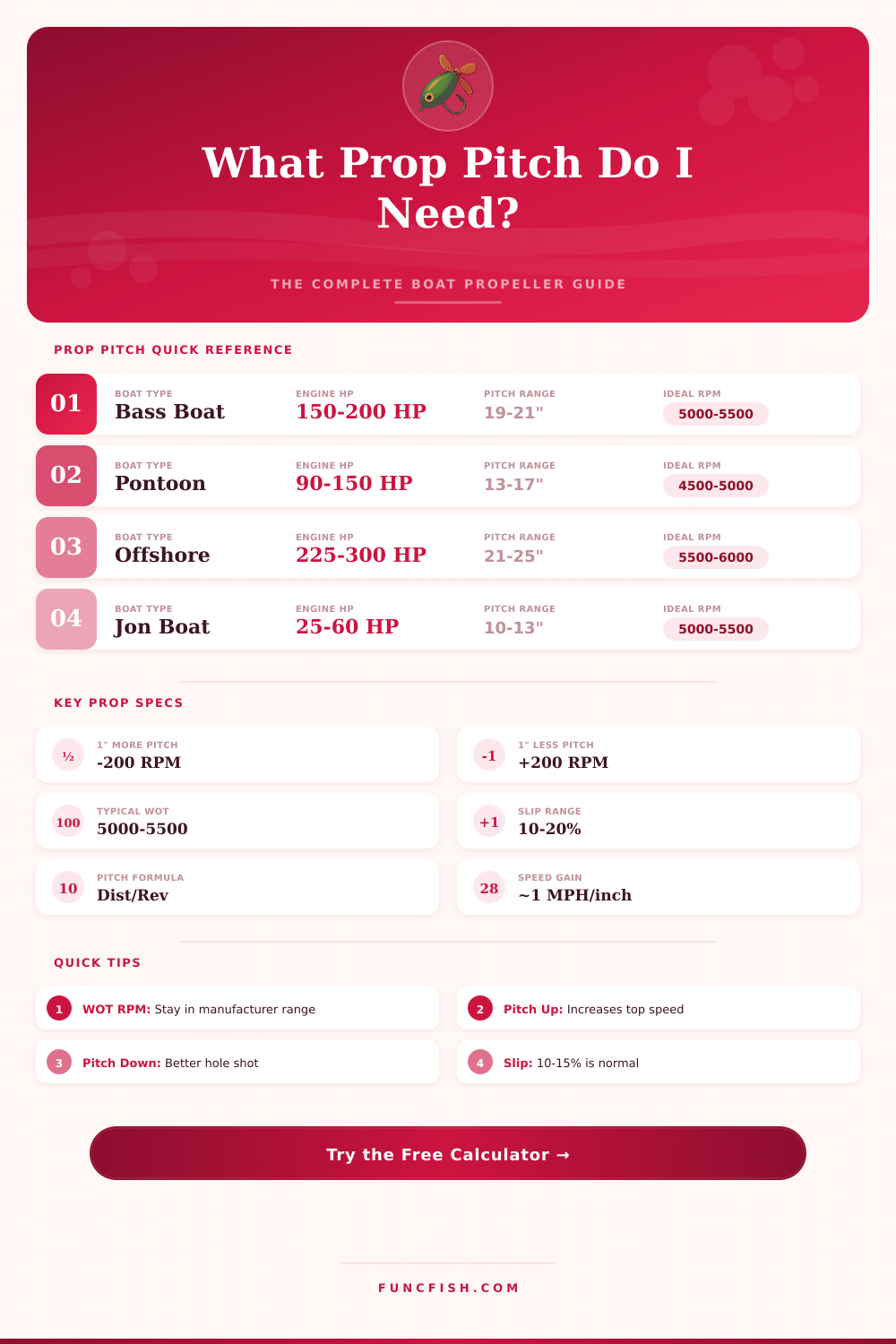
| Boat Type | Engine HP Range | Recommended Pitch (in) | Recommended Pitch (cm) | Typical WOT RPM | Blades |
|---|---|---|---|---|---|
| Bass Boat | 150–225 HP | 19–23" | 48–58 cm | 5,000–5,500 | 3–4 |
| Pontoon | 60–150 HP | 13–17" | 33–43 cm | 4,500–5,200 | 3–4 |
| Offshore / Sport | 200–400 HP | 21–27" | 53–69 cm | 5,200–6,000 | 3–5 |
| Jon Boat | 10–60 HP | 9–13" | 23–33 cm | 4,500–5,500 | 2–3 |
| Center Console | 115–350 HP | 17–25" | 43–64 cm | 5,000–5,800 | 3–4 |
| Ski / Wake Sport | 300–600 HP | 13–17" | 33–43 cm | 4,200–4,800 | 4 |
| Walleye / Fishing | 75–175 HP | 17–21" | 43–53 cm | 5,000–5,500 | 3 |
| Kayak Motor | 2.5–10 HP | 7–10" | 18–25 cm | 4,000–5,500 | 2–3 |
| Tow Boat | 300–600 HP | 14–18" | 36–46 cm | 4,400–5,000 | 4–5 |
| Wake Boat | 300–600 HP | 14–18" | 36–46 cm | 4,200–4,800 | 4 |
| Engine Brand / Type | Common Gear Ratios | HP Range | Notes |
|---|---|---|---|
| Yamaha Outboard | 1.75, 1.86, 2.00 | 25–425 HP | 1.86 common on mid-range 4-stroke |
| Mercury Outboard | 1.75, 1.87, 2.08 | 15–400 HP | 1.87 standard on many V6 motors |
| Evinrude E-TEC | 1.86, 2.00 | 25–300 HP | 2.0 on high-torque models |
| Honda Outboard | 1.75, 2.08 | 2.3–250 HP | 2.08 on smaller displacement |
| Suzuki Outboard | 1.85, 2.0 | 2.5–350 HP | 1.85 on DF200-300 series |
| Inboard / Sterndrive | 1.47, 1.50, 1.72 | 175–600 HP | Lower ratios common; check manual |
| Small Kicker | 2.08, 2.15 | 2.5–25 HP | Higher ratio for torque |
| Condition / Hull Type | Typical Slip % | Notes |
|---|---|---|
| Performance Planing Hull (SS prop) | 8–12% | Optimal efficiency range |
| Standard Planing Hull (Aluminum) | 12–18% | Most recreational boats |
| Pontoon / Flat Bottom | 15–22% | Higher drag surfaces |
| Displacement Hull | 25–40% | By design, not a fault |
| Heavy Load / Towing | 20–30% | Prop slip increases under load |
| Small Motor / Kayak | 18–28% | Smaller props less efficient |
| Racing / High-Perf Hull | 5–9% | Surface-piercing props possible |
Prop pitch shows how much distance the screw would push forward during one whole revolution if it moved through a soft solid. Think about a screw that you turn in wood, or a corkscrew in a wine bottle cork. Usually you measure it in inches.
Like this prop marked 14 x 19 has 14-inch diameter and 19-inch pitch, so it would push 19 inches with every revolution 15-inch pitch gives 15 inches with rotation, while 22-inch pitch pushes 22 inches.
What Prop Pitch Is and How It Affects Speed
A propeller is made up of two or more blades that twist around a shaft and create force for boats or airplanes. Several terms describe its attributes, for instance diameter, pitch and the relation of disc area. The diameter is simply the size of the circle that the blade tips make.
The differense between the theoretical distance of prop and the real way is called slip or prop slip. For 50-inch pitch theoretically one revolution would give 50 inches forward. Reality however shows a bit shorter distance.
Little pitch helps hole-shot, so stronger start from a standstill. But it costs maximum speed. Big pitch increases the speed, but lowers the boost.
Fast boats often use little props, while slow or heavy planning boats require bigger.
Long pitch helps to reach high cruise speed in middle RPM. Too high pitch however stops the engine reaching its maximum RPM range, so the top pace actually sinks. Low or flat pitch gives fast boost.
Excessive RPM of flat prop can cause vibration, that maybe breaks it or even destroy the engine. Similar to run of F1-car only in first gear.
Variable pitch prop allows you to change the setting. For good hole-shot you want little pitch, because it lets it twist quickly and push strongly. During cruise, more pitch takes bigger bites of air in low RPM.
During speed growth, you must change the blade angle for good angle of attack, which lowers RPM, fuel consumption and wear of engine.
General rule says that one degree of pitch change matches around 250 RPM change for many engines. Add degree and RPM sinks by 250, drop and it grows. Ideal compromise is prop that reaches the maximum continuous RPM in full throttle.
Good starting point is basic aluminum 3-blade prop, later you measure maximum RPM and speed for baseline.