📡 Sonar Beam Width Calculator
Calculate transducer cone coverage, bottom diameter, and beam footprint for any depth and frequency
| Frequency | Typical Beam Angle | Cone Diam @ 20ft (6m) | Cone Diam @ 50ft (15m) | Best Application |
|---|---|---|---|---|
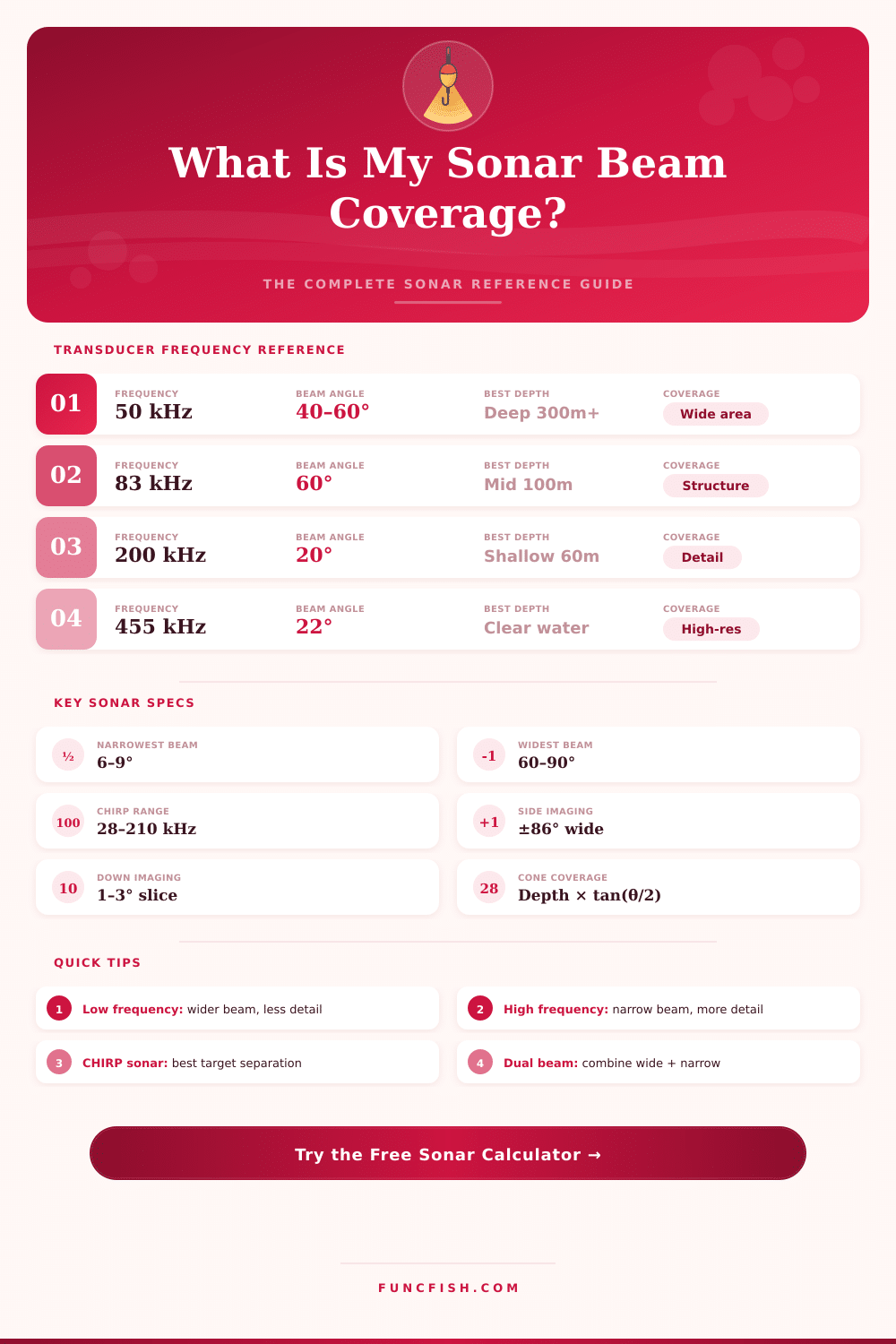
| 28–50 kHz | 45°–60° | 16.6–23.1 ft (5–7 m) | 41.4–57.7 ft (12.6–17.6 m) | Deep offshore, structure search |
| 83 kHz | 60° | 23.1 ft (7 m) | 57.7 ft (17.6 m) | Wide area coverage, shallow freshwater |
| 200 kHz | 20° | 7.3 ft (2.2 m) | 18.2 ft (5.5 m) | Standard freshwater, detail, bottom hardness |
| 455 kHz | 22° | 8.0 ft (2.4 m) | 20.1 ft (6.1 m) | Side imaging, structure detail |
| 800 kHz | 9° | 3.2 ft (0.97 m) | 7.9 ft (2.4 m) | Down imaging, precise bottom reading |
| 1 MHz+ | 6° | 2.1 ft (0.64 m) | 5.2 ft (1.6 m) | Very shallow, ultra-high definition |
| Target Species | Typical Depth | Recommended Freq | Beam Angle | Sonar Mode |
|---|---|---|---|---|
| Largemouth Bass | 5–30 ft (1.5–9 m) | 200 kHz | 20° | Standard / CHIRP |
| Walleye | 10–60 ft (3–18 m) | 83 / 200 kHz | 20°–60° | Dual beam |
| Crappie / Panfish | 5–25 ft (1.5–7.6 m) | 83 kHz | 60° | Wide beam |
| Catfish | 10–40 ft (3–12 m) | 83 / 200 kHz | 60° | Wide beam, bottom mode |
| Trout (Lake) | 20–100 ft (6–30 m) | 200 kHz / CHIRP | 12°–20° | CHIRP narrow |
| Striped Bass | 10–80 ft (3–24 m) | 455 kHz | 22° | Side / Down Imaging |
| Northern Pike | 5–20 ft (1.5–6 m) | 200 kHz | 20° | Standard, weeds focus |
| Offshore Tuna | 100–500 ft (30–150 m) | 50 kHz | 45° | Low freq, wide cone |
| Ice Fishing — All | 5–50 ft (1.5–15 m) | 200 / 800 kHz | 9°–20° | Narrow, real-time |
| Depth | 20° Beam Diam | 45° Beam Diam | 60° Beam Diam | Coverage Area (20°) |
|---|---|---|---|---|
| 10 ft (3 m) | 3.5 ft (1.07 m) | 8.3 ft (2.5 m) | 11.5 ft (3.5 m) | 9.8 ft² (0.91 m²) |
| 20 ft (6.1 m) | 7.1 ft (2.16 m) | 16.6 ft (5.1 m) | 23.1 ft (7.0 m) | 39.2 ft² (3.64 m²) |
| 40 ft (12.2 m) | 14.1 ft (4.3 m) | 33.1 ft (10.1 m) | 46.2 ft (14.1 m) | 157 ft² (14.6 m²) |
| 60 ft (18.3 m) | 21.2 ft (6.5 m) | 49.7 ft (15.1 m) | 69.3 ft (21.1 m) | 353 ft² (32.8 m²) |
| 100 ft (30.5 m) | 35.3 ft (10.7 m) | 82.8 ft (25.2 m) | 115.5 ft (35.2 m) | 979 ft² (90.9 m²) |
| 200 ft (61 m) | 70.5 ft (21.5 m) | 165.7 ft (50.5 m) | 231 ft (70.4 m) | 3,904 ft² (362.7 m²) |
The beam width of the sonar genuinely matters when you are on the water with a fish finder or depth sounder, although it commonly confuses people. The angle of the beam strongly affects how your depth sounder works… More than simply the area that it covers.
Most single-beam sounders have between 10 and 30 degrees for the beam width, and the broader ones get the name “broad beam“.
How Beam Width Affects Your Fish Finder
There is a strong tie between the beam width and the frequency of the transducer, that it is possible not to ignore. You cannot talk about beam angles without mentioning the frequency, because they are closely tied. With lower frequency the wavelength gets longer, which makes the beam angle broader.
This is one of two main factors that determines how far the beam spreads in your fish finder. The second is the size of the transducer, a bigger diameter gives a narrower beam. So it is possible not to simply take any transducer at a certain frequency and change it to any wanted beam width.
You need a balance between the frequency you use and the actual design of the transducer itself.
In traditional sonar systems I noticed that: at low frequencies, like 50 kHz or 83 kHz, the beam width would match roughly your water depth. So you cover a bigger area below, but lose detail in the image. At 200 kHz on the other hand you get crystal clear detail.
The problem comes with it: the beam now is very narrow, so it only reaches a small zone under the boat. Also it fails at about 200 feet depth, so give or take.
In shallow water shine the broad cones. Deeper water? Here helps narrow cone width.
If you want to exactly find where fishes are, a narrow beam is better, because it does not spread itself that much. One quirk that matters sometimes: some narrow cones miss objects at the surface.
The sent ultrasound can also spread depending on the amplitude. Modern fish finders use digital signal processing to lower power and gain, what keeps the beam width tight for your transducer.
Double beam is a practical solution, you have clear pictures of the bottom and structures by means of a narrow beam, plus broad around 60 degrees, that looks for fishes. Fish that move through the whole cone show full arches. Partial passage gives a half arch or thick lines on the screen.
If everything stays still, a direct line appears. The trouble? There does not exist a simple way to measure the precise beam width during fishing, what limits the accuracy.
Choosing the right beam width depends on several factors that affect data collection and image quality.