🐟 Fish Von Bertalanffy Growth Calculator
Predict fish length and age using the Von Bertalanffy Growth Function (VBGF) — the gold standard in fisheries science
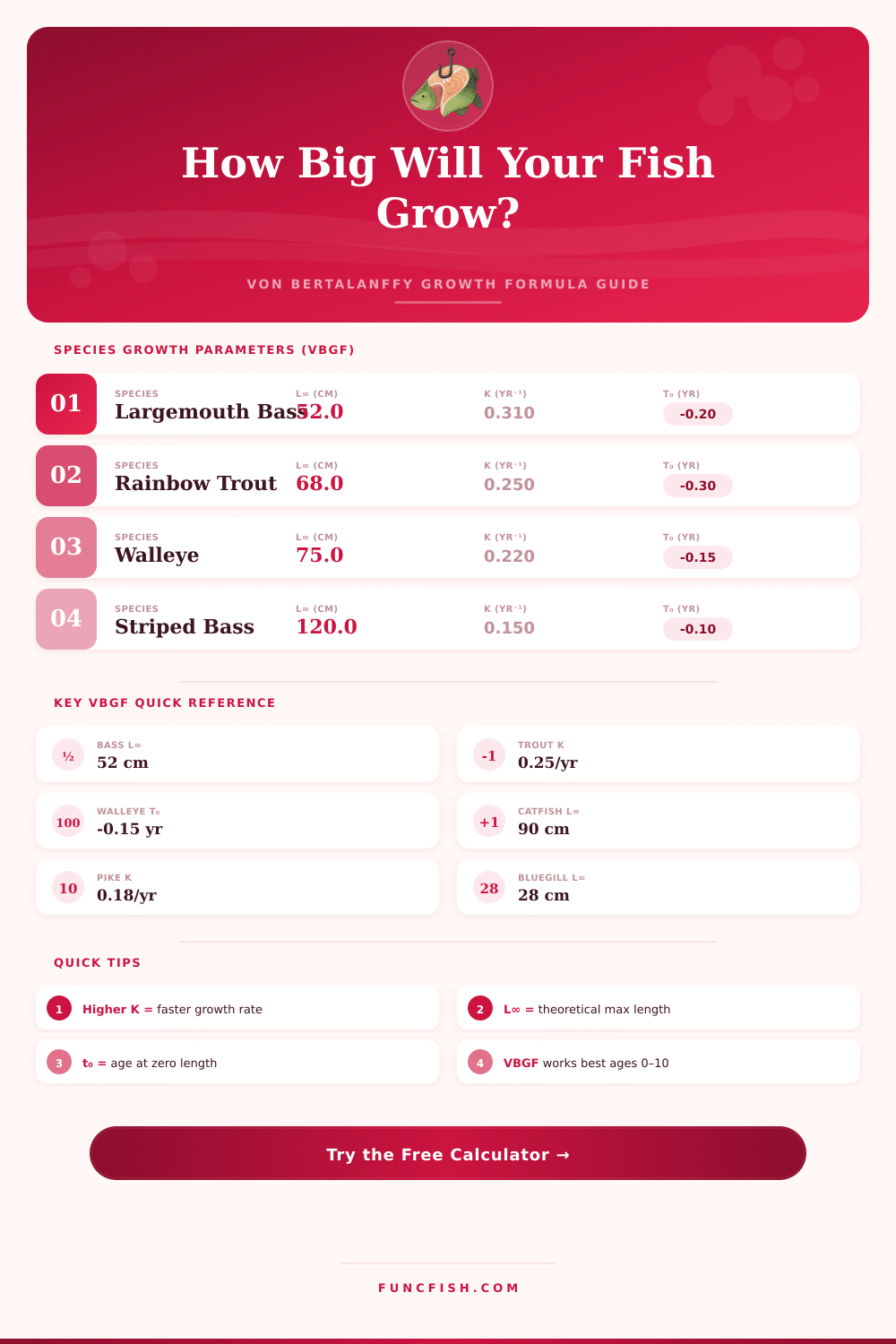
| Species | L∞ (cm) | L∞ (in) | K (yr⁻¹) | t₀ (yr) | Max Age (yr) | Habitat |
|---|---|---|---|---|---|---|
| Largemouth Bass | 52.0 | 20.5 | 0.310 | -0.20 | 16 | Warm lake/river |
| Smallmouth Bass | 48.0 | 18.9 | 0.270 | -0.25 | 18 | Cool river/lake |
| Rainbow Trout | 68.0 | 26.8 | 0.250 | -0.30 | 11 | Cold stream/lake |
| Brook Trout | 42.0 | 16.5 | 0.320 | -0.18 | 9 | Cold stream |
| Walleye | 75.0 | 29.5 | 0.220 | -0.15 | 29 | Cool lake/river |
| Northern Pike | 110.0 | 43.3 | 0.180 | -0.12 | 25 | Cool lake |
| Channel Catfish | 90.0 | 35.4 | 0.160 | -0.10 | 40 | Warm river |
| Bluegill | 28.0 | 11.0 | 0.380 | -0.22 | 11 | Warm lake |
| Chinook Salmon | 120.0 | 47.2 | 0.150 | -0.10 | 7 | Cold ocean/river |
| Striped Bass | 120.0 | 47.2 | 0.150 | -0.10 | 30 | Estuary/ocean |
| Species | Age 1 | Age 2 | Age 3 | Age 5 | Age 8 | Age 10 |
|---|---|---|---|---|---|---|
| Largemouth Bass | 13.6 cm (5.4 in) | 23.1 cm (9.1 in) | 30.5 cm (12.0 in) | 41.1 cm (16.2 in) | 48.1 cm (18.9 in) | 50.4 cm (19.8 in) |
| Rainbow Trout | 15.2 cm (6.0 in) | 27.2 cm (10.7 in) | 37.2 cm (14.6 in) | 52.3 cm (20.6 in) | 62.5 cm (24.6 in) | 65.6 cm (25.8 in) |
| Walleye | 16.8 cm (6.6 in) | 30.5 cm (12.0 in) | 41.8 cm (16.5 in) | 58.5 cm (23.0 in) | 69.4 cm (27.3 in) | 72.9 cm (28.7 in) |
| Northern Pike | 24.8 cm (9.8 in) | 45.7 cm (18.0 in) | 63.0 cm (24.8 in) | 89.3 cm (35.2 in) | 104.2 cm (41.0 in) | 108.3 cm (42.6 in) |
| Bluegill | 7.3 cm (2.9 in) | 13.4 cm (5.3 in) | 18.4 cm (7.2 in) | 25.4 cm (10.0 in) | 26.9 cm (10.6 in) | 27.5 cm (10.8 in) |
| Species | Coefficient a | Exponent b | 30 cm Weight | 50 cm Weight | Weight Method |
|---|---|---|---|---|---|
| Largemouth Bass | 0.00001016 | 3.085 | 0.31 kg (0.68 lb) | 1.47 kg (3.24 lb) | W = a × L^b |
| Rainbow Trout | 0.00000794 | 3.106 | 0.23 kg (0.51 lb) | 1.14 kg (2.51 lb) | W = a × L^b |
| Walleye | 0.00000776 | 3.108 | 0.22 kg (0.49 lb) | 1.10 kg (2.43 lb) | W = a × L^b |
| Northern Pike | 0.00000794 | 3.094 | 0.22 kg (0.49 lb) | 1.08 kg (2.38 lb) | W = a × L^b |
| Channel Catfish | 0.00001047 | 3.059 | 0.29 kg (0.64 lb) | 1.30 kg (2.87 lb) | W = a × L^b |
| Bluegill | 0.00001698 | 3.048 | 0.45 kg (0.99 lb) | 1.97 kg (4.34 lb) | W = a × L^b |
Fish growth is a pretty interesting topic and there is much more to it than most folks think. Most fish have what is called indeterminate growth. The point is: there is no biological signal that tells them to stop growing.
Unlike humans, whose growth stops after puberty, fish with right conditions keep gaining weight and length their whole life, until they age and decline. Average goldfish from pet store reaches typical full size in two years, but because of that indeterminate growth pattern there is no maximum limit.
Why Fish Keep Growing and What Affects Their Size
Even if fish keep growing, the speed slows down with age. Whether fish becomes big depends on species, environment and other factors. Many species after a certain length get bulkier instead of longer.
Size is a good point for age, except in case of stunting becuase of bad nutrition.
Tank size has big gravity. If fish is kept in too little space, it grows stunted. The body stays little, but organs keep expanding.
That shortens the lifetime, because organs press each other and do not work normally. Fishes in little aquariums usually do not reach full size, because the water alters biological, chemical and behavioral conditions for growth. Oxygen is often lower and changes more in little volumes, which limits aerobic energy and growth potential.
Some think that fishes stop growing when they lack space. That is a myth. Creatures do not stop growing only because of tight space.
Koi from a little goldfish bowl however try to grow until it must twist in its tin. Fish do not stop growing, but less food slows the rate. Even so none should keep fish in too little aquarium, hoping they stay little.
Food quality matters a lot. High quality food gives nutrients in good balance, which helps growth. Switching between foods helps also.
Live foods like worms or daphnia feed better in rotation, because ready foods have similar cheap ingredients. Everyday food amount you must adapt for good growth. For fish farmers, a big problem is that natural maturity of reproductive organs divert energy from growth and slows itdown.