🪝 Fish Hook Size Matcher
Match the perfect hook size, style, and wire gauge to your target species and fishing technique
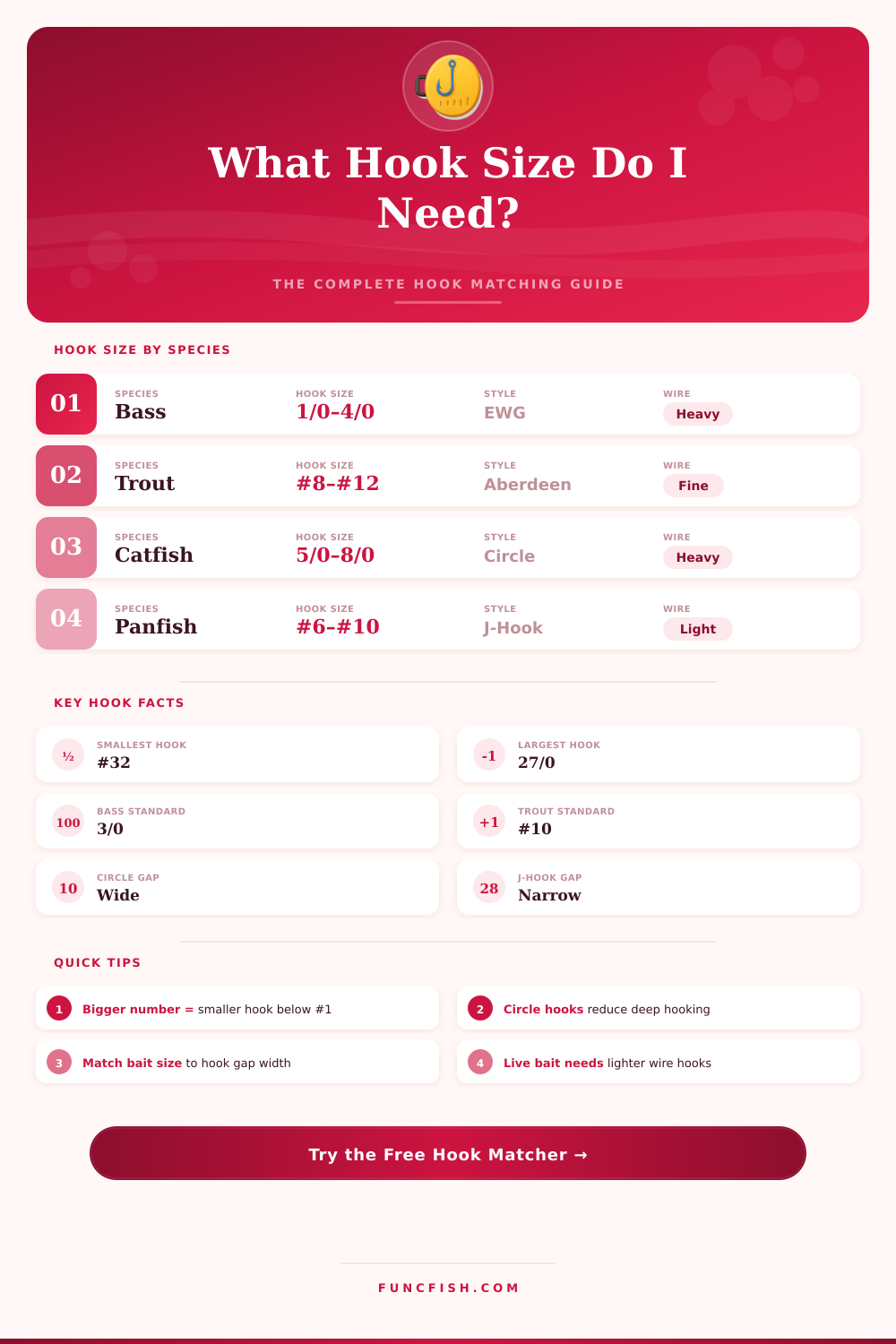
| Species | Weight Range | Rec. Hook Size | Best Style | Wire Weight |
|---|---|---|---|---|
| Largemouth Bass | 1–10 lb (0.5–4.5 kg) | 1/0–4/0 | EWG / Offset Worm | Medium–Heavy |
| Smallmouth Bass | 0.5–5 lb (0.2–2.3 kg) | #2–2/0 | EWG / Aberdeen | Medium |
| Rainbow Trout | 0.5–8 lb (0.2–3.6 kg) | #8–#12 | Aberdeen / Octopus | Fine–Light |
| Brook Trout | 0.25–3 lb (0.1–1.4 kg) | #10–#14 | Aberdeen | Fine |
| Brown Trout | 0.5–20 lb (0.2–9 kg) | #6–#10 | Aberdeen / Circle | Light–Medium |
| Channel Catfish | 1–20 lb (0.5–9 kg) | 2/0–5/0 | Circle / J-Hook | Heavy |
| Blue Catfish | 5–50 lb (2.3–22.7 kg) | 5/0–10/0 | Circle | Extra Heavy |
| Flathead Catfish | 5–60 lb (2.3–27 kg) | 5/0–8/0 | J-Hook / Circle | Extra Heavy |
| Bluegill / Panfish | 0.1–1 lb (0.05–0.5 kg) | #6–#10 | J-Hook / Aberdeen | Light–Fine |
| Crappie | 0.25–2 lb (0.1–0.9 kg) | #6–#8 | Aberdeen / Octopus | Light |
| Walleye | 1–10 lb (0.5–4.5 kg) | #4–1/0 | Octopus / J-Hook | Medium |
| Northern Pike | 2–30 lb (0.9–13.6 kg) | 3/0–6/0 | Treble / Circle | Heavy |
| Muskellunge | 5–50 lb (2.3–22.7 kg) | 6/0–10/0 | Treble / J-Hook | Extra Heavy |
| Atlantic Salmon | 5–30 lb (2.3–13.6 kg) | 2/0–4/0 | Octopus / Circle | Medium–Heavy |
| Steelhead | 3–20 lb (1.4–9 kg) | #2–2/0 | Octopus | Medium |
| Snook | 2–30 lb (0.9–13.6 kg) | 2/0–5/0 | Circle / J-Hook | Medium–Heavy |
| Redfish | 2–20 lb (0.9–9 kg) | 2/0–4/0 | Circle | Medium |
| Yellowfin Tuna | 20–200 lb (9–90 kg) | 6/0–10/0 | Circle / J-Hook | Extra Heavy |
| Mahi-Mahi | 5–50 lb (2.3–22.7 kg) | 4/0–7/0 | J-Hook / Circle | Heavy |
| Hook Size | Gap Width (in) | Gap Width (mm) | Shank Length (in) | Typical Use |
|---|---|---|---|---|
| #32 | 0.06" | 1.5 mm | 0.12" | Micro fly patterns |
| #20 | 0.1" | 2.5 mm | 0.18" | Midge / dry fly |
| #14 | 0.17" | 4.3 mm | 0.31" | Small dry fly / nymph |
| #10 | 0.22" | 5.6 mm | 0.4" | Trout / panfish fly |
| #8 | 0.27" | 6.9 mm | 0.5" | Panfish / small trout |
| #6 | 0.33" | 8.4 mm | 0.6" | Trout / crappie |
| #4 | 0.4" | 10.2 mm | 0.73" | Walleye / large trout |
| #2 | 0.48" | 12.2 mm | 0.87" | Bass / walleye |
| #1 | 0.54" | 13.7 mm | 0.98" | Bass / steelhead |
| 1/0 | 0.6" | 15.2 mm | 1.1" | Bass / snook |
| 2/0 | 0.67" | 17 mm | 1.22" | Bass / salmon |
| 3/0 | 0.75" | 19 mm | 1.35" | Bass / pike |
| 4/0 | 0.84" | 21.3 mm | 1.5" | Large bass / salmon |
| 5/0 | 0.94" | 23.9 mm | 1.67" | Catfish / redfish |
| 7/0 | 1.15" | 29.2 mm | 2.0" | Large catfish / tuna |
| 10/0 | 1.5" | 38.1 mm | 2.6" | Offshore big game |
| Style | Gap Profile | Best Application | Hookset Type | Snag Risk |
|---|---|---|---|---|
| EWG (Extra Wide Gap) | Very Wide | Soft plastics, worms | Active set | Low (weedless) |
| Aberdeen | Narrow, long shank | Live minnows, panfish | Active set | Low |
| Circle Hook | Inward-pointing | Live bait, catch & release | Passive (reel set) | Very Low |
| J-Hook (Standard) | Medium | Cut bait, worms, versatile | Active set | Medium |
| Octopus / Beak | Medium, short shank | Salmon eggs, bait, jigs | Active set | Low |
| Treble Hook | Three points | Lures, crankbaits, pike | Passive / active | High |
| Dry Fly Hook | Fine wire, up-eye | Dry fly patterns | Wrist flick | Low |
| Worm / Offset Hook | Wide, offset point | Texas rig, Carolina rig | Active set | Very Low (weedless) |
Choosing the right size of hook depends on the kind of fish that you want, and of the used bait. Usually you say that big bait needs big hook, but little bait needs little. You use little hooks for fish as panfish or trout, while bigger hooks work for species as bass or catfish.
For instance, the tiny mouths of bluegill do not allow a #10-hook. Instead, striped bass has like this big mouth that a #10-hook would seem little for it.
How to Choose the Right Hook Size
The system of hook sizes breaks into two parts. One cover little and medium hooks, from #32 to #1. The second part deals with big hooks, since 1/0 up.
At hooks without /0 count, that higher number means smaller hook… #10 are less than #2. Later, when you reach /0, everything changes they call “aught”-sizes.
Here bigger number gives bigger hook, so 1/0 is bigger than 1, 2 or 32. The range goes from the tiny #32 until 20/0 for sharks. Sizes are basic opposites of aughts: increasing number shrinks the hook, during aught-number growing expands it.
does not exist one standard for hook sizes, because they differ according to makers. Different brands have their own sizes. Even in same brand one hook style can be much more big than another with same number.
For instance, circle hook, bait holder or octopus hook has different size even under same title.
While fly fishing you measure flies according to even numbers. For trout in streams you commonly choose little fly fishing hooks. In trout flies the biggest size, that fisherman wants, is #2 for streamer or nymph.
The hook size also affect how well a natural fly looks like prey. Too big fly can seem strange and frighten careful fish. Too little fly does not stay firmly hooked during capture.
For trout a 24-inch brookie could require change to #1 or 1/0 streamer.