🐟 Walleye Out-of-Water Survival Time Calculator
Estimate safe handling time for catch & release based on water temp, air temp, and conditions
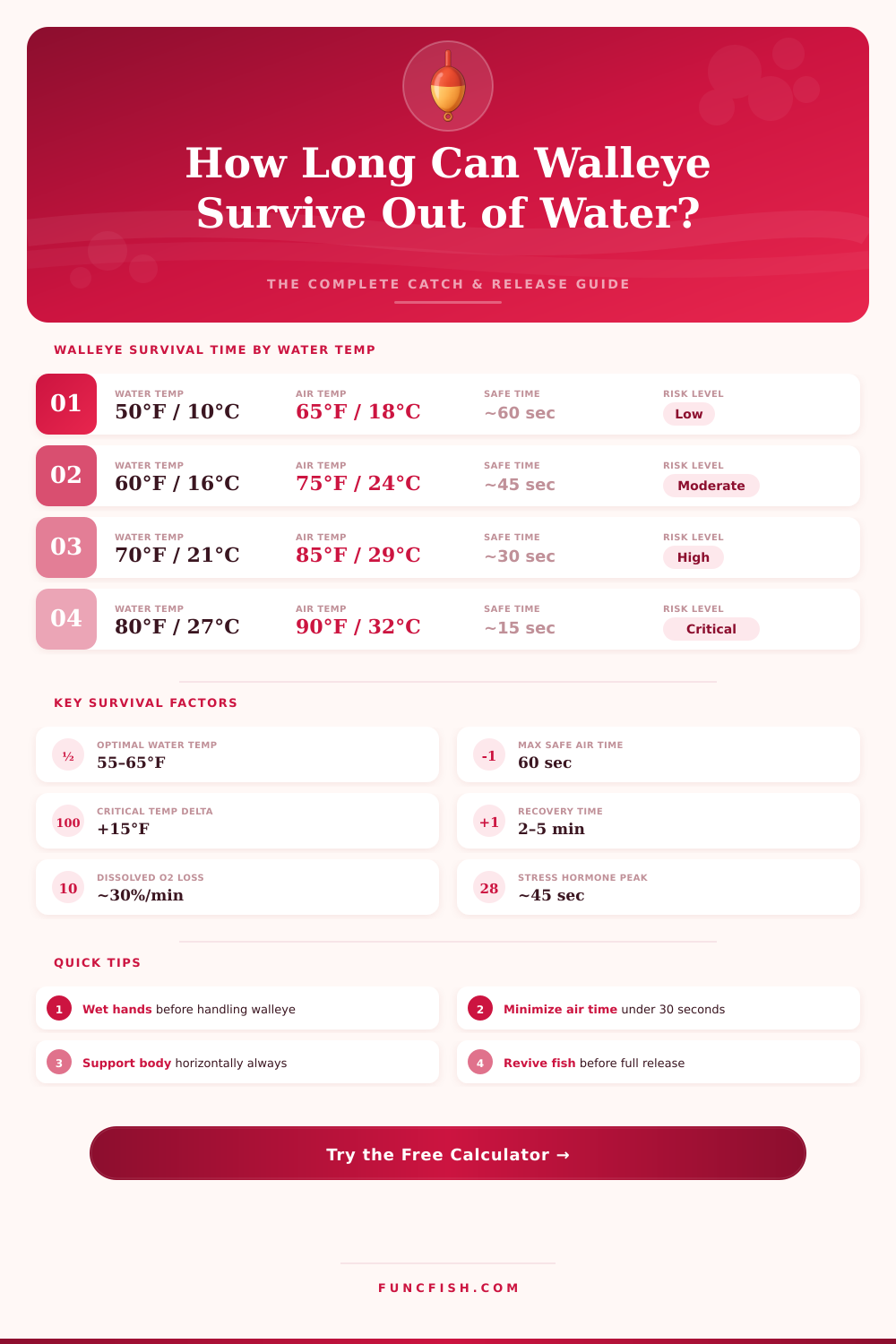
| Water Temp | Air Temp | Safe OOW Time | Risk Level | Recommended Action |
|---|---|---|---|---|
| Below 50°F / 10°C | Any | Up to 75 sec | Low | Quick photo OK |
| 50–60°F / 10–16°C | Below 70°F | 45–60 sec | Low–Moderate | Minimize handling |
| 60–65°F / 16–18°C | 65–80°F | 30–45 sec | Moderate | Wet hands, fast photo |
| 65–70°F / 18–21°C | 75–85°F | 20–30 sec | High | Skip photo if possible |
| 70–75°F / 21–24°C | 80–90°F | 10–20 sec | Very High | Immediate release |
| 75–80°F / 24–27°C | 85–95°F | 5–10 sec | Critical | Release in-water only |
| Above 80°F / 27°C | Any warm | <5 sec | Extreme | Do not remove from water |
| Holding Method | Stress Level | Time Multiplier | Scale/Gill Damage |
|---|---|---|---|
| Horizontal (full support) | Low | 1.0x (baseline) | Minimal |
| Rubber Mesh Net (wet) | Low | 1.0x (baseline) | Minimal |
| Vertical Jaw Hold (<10 sec) | Moderate | 0.85x | Moderate |
| Vertical Jaw Hold (>10 sec) | High | 0.65x | High (jaw stress) |
| Standard Nylon Net (dry) | High | 0.70x | Significant |
| No support (flopping) | Very High | 0.40x | Severe |
| Fish Size | Estimated Weight | Typical Fight Time | Recovery Time Needed |
|---|---|---|---|
| 12–15 in / 30–38 cm | 0.8–1.5 lb / 0.4–0.7 kg | 10–25 sec | 30–60 sec |
| 15–18 in / 38–46 cm | 1.5–2.5 lb / 0.7–1.1 kg | 20–40 sec | 45–90 sec |
| 18–22 in / 46–56 cm | 2.5–4.5 lb / 1.1–2.0 kg | 35–75 sec | 60–120 sec |
| 22–26 in / 56–66 cm | 4.5–7.5 lb / 2.0–3.4 kg | 60–120 sec | 90–180 sec |
| 26–30 in / 66–76 cm | 7.5–12 lb / 3.4–5.4 kg | 90–180 sec | 2–4 min |
| 30+ in / 76+ cm (Trophy) | 12+ lb / 5.4+ kg | 2–5 min | 3–8 min |
| Scenario / Factor | Modifier | Safe Time Adjustment | Notes |
|---|---|---|---|
| Ice Fishing (sub-40°F air) | +25% | +10–15 sec | Cold air helps preserve O2 |
| Direct Sunlight / Hot Air | -30% | -10–20 sec | Rapid gill desiccation |
| Windy Conditions | -15% | -5–10 sec | Accelerates drying |
| Overcast / Calm | Baseline | No adjustment | Ideal photo conditions |
| Long Fight (>90 sec) | -25% | -10–15 sec | Lactic acid buildup |
| Deep Water Catch (>30 ft) | -10% | -5 sec | Barotrauma possible |
| Tournament / Multiple Handles | -35% | -15–20 sec | Cumulative stress |
| Wet Hands / Minimal Touch | +10% | +5 sec | Preserves slime coat |
Walleye is a type of fish that requires specific conditions to survives after the walleye is removed from the water. The two factor that affect the survival of the walleye after it is removed from the water are the temperature and humidity of the water. These two factors will determine the lengths of time that the walleye can spend in the air.
While walleye can survive in the air better than other fish species like bass or pike, the temperature of the water in which the walleye was living affects the length of time that the walleye can spend in the air. If the water in which the walleye resided was cold, the walleye may be able to spend twenty minutes or more in the air before the stress to its organs results in the shutdown of those organs. However, if the temperature of the water was above twenty degrees Celsius, the length of time that the walleye could survive in the air decreased to less than two minutes.
How to Keep a Walleye Alive After You Catch It
This is due to the fact that the higher the temperature of the water, the more higher the metabolism of the walleye, and the higher the metabolism of the walleye, the more oxygen that its gills will require in order to survive. Beyond the temperature and humidity of the water, the air temperature and humidity will also affect the survival of the walleye. If the temperature of the air is higher than the water in which the walleye lived, the walleye will lose moisture in its slime coat.
The slime coat of the walleye is responsible for protect the fish from getting infected with other organisms in the water. Additionally, if the air contains wind and low humidity, the walleye will lose its slime coat quick, leading to the same risk of infection. In these instances, it is best to use a rubber net or use wet hands when handling the walleye.
Additionally, it is best to avoid placing the walleye on a dry deck or boat floor, as this will lead to the walleye losing its protective layer. Another factor in determining how the walleye should be handled is the size of the walleye. For instance, if the walleye is large (especially if the length is sixty centimeters or more), the walleye will lose moisture at a slower rate than smaller walleye.
In this case, if the walleye deeply swallows a hook, the individual should work quickly to remove the hook from the walleyes mouth. If the hook is deep within the throat of the walleye, it is best to simply cut the line to which the hook is attached rather than attempt to remove the hook from the walleye. If the walleyes esophagus is damaged from this deep hooking, bacteria can enter the body of the walleye and lead to its death.
To aid in the survival of the walleye, specific gear can be utilized when handling the fish. For example, a net with a small mesh allows the walleye to roll within the net without damaging its fins. Additionally, placing the walleye into a rubber coated bag will provide some cushioning to the walleye when the individual is transporting it.
A six-inch dehooker will allow the hook to be removed from the jaw of the walleye without having to deeply probe into the mouth of the fish. It is also important to use a thermometer to determine the temperature of the water in which the walleye lived. This will allow the individual to understand whether the time that they have to handle the walleye is a generous allowance or whether they should be frantic in their attempts to land the walleye.
Beyond the gear that can be utilized, the humidity and wind in the air can also affect the survival of the walleye. High humidity will help to keep the gills of the walleye moist, which will extend the length of time that the walleye can spend in the air. However, the wind in the air will counteract the humidity, leading to the drying of the gills of the walleye.
Because the ratio of the surface area to the volume of the walleye is different for large walleye as compared to small walleye, the large walleye will be affected more by the drying of the gills and slime coat from the wind and low humidity. Thus, the angler must consider each of these factors to ensure that the walleye can survive long enough to swim away from where it was caught.