🦀 Sand Flea Out-of-Water Survival Time Calculator
Estimate how long your sand flea bait stays alive based on temperature, humidity, container type & storage method
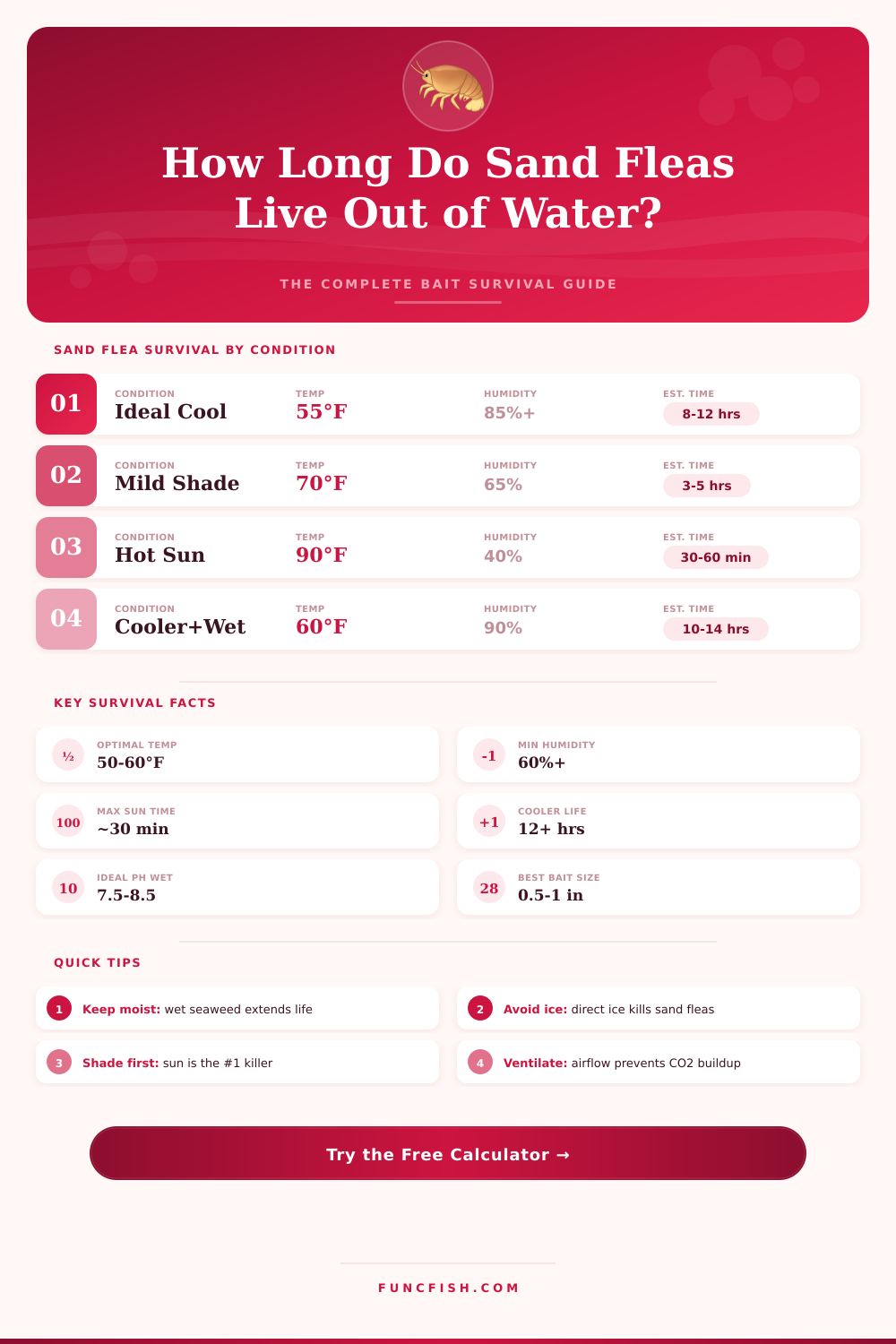
| Temp (°F) | Temp (°C) | Base Survival (Covered Bucket) | Risk Level |
|---|---|---|---|
| 40°F | 4°C | 14–18 hrs | 🟢 Very Low Stress |
| 50°F | 10°C | 10–14 hrs | 🟢 Low Stress |
| 60°F | 16°C | 7–10 hrs | 🟡 Mild Stress |
| 70°F | 21°C | 4–7 hrs | 🟡 Moderate Stress |
| 80°F | 27°C | 2–4 hrs | 🟠 High Stress |
| 90°F | 32°C | 0.5–1.5 hrs | 🔴 Critical Stress |
| 100°F+ | 38°C+ | < 30 min | 🔴 Lethal Range |
| Target Species | Preferred Flea Size | Hook Size | Bait Freshness Need |
|---|---|---|---|
| Pompano | 0.5–1 in (1.2–2.5 cm) | #1 – 1/0 | 🔴 Very High (live only) |
| Whiting / Kingfish | 0.4–0.8 in (1–2 cm) | #4 – #1 | 🟠 High (fresh preferred) |
| Sheepshead | 0.75–1.25 in (2–3 cm) | #1 – 2/0 | 🟡 Medium (recently dead OK) |
| Red Drum (Redfish) | 0.75–1.5 in (2–3.8 cm) | #2/0 – 3/0 | 🟡 Medium |
| Black Drum | 1–2 in (2.5–5 cm) | #2/0 – 4/0 | 🟢 Lower (will take dead) |
| Snook | 1–1.5 in (2.5–3.8 cm) | #1/0 – 2/0 | 🔴 Very High (live only) |
| Striped Bass | 1–2 in (2.5–5 cm) | #2/0 – 4/0 | 🟠 High |
| Cobia | 1.5–2 in (3.8–5 cm) | #3/0 – 5/0 | 🟡 Medium |
| Humidity Level | Moisture Effect | Survival Modifier | Recommendation |
|---|---|---|---|
| 90–100% | Near saturated | +35% survival time | Ideal — no added moisture needed |
| 70–89% | High humidity | +15% survival time | Good — occasional misting helps |
| 50–69% | Moderate | Baseline (0%) | Use wet seaweed or misting |
| 30–49% | Low / Dry | –20% survival time | Mist every 15–20 min required |
| < 30% | Very dry / Arid | –40% survival time | Use damp cooler or wet burlap urgently |
| Factor | Condition | Survival Time Change | Notes |
|---|---|---|---|
| Sun | Full Direct Sun | –40% | Rapid desiccation and overheating |
| Sun | Partial Shade | –15% | Significantly better than full sun |
| Sun | Full Shade | +0% | Baseline — always aim for shade |
| Sun | Indoors / Covered | +10% | Best non-cooler passive option |
| Wind | Calm (0–5 mph) | +0% | No evaporative loss bonus |
| Wind | Light (5–15 mph) | –10% | Speeds moisture loss |
| Wind | Moderate (15–25 mph) | –20% | Keep container covered tightly |
| Wind | Strong (25+ mph) | –30% | Critical — seal container or use cooler |
The mole crab and beach hopper is two types of crustacean that live near an ocean. These two type of crustaceans require constant moisture to survive. The survival of mole crabs and beach hoppers depend upon a thin layer of moisture that coats the gill and exoskeleton of the mole crabs and beach hoppers.
If you remove these crustaceans from the water, that layer of moisture will evaporate from the gills and exoskeleton of the mole crabs and beach hoppers, leading to dehydration of those creature. The dehydration of these crustaceans can happen at a rapid rate due to the heat of the sun, as well as the drying effect of the wind. Each of the different types of crustaceans, including mole crabs, beach hoppers, and landhoppers, has different level of tolerance for moisture within their species.
How to Keep Mole Crabs and Beach Hoppers Alive
For instance, mole crabs live within the swash zone of the ocean floor, and often dig burrows in the sand to construct their home. As a result, mole crabs require a constant supply of wetting to survive. Beach hoppers live within pile of seaweed, and while they are exposed to similar environments than mole crabs, they can tolerate periods of dryness.
Landhoppers live even further inland from beach hoppers homes, and, therefore, can tolerate dryness to a more greater extent than beach hoppers. Additionally, the size of the crustacean can also impact how much moisture it can hold. The larger the crustacean, the less chance of drying out due to the surface area of its body relative to the bodys volume.
Environmental factor also impact the survival of these organisms, as well. For instance, hot air will increase the rate at which the crustaceans dehydrates, as will high rates of wind. Conversely, high humidity rates will increase the survival time of mole crabs and beach hoppers, as the high humidity will counteract the evaporation of moisture from they gills and exoskeletons.
In determining the survival time of mole crabs or beach hoppers, there are a few factor that must be considered. For instance, the way in which you handle the crustaceans will have an impact upon their survival. If you handle the mole crabs and beach hoppers with wet hands or an damp net, the moisture on their gills and exoskeleton will be retained.
If, however, you use dry tools to handle these crustaceans, their exoskeletons will be abraded, leading to the drying of those species. Additionally, the substrate upon which the crustaceans are placed will have an impact upon their survival. If damp sand or seaweed is used, the crustaceans will be able to remain moist.
If, however, the crustaceans are placed upon a hot deck, they will dry out quick. Lastly, the activity of the mole crabs and beach hoppers will also have an impact upon their survival. If the crustaceans are calm, they will lose less energy then if they are thrashing about within panic.
A survival model can be used to calculate the survival window of mole crabs and beach hoppers. Within that survival window, 70% of the window should be used to handle the crustaceans, as this provide a margin of error in case any outside factors affect the survival of the species. For instance, if the water is warm and there is a high amount of wind, the survival window for mole crabs will be small.
However, if the water is cool and there is little or no wind, the survival window will be much longer. You can increase the survival time of mole crabs and beach hoppers by providing shade for the species, or by placing the crustaceans upon wet sand to prevent them from drying out. Many people make mistake when attempting to handle mole crabs or beach hoppers.
For instance, many people overestimate the toughness of beach hoppers, and do not remember that beach hoppers need damp debris to survive. Additionally, many people do not consider the activity of the mole crabs and beach hoppers, as they may think that a struggling species will survive the same as a calm organism. Therefore, because the mathematical models suggest that releasing the mole crabs and beach hoppers early will allow for the crustaceans to survive longer, you should return the species to their habitat within a wet and shade area.