🐟 Bluegill Out-of-Water Survival Time Calculator
Estimate safe handling time for bluegill based on air temperature, humidity, sun exposure & fish condition
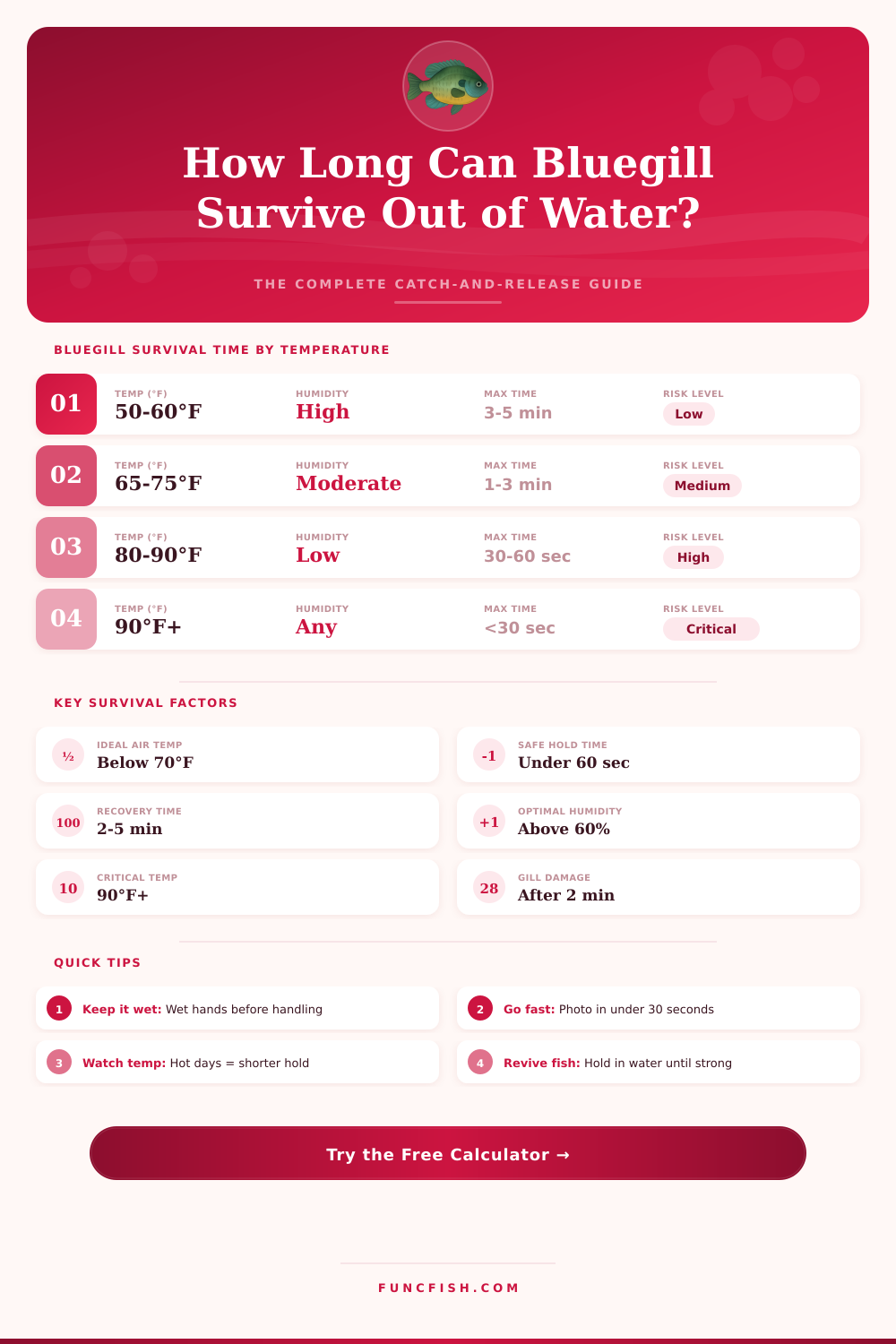
| Air Temp (°F) | Air Temp (°C) | Humidity | Max Safe Time | Risk Level |
|---|---|---|---|---|
| Below 50°F | Below 10°C | Any | 4–6 minutes | Low |
| 50–60°F | 10–15°C | High (>70%) | 3–5 minutes | Low |
| 60–70°F | 15–21°C | Moderate | 2–3 minutes | Medium |
| 70–80°F | 21–26°C | Low–Moderate | 1–2 minutes | Medium |
| 80–90°F | 26–32°C | Low | 30–60 seconds | High |
| 90–100°F | 32–38°C | Any | <30 seconds | Critical |
| Above 100°F | Above 38°C | Any | <15 seconds | Critical |
| Size Class | Length (in/cm) | Weight (oz/g) | Stress Tolerance | Rec. Max Out-of-Water |
|---|---|---|---|---|
| Fingerling | 2–4 in / 5–10 cm | 0.2–1 oz / 6–28g | Very Low | 20–30 seconds |
| Small / Juvenile | 4–6 in / 10–15 cm | 1–3 oz / 28–85g | Low | 30–45 seconds |
| Average | 6–8 in / 15–20 cm | 3–8 oz / 85–227g | Moderate | 45–90 seconds |
| Large / Slab | 8–10 in / 20–25 cm | 8–16 oz / 227–454g | Good | 60–120 seconds |
| Trophy | 10+ in / 25+ cm | 16+ oz / 454g+ | High | Up to 2 minutes |
| Handling Method | Slime Coat Protection | Stress Level Added | Time Adjustment |
|---|---|---|---|
| Wet Hands | High | Minimal (+0%) | +15% more time |
| Net Cradle (Wet) | High | Minimal (+0%) | +10% more time |
| Rubberized Gloves | Moderate | Low (+10%) | Neutral |
| Lip Grip Tool | Moderate | Moderate (+15%) | -10% less time |
| Dry Hands | Low | High (+25%) | -20% less time |
| Towel / Cloth | Very Low | Very High (+40%) | -35% less time |
Bluegill is a type of fish that can experience high levels of stress when the bluegill are removed from the water. When the bluegill is removed from the water, the fish is exposed to air, which create stress for the fish. The amount of time that the bluegill can stay out of the water depend upon a variety of environmental factors, such as the water temperature, the air temperature, the wind, and the humidity in the air.
Water temperature has an impact on the ability of the bluegill to remain out of the water due to the fact that the water temperature dictate the metabolism of the fish. When the water is cooler temperatures, such as 73°F, the metabolism of the bluegill will be more slower. A slower metabolism mean that the bluegill uses oxygen in the water at a slower rate.
How to Keep Bluegill Safe Out of the Water
At higher temperatures, such as 81°F or higher, the metabolism of the bluegill will be faster. The more faster the metabolism of the fish, the more rapidly that it utilize the oxygen from the water, creating stress for the fish. Air temperature is also a factor in the amount of time that bluegill can remain out of the water.
High temperatures in the air can dry the gills of the bluegill. Wind and low humidity also has an impact upon the fish. These factor contribute to the evaporation of the slime coat that protect the bluegill from infection.
The size of the bluegill also play a role in the amount of stress that the fish can tolerate. For instance, bluegill that are eight inches in length have more body mass then smaller bluegill. The additional body mass allow the larger fish to better endure the stress of being removed from the water.
Additionally, the way that the fish is handled also has an impact upon the survival of the fish while out of the water. Using wet hands when handling the fish will help to preserve the protective slime coat of the fish. Using dry hands will strip the protective slime coat from the bluegill.
The type of hook that you use to catch the bluegill also have an impact upon the amount of stress that the fish will experience. Using a lip hook will minimize the damage to the bluegill. A deep-swallowed treble hook will damage the bluegill internally.
Additionally, if the fish has a deep hook, you should cut the line instead of attempt to remove the hook. Cutting the line is a faster process and each second that the fish is out of the water is crucial for its survival. People tend to overestimate the amount of stress that a bluegill can take.
If the water temperature is moderate, the fish can survive thirty seconds out of the water, but a study showed that the mortality rate of the bluegill was seven percent. If the bluegill is exposed to air for one minute, the mortality rate increase. If the water is warm, the mortality rate can be twenty percent or more.
The best way to minimize the stress of the bluegill is to use rubber nets that has fine mesh. The fine mesh will not harm the fish, yet allow the water to move through the nets to the fish. Additionally, using dehookers will allow you to remove the hooks from the fish more quick.
Removing the hooks more quickly will allow the bluegill to spend less time out of the water. When releasing the bluegill, the fish should be released headfirst into shallow water. The fish should not be tossed out of the water.
Tossing the fish could cause additional damage to the fish. Additionally, ensuring that the fish is completely submerged in the water allow water to flow over the gills of the fish. However, if the water in which the fish is being released is shallow and contains less than five milligram of oxygen per liter of water, the bluegill may experience more stress.
By following these steps, however, the angler will lessen the stress that the fish experiences, and the chance of the fish surviving after being released will be increased.