🐊 Gar Out-of-Water Survival Time Calculator
Estimate how long gar can safely survive air exposure based on species, water temperature, fish size, and conditions
| Water Temp (°F) | Water Temp (°C) | Dissolved O₂ Level | Survival Multiplier | Stress Level |
|---|---|---|---|---|
| 55°F | 13°C | 10.8 mg/L | 1.4x (better) | Low |
| 60°F | 16°C | 9.8 mg/L | 1.25x | Low |
| 65°F | 18°C | 9.0 mg/L | 1.1x | Low–Mod |
| 70°F | 21°C | 8.3 mg/L | 1.0x (baseline) | Moderate |
| 75°F | 24°C | 7.7 mg/L | 0.85x | Moderate |
| 80°F | 27°C | 7.1 mg/L | 0.70x | High |
| 85°F | 29°C | 6.5 mg/L | 0.55x | Very High |
| 90°F+ | 32°C+ | <6.0 mg/L | 0.40x | Critical |
| Species | Typical Length | Typical Weight | Base Air Tolerance | Swim Bladder Use | Habitat |
|---|---|---|---|---|---|
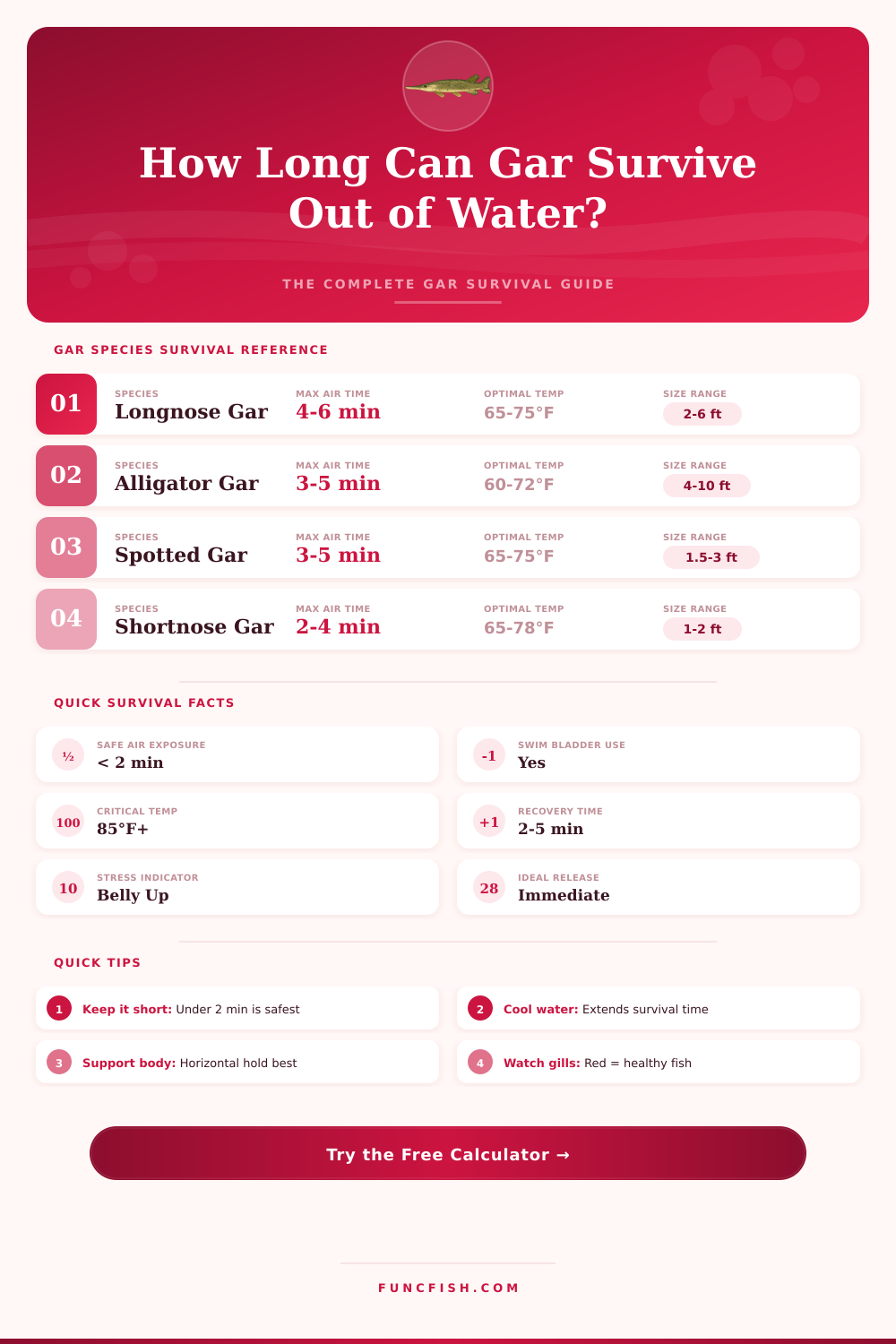
| Longnose Gar | 2–6 ft (60–180 cm) | 2–35 lb (0.9–16 kg) | 4–6 min | Active aerial breather | Rivers, lakes |
| Alligator Gar | 4–10 ft (120–305 cm) | 30–350 lb (14–159 kg) | 3–5 min | Active aerial breather | Large rivers, bays |
| Spotted Gar | 1.5–3 ft (45–90 cm) | 2–8 lb (0.9–3.6 kg) | 3–5 min | Active aerial breather | Weedy shallows |
| Shortnose Gar | 1–2.5 ft (30–75 cm) | 0.5–4 lb (0.2–1.8 kg) | 2–4 min | Moderate aerial use | Slow rivers |
| Florida Gar | 1.5–3.5 ft (45–105 cm) | 1–10 lb (0.5–4.5 kg) | 3–4.5 min | Active aerial breather | Lakes, backwaters |
| Scenario | Recommended Max Air Time | Recovery Time Needed | Risk Level |
|---|---|---|---|
| Quick Catch & Release | 30–60 sec | 1–2 min in water | Low |
| Photo & Release | 60–120 sec | 2–4 min in water | Moderate |
| Netting / Sampling | 90–180 sec | 3–5 min in water | Moderate |
| Research / Tagging | 2–4 min | 5–10 min in water | High |
| Bowfishing Retrieve | N/A (lethal) | N/A | N/A |
| Extended Handling | Over 4 min | 10+ min or may not recover | Critical |
Gar possess a vascularized swim bladder that functions like a primitive lung, allowing them to gulp air at the surface. While this gives them more air tolerance than most fish, sustained out-of-water exposure still causes rapid physiological stress, lactic acid buildup, and can cause mortality within minutes in warm conditions.
Every 10°F (5.6°C) increase in water temperature reduces available dissolved oxygen by roughly 10–15%. When both air and water temperatures are high (above 80°F/27°C), safe out-of-water time can drop by 50% or more. Wet your hands and keep the fish horizontal and supported for maximum survival odds.
A longnose gar are a type of fish that is able to breathe atmospheric air. However, the fishes can also experience physiological stress when its removed from its natural water home. When a longnose gar is removed from the water, the fish begin to lose moisture from its body, leading to heat stress.
The amount of time that the longnose gar can be out of the water will determine if the fish survives the condition. There are several biological factor related to the survival of a longnose gar that are important to consider. One factor is the species of the longnose gar that people are consider.
How to Keep a Longnose Gar Safe Out of Water
For instance, an alligator gar is much more larger than a shortnose gar, and the larger body mass of the alligator gar allow it to better tolerate stress conditions. Another factor that relates to the survival of a longnose gar is the temperature in which the fish is being held out of the water. Warmer temperature can increase the metabolic rate of the fish, and can also cause the fish to lose moisture at a more faster rate.
If the air temperature is much higher then the water temperature of the longnose gars natural home, the fish will lose moisture at a much faster rate. The fight time of the longnose gar can also have an impact on the survival of the fish; the longer the fish fights (swims), the more lactic acid will build up in its body, which can weaken the fish. The way in which the longnose gar is handled also have an impact on its survival.
For instance, the fish should be handled with wet tools, and with a wet rubber net or cradles. The longnose gar naturally produce a slime coat that protects its body from pathogens that may enter its body. If the slime coat are damaged, the longnose gar can become infected.
Using dry hands to handle the longnose gar can also damage the slime coat, as the dryness of the human skin can strip moisture from the fishs body. Finally, the weight of the longnose gar should be supported with a sling or cradle, to avoid placing strain upon its internal organ if it is held low to the water. In addition to these biological factors, someone can calculate the survival of a longnose gar with a mathematical model.
The survival window for a longnose gar is the amount of time that the fish can remain out of the water before it perishes due to stress. Instead of utilizing the full survival window for the longnose gar, the survival window should be reduce to 60% of the maximum survival time. Calculating a safe limit for how long the longnose gar will remain out of the water is important to account for factor like the wind and the cloud cover of the area in which the longnose gar is being handled.
For instance, if the longnose gar is exposed to 25% of the limit, the status of the longnose gar is considered stable. However, if the longnose gar is exposed to 75% of the limit, the status of the longnose gar is considered critical. If the status of a longnose gar is strained, the fish should not be photographed; the process of taking a photograph of the longnose gar will increase the amount of time that the longnose gar is out of the water.
If the status of the longnose gar is critical, though, it is important to return the longnose gar to its habitat in the water immediately; the longnose gar will require an instant revival of its condition. It is also possible to use presets in order to prepare for certain situation. For instance, a preset can be set to handle a longnose gar that is being lifted out of a cold river at dawn.
Another preset can handle the situation of having to hold a longnose gar for a photograph in a hot marsh. The temperature relationship to the longnose gar has a strong influence upon the survival of the species; higher temperatures lead to the longnose gar quickly hitting its stress point. Overall, there are several factor that should of been considered when a longnose gar is taken out of the water.
The species, temperature, fight time, and handling method are all factors that should be considered. Using wet gear to handle the longnose gar will help to preserve its slime coat. Additionally, supporting the weight of the longnose gar will prevent strain upon its internal organs.
Overall, by taking these step, it is possible to increase the chances that the longnose gar will survive its encounter with human.