🪝 Circle Hook Size Calculator
Find the perfect circle hook size for your target species, bait, and fishing technique
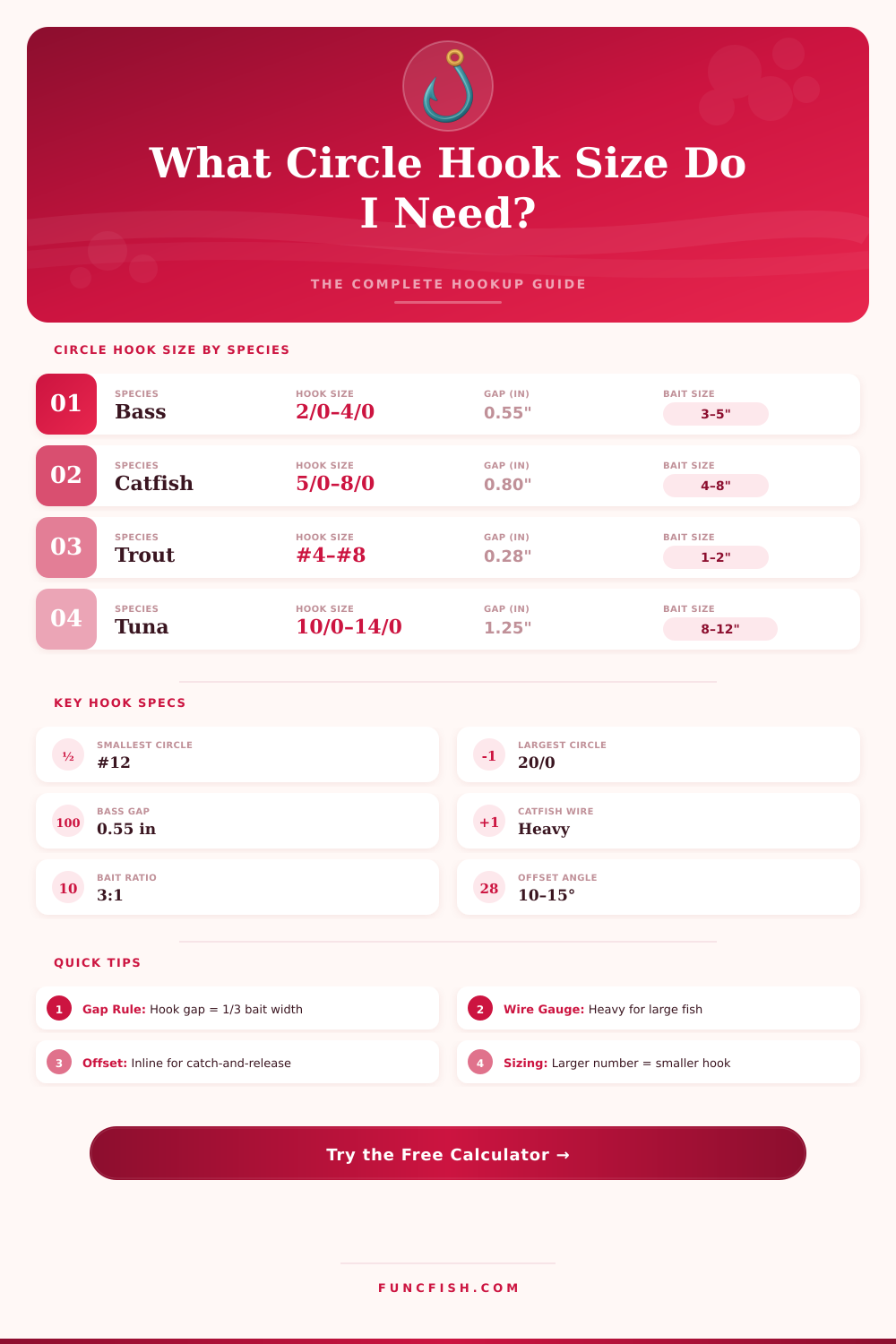
| Species | Hook Size Range | Gap (in / cm) | Recommended Bait | Wire Weight |
|---|---|---|---|---|
| Panfish (Bluegill, Crappie) | #10 – #6 | 0.18–0.25 / 0.46–0.64 | Small worm, grub | Light |
| Trout (Stream) | #8 – #4 | 0.22–0.32 / 0.56–0.81 | Worm, minnow, PowerBait | Light–Med |
| Bass (Largemouth/Smallmouth) | 1/0 – 4/0 | 0.45–0.65 / 1.14–1.65 | Shiner, crawfish, worm | Medium |
| Walleye | #4 – 2/0 | 0.28–0.52 / 0.71–1.32 | Leech, minnow, crawler | Medium |
| Catfish (Channel) | 2/0 – 5/0 | 0.52–0.75 / 1.32–1.91 | Cut bait, liver, worm | Medium–Hvy |
| Catfish (Flathead/Blue) | 5/0 – 10/0 | 0.75–1.10 / 1.91–2.79 | Live bream, cut shad | Heavy |
| Striped Bass | 4/0 – 8/0 | 0.65–0.95 / 1.65–2.41 | Bunker, herring, eel | Heavy |
| Red Drum (Redfish) | 3/0 – 6/0 | 0.58–0.82 / 1.47–2.08 | Shrimp, crab, mullet | Med–Hvy |
| Snook / Tarpon | 4/0 – 7/0 | 0.65–0.88 / 1.65–2.24 | Live mullet, pinfish | Heavy |
| Yellowfin Tuna | 8/0 – 12/0 | 1.05–1.30 / 2.67–3.30 | Mackerel, squid | Forged |
| Bluefin Tuna | 12/0 – 16/0 | 1.30–1.65 / 3.30–4.19 | Live bluefish, mackerel | Forged |
| Shark | 10/0 – 20/0 | 1.10–2.00 / 2.79–5.08 | Chunk bait, whole fish | Extra Heavy |
| Hook Size | Gap (in) | Gap (mm) | Shank Length (in) | Best Line Test |
|---|---|---|---|---|
| #10 | 0.18 | 4.6 | 0.35 | 2–6 lb |
| #8 | 0.22 | 5.6 | 0.42 | 4–8 lb |
| #6 | 0.25 | 6.4 | 0.50 | 4–10 lb |
| #4 | 0.32 | 8.1 | 0.60 | 6–12 lb |
| #2 | 0.38 | 9.7 | 0.72 | 8–15 lb |
| #1 | 0.42 | 10.7 | 0.78 | 10–17 lb |
| 1/0 | 0.45 | 11.4 | 0.85 | 12–20 lb |
| 2/0 | 0.52 | 13.2 | 0.95 | 15–25 lb |
| 3/0 | 0.58 | 14.7 | 1.05 | 17–30 lb |
| 4/0 | 0.65 | 16.5 | 1.18 | 20–40 lb |
| 5/0 | 0.72 | 18.3 | 1.30 | 25–50 lb |
| 6/0 | 0.80 | 20.3 | 1.45 | 30–65 lb |
| 8/0 | 0.95 | 24.1 | 1.70 | 40–80 lb |
| 10/0 | 1.10 | 27.9 | 1.95 | 50–100 lb |
| 12/0 | 1.30 | 33.0 | 2.25 | 80–130 lb |
| 14/0 | 1.45 | 36.8 | 2.55 | 100–200 lb |
| Wire Class | Wire Diameter (in) | Wire Diameter (mm) | Breaking Strength | Best For |
|---|---|---|---|---|
| Ultra-Light Wire | 0.018–0.022 | 0.46–0.56 | 6–15 lb | Panfish, small trout |
| Light Wire | 0.023–0.030 | 0.58–0.76 | 15–35 lb | Trout, walleye, bass |
| Medium Wire | 0.031–0.042 | 0.79–1.07 | 35–80 lb | Bass, catfish, redfish |
| Heavy Wire | 0.043–0.058 | 1.09–1.47 | 80–200 lb | Tuna, tarpon, stripers |
| Extra Heavy / Forged | 0.059–0.080 | 1.50–2.03 | 200–600 lb | Sharks, marlin, billfish |
Selecting a circle hook require you to consider the size of the bait that you will be using and the size of the hook gap. The hook gap is the distance between the bend of the hook and the point of the hook. If the hook gap is too small for the size of the bait, the bait will cover the point of the hook.
If the point of the hook are covered, the hook point cannot enter the mouth of the fish. The point of the hook must remain exposed so that the hook can perform it’s self-setting action on the fish when it turn on the hook. The thickness of the baits will determine the size of the gap of a circle hook.
How to Choose the Right Circle Hook
Thicker baits require larger gaps because they take up more space on the hook than narrow baits. For example, chunks of bunker or mullet require a larger hook gap than sweet corn kernel. The size of the mouth of the fish that you are targeting will also affect the size of the circle hook that you use.
Fish with large mouths, like tarpon, will allow for larger hooks than the mouth of fish with small mouths, like walleye. The conditions of the water in which you will be fishing will affect the size of the gap of your circle hook. In currents or tides, the current will cause the bait to twist on the hook.
To prevent this, you will need a wider gap of the circle hook or a heavier wire for the hook. In still water, lighter and more fine hooks will work best for you. The type of bait that you use will also affect the type of circle hook that you must use when you are fishing.
If you use live bait and hook it through the nose of the fish, you will use a hook with a shorter shank. If you use larger bait like mullet, you will use a hook with a longer shank to allow for the bait to rotate in the water. The wire gauge of a circle hook will affect the type of fish that you are targeting.
Small mouths require a light wire for the circle hook. The light wire will flex to the smaller mouth of the fish. Large fish require a heavy wire for the circle hook because the heavy wire will not straighten out under the pulling strength of a large fish like tuna.
For example, when fishing for channel catfish in fresh water, a standard 4/0 circle hook will work best. However, if the water has strong currents, a circle hook with heavier wire will not allow the bend of the hook to straighten out under the pull of the fish. For targeting redfish with shrimp, use a 2/0 circle hook so that the point of the hook is exposed so that the fish will slurp the bait sideways on the hook.
For tuna with chunks of mullet, use an 8/0 circle hook so that the gap of the hook is large enough for the bulky meat to clear the hook gap. Many anglers make the mistake of using a circle hook based off the luck that they experienced when they use that specific circle hook previously. A circle hook may have worked well for fishing for striped bass but may be too large for baitfish.
Using a circle hook that is too large for the baitfish will result in the point of the hook burying into the body fat of the baitfish. Using a standard circle hook as opposed to an offset circle hook will result in the hook rolling into the corner of the mouth of the fish very pure. Offset circle hooks will penetrate the bait faster because of the offset portion of the circle hook.
You can calculate a fit score to determine if your circle hook and bait size are correct for your target species of fish. A fit score above 85 is acceptable for your fishing rig. A score below 60 indicate that you need to change the size of your bait or the number of the hook.
Fish species has different features of their mouths and the strength that they use to pull their teeth. Carp have small mouths and will require circle hooks with short shanks so that the angler does not lose their leverage holding the fish. Flathead catfish have a great pulling strength with their teeth and thus require the angler to tune their rod load and hook according to the strength of the fish.
Tuna have a massive body mass and thus require circle hooks made of super-heavy wire to not bend under their massive body mass. Live baitfish require a gap in the circle hook to allow for the swimming action of the baitfish. Cut bait requires a hook with a shank that allow for stability of the bait on the hook.
To ensure that your circle hook is correctly rigged for your target species of fish, you should inspect the hook before you cast your line. One way to do this is to pinch the bait on the hook. If the point of the hook is covered by less than a quarter-inch of bait, your circle hook must be larger in size or you should trim the size of the bait.
You should also allow your rod to fully load when the fish makes contact with your bait because sweeping or jerking the rod will stall the hook before it can properly set into the fish mouth. Using a heavier wire for the circle hook when fishing in a current will prevent the bait from twisting on the hook. However, you should first test the hook to ensure that the bait does not foul the hook.
A circle hook will be most effective when the fish self-impales itself on the hook as it turns in the water.