⚓ Anchor Rope Length Calculator
Calculate the exact anchor rode you need based on depth, conditions & vessel size
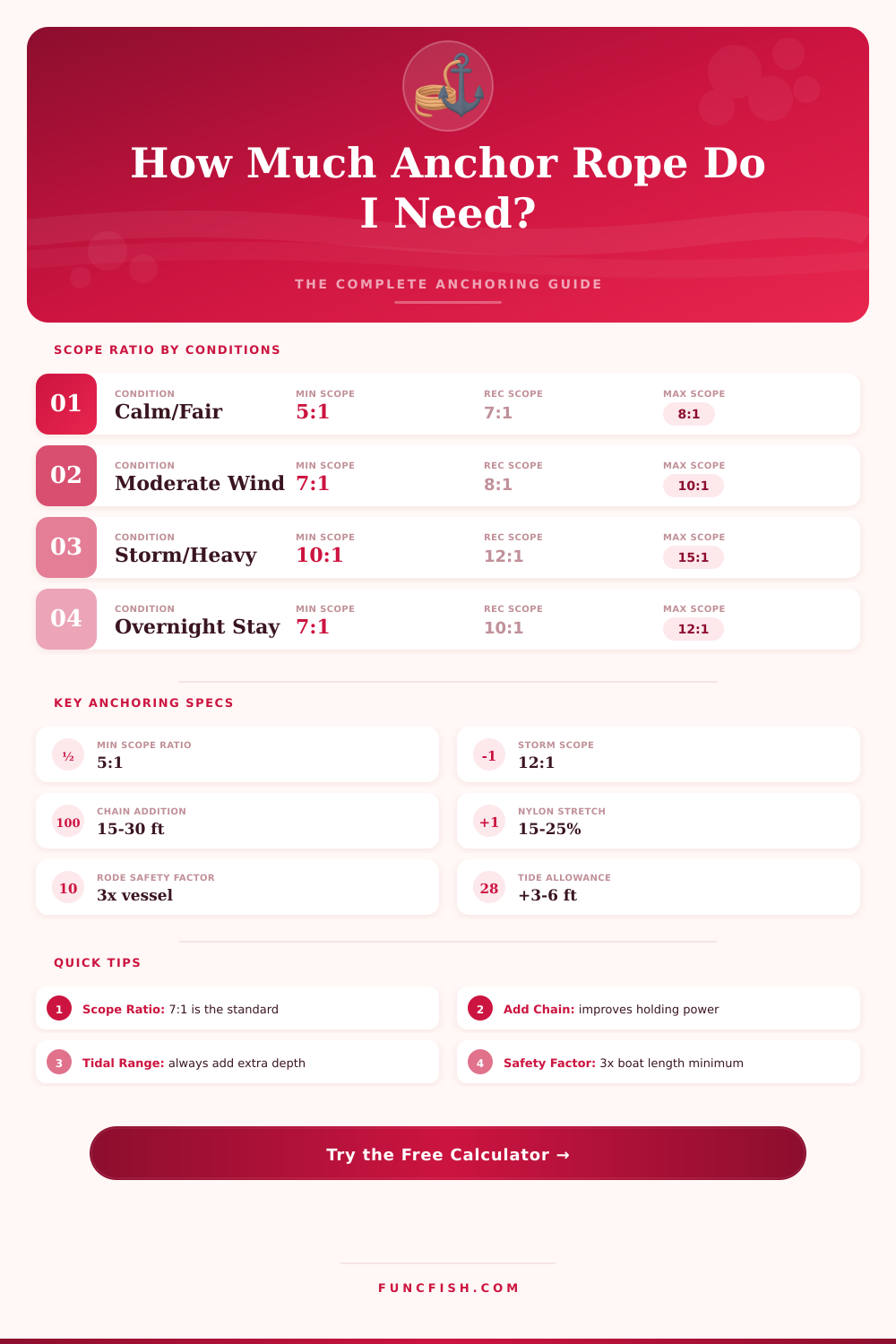
| Conditions | Min Scope | Recommended | Heavy Weather | Storm |
|---|---|---|---|---|
| Calm (0-10 mph) | 5:1 | 7:1 | 8:1 | 10:1 |
| Moderate (10-20 mph) | 7:1 | 8:1 | 10:1 | 12:1 |
| Heavy (20-35 mph) | 8:1 | 10:1 | 12:1 | 15:1 |
| Storm (35+ mph) | 10:1 | 12:1 | 15:1 | As much as possible |
| Overnight Stay | 7:1 | 10:1 | 12:1 | 15:1 |
| Shallow Flats (<8 ft) | 5:1 | 7:1 | 8:1 | 10:1 |
| Diameter (in) | Diameter (mm) | Break Strength (lb) | Break Strength (kg) | Vessel Size |
|---|---|---|---|---|
| 3/16" | 4.8 mm | 2,300 lb | 1,043 kg | Up to 18 ft |
| 1/4" | 6.4 mm | 4,000 lb | 1,814 kg | Up to 22 ft |
| 5/16" | 7.9 mm | 6,300 lb | 2,858 kg | 22-28 ft |
| 3/8" | 9.5 mm | 9,000 lb | 4,082 kg | 28-35 ft |
| 7/16" | 11.1 mm | 12,000 lb | 5,443 kg | 35-42 ft |
| 1/2" | 12.7 mm | 16,000 lb | 7,257 kg | 42-50 ft |
| 5/8" | 15.9 mm | 24,000 lb | 10,886 kg | 50-65 ft |
| 3/4" | 19.1 mm | 35,000 lb | 15,876 kg | 65+ ft |
| Vessel Length | Min Rode (ft) | Rec Rode (ft) | Min Rode (m) | Rec Rope Dia. | Chain Lead |
|---|---|---|---|---|---|
| Up to 16 ft (5 m) | 75 ft | 100 ft | 23 m | 1/4" (6mm) | 4-6 ft / 1-2 m |
| 17-22 ft (5-7 m) | 100 ft | 150 ft | 30 m | 5/16" (8mm) | 6-10 ft / 2-3 m |
| 23-28 ft (7-9 m) | 150 ft | 200 ft | 46 m | 3/8" (10mm) | 10-15 ft / 3-5 m |
| 29-35 ft (9-11 m) | 200 ft | 250 ft | 61 m | 7/16" (11mm) | 15-20 ft / 5-6 m |
| 36-45 ft (11-14 m) | 250 ft | 300 ft | 76 m | 1/2" (12mm) | 20-25 ft / 6-8 m |
| 46-60 ft (14-18 m) | 300 ft | 400 ft | 91 m | 5/8" (16mm) | 25-30 ft / 8-9 m |
| 60+ ft (18+ m) | 400 ft | 500+ ft | 122 m | 3/4" (19mm) | 30+ ft / 9+ m |
To properly anchor a boat, you must calculate the length of an anchor rope. The length of the anchor rope is referred to as scope. In order to calculate the scope, you must use the length of the anchor rope divided by the vertical distance between the boat and the bottom of the water.
You must calculate the scope to determine the angle of the anchor rope to the anchor. If the angle is too great, the anchor may pull out of the bottoms of the water, which will cause the boat to drift. To calculate the vertical distance, you must use the depth of the water plus the height of the bow of the boat above the water line.
How to Calculate Anchor Rope Length
To properly calculate the vertical distance, you must use the height of the bow above the water from the point where the anchor rope exit the boat. For example, if the depth of the water is 10 feet and the height of the bow above the water is 5 feet, the vertical distance is 15 feet. You must include the height of the bow in the calculation because if the tide rises or there are waves that move the boat forward or backward, there wont be enough anchor rope to allow the boat to move.
For calm conditions, the scope should be 5:1. However, if the conditions are often rough or if there are many weeds in the water, you should use a scope of 7:1 or 8:1. A larger scope allow for the catenary of the anchor rope to increase.
The catenary is the sag in the anchor rope. If the anchor rope has more catenary, the weight of the catenary will help to pull the anchor down into the bottoms of the water. Another factor that will impact the scope of the anchor rope is the type of bottom upon which the boat will anchor.
If the bottom of the water is sandy, the anchor will allow for the boat to anchor at a more small scope. However, if the bottom of the water is muddy or contains weeds, or if there are rocks on the bottoms of the water, you will need to use more anchor rope. Sand bottoms is more stable than muddy, weedy, and rocky bottoms.
If the anchor rope is made of nylon, there will be some stretch to the rope. The stretch in the rope will allow for the boat to move with the waves. However, for this reason, you may need more anchor rope to account for this stretch in the rope.
If materials like polyester make the anchor rope, which does not stretch like nylon, you dont have to account for the movement of the boat based off the movement of the waves. The profile of the boat will affect the amount of wind that affects the boat. Boats with large profiles will experience more wind than boats with lower profiles.
Because the boat will experience more force from the wind and the wind will pull the anchor from the bottoms of the water, boats will require a longer scope. The swing circle of the boat will also impact the scope. The swing circle is the area in which the boat will move while rotating around the anchored boat.
You can calculate the size of the swing circle by taking the length of the anchor rope and multiplying it by two. The size of the swing circle will help you to ensure that you will not drift into other boats while anchored. Adding a chain to the anchor rope will not have the same effect as increasing the scope of the anchor rope.
While the chain will help to keep the anchor low to the bottoms of the water, the anchor chain will not replace the need for an appropriate scope of anchor rope. You should not ignore the effect of the wind and the current on the anchored boat. If the wind or the current increases in strength, the force that acts upon the boat will significantly increases.
In these cases, you will need to increase the length of the anchor rope. After you anchor your boat, you should check the anchor. Back the boat down slow to ensure the anchor has properly attached to the bottoms of the water.
Monitor the anchor rope to ensure that your boat is not dragging through the water. When using an anchor rope scope calculator, you will be able to calculate the length of the anchor rope that should be used to anchor the boat. By knowing how much anchor rope is required, you can ensure that your boat will become properly anchored to the bottoms of the water.