🐟 Peacock Bass Weight Calculator
Estimate peacock bass weight from length & girth measurements — imperial & metric
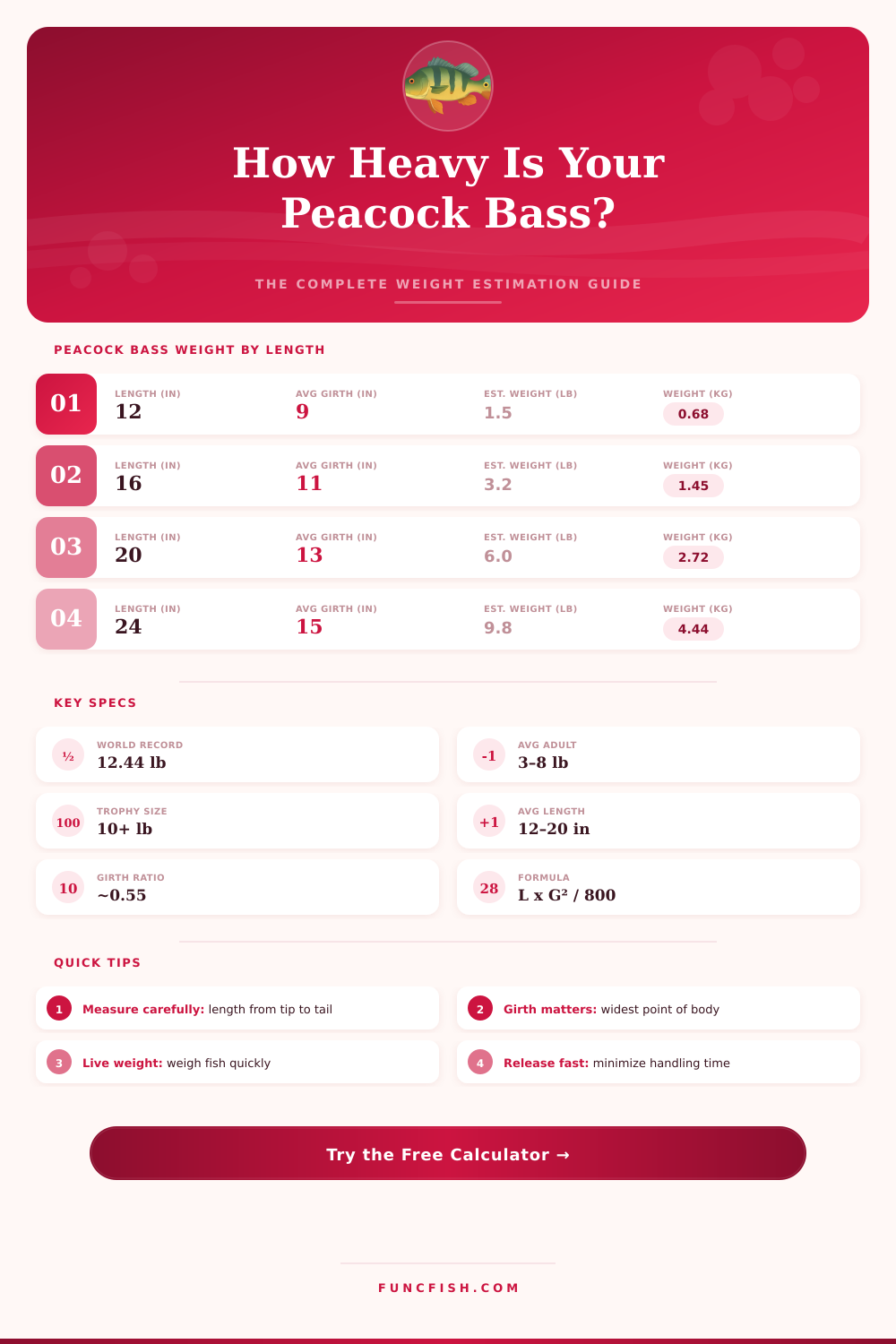
| Length (in) | Length (cm) | Avg Girth (in) | Est. Weight (lb) | Est. Weight (kg) | Category |
|---|---|---|---|---|---|
| 8 | 20.3 | 6.5 | 0.42 | 0.19 | Juvenile |
| 10 | 25.4 | 7.5 | 0.70 | 0.32 | Sub-Adult |
| 12 | 30.5 | 9.0 | 1.22 | 0.55 | Sub-Adult |
| 14 | 35.6 | 10.0 | 1.75 | 0.79 | Adult |
| 16 | 40.6 | 11.0 | 2.42 | 1.10 | Adult |
| 18 | 45.7 | 12.0 | 3.24 | 1.47 | Adult |
| 20 | 50.8 | 13.0 | 4.23 | 1.92 | Good |
| 22 | 55.9 | 14.0 | 5.39 | 2.44 | Good |
| 24 | 61.0 | 15.0 | 6.75 | 3.06 | Trophy |
| 26 | 66.0 | 16.0 | 8.32 | 3.77 | Trophy |
| 28 | 71.1 | 17.0 | 10.11 | 4.59 | Super Trophy |
| 30 | 76.2 | 18.0 | 12.15 | 5.51 | World Class |
| Species | Max Weight (lb) | Max Weight (kg) | Max Length (in) | Avg Weight (lb) | Primary Range |
|---|---|---|---|---|---|
| C. spicatus (Butterfly) | 12.44 | 5.65 | 30 | 2–5 | Amazon Basin, Florida |
| C. temensis (Speckled) | 29.0 | 13.2 | 36 | 5–12 | Amazon, Orinoco |
| C. monoculus (Royal) | 13.2 | 6.0 | 28 | 2–6 | Amazon Basin |
| C. ocellaris (Big-Eye) | 8.8 | 4.0 | 24 | 1–4 | Amazon, Guiana |
| Condition | Girth/Length Ratio | Formula Divisor | Weight Multiplier | Description |
|---|---|---|---|---|
| Lean (Post-Spawn) | 0.48–0.50 | 900 | 0.88x | Depleted energy reserves |
| Standard (Average) | 0.52–0.56 | 800 | 1.00x | Normal healthy fish |
| Excellent (Well-Fed) | 0.57–0.60 | 750 | 1.07x | Peak feeding season |
| Trophy (Maximum) | 0.61–0.65 | 700 | 1.14x | Exceptional condition |
Estimating the weight of a peacock bass require the use of specific measurements. These measurements must account for the physical differences between different types of peacock bass. Peacock bass are a type of cichlid fish that lives in different environments, from Florida canals to the blackwaters of an Amazonian rainforest.
Due to the fact that there are physical differences between these environments, there is also physical differences in the body shapes of the fish from these regions. In some areas where the water is fed with many fish, the peacock bass are very heavly. In areas where there are much fish, the bass are lean and light in weight.
How to Measure and Estimate Peacock Bass Weight
To calculate the weight of a peacock bass, you must measure the total length of the fish and the girth of the fish. The total length of the fish is from the nose of the fish to the end of it’s tail. The girth of the fish is the circumference of the fish.
It is important to measure the girth of the fish at the shoulder area of the fish. This is the thickest part of the fishs body. Measuring the girth of the fish at the belly area of the fish may result in an overestimation of the true weight of the fish if the fish have a full belly.
Depending on the species of the peacock bass, different mathematical formula are used to calculate the weight of the fish. The temensis species of the peacock bass are known for their elongated body shape. A mathematical formula that accounts for this elongation of the body must be used for the weight calculation of these fish.
The butterfly peacock species have a different body shape, one that is more compact than the other species of the peacock bass. A different mathematical formula is used to calculate the weight of these species of fish. The body condition of the fish can also play a role in the weight of the fish.
If the fish has eaten many small fish recently, it will weigh more then a fish that just recently spawn. There are different tools that can be used to measure the weight of a peacock bass. Using a flat board to measure the total length of the fish will ensure accuracy in the measurement of the length of the fish.
Flexible measuring tapes could result in an incorrect measurement of the length of the fish. Using wet measuring tapes can also result in an incorrect measurement of the length of the fish due to the stretching of the tape. Finally, using a lip-grip scale to weigh the fish may also result in an incorrect measurement of the weight of the fish.
One tool that can be used to calculate the weight of the fish is a weight calculator. A weight calculator uses the length and girth measurements of the fish to calculate the weight of the fish. In addition, the weight calculator can calculate the plumpness index of the fish.
The plumpness index provide information on the amount of mass that the peacock bass has compared to its standard profile. The weight of the peacock bass can help anglers decide on the appropriate fishing tackle to use when trying to catch the bass. If the estimated weight of the peacock bass is relatively small, using light fishing line is sufficient.
For larger weights, however, the fishing line must be heavy and has a strong drag setting. Common mistakes when calculating the weight of a peacock bass may result in an incorrect estimation of the true weight of the bass. One of the most common mistakes is measuring the girth of the fish at the belly instead of the shoulder area where the fish is the thickest.
Additionally, another common mistake is utilizing the wrong measuring tool for the size of the fish. Using the wrong measuring tool can result in inaccurate measurement. Finally, you should of measure the weight of the fish when the fish is calm so that the fish can be properly measured when it is not thrashing about in its water habitat.