Fishing Line Knot Break Strength Calculator
Estimate the actual break point of a knot under reel drag, sudden shock, line material, leader material, wetness, age, and safety factor so the weak link is visible before the fish surges.
📌Break-strength presets
⚙Line, knot, drag, and shock inputs
Knot break strength result
Calculated from line test, knot efficiency, drag, shock, leader pairing, wetness, age, rod angle, and safety factor.
Breakdown
🧵Knot and line comparison grid
Palomar
FG Knot
Alberto
Bimini
📊Knot retention reference
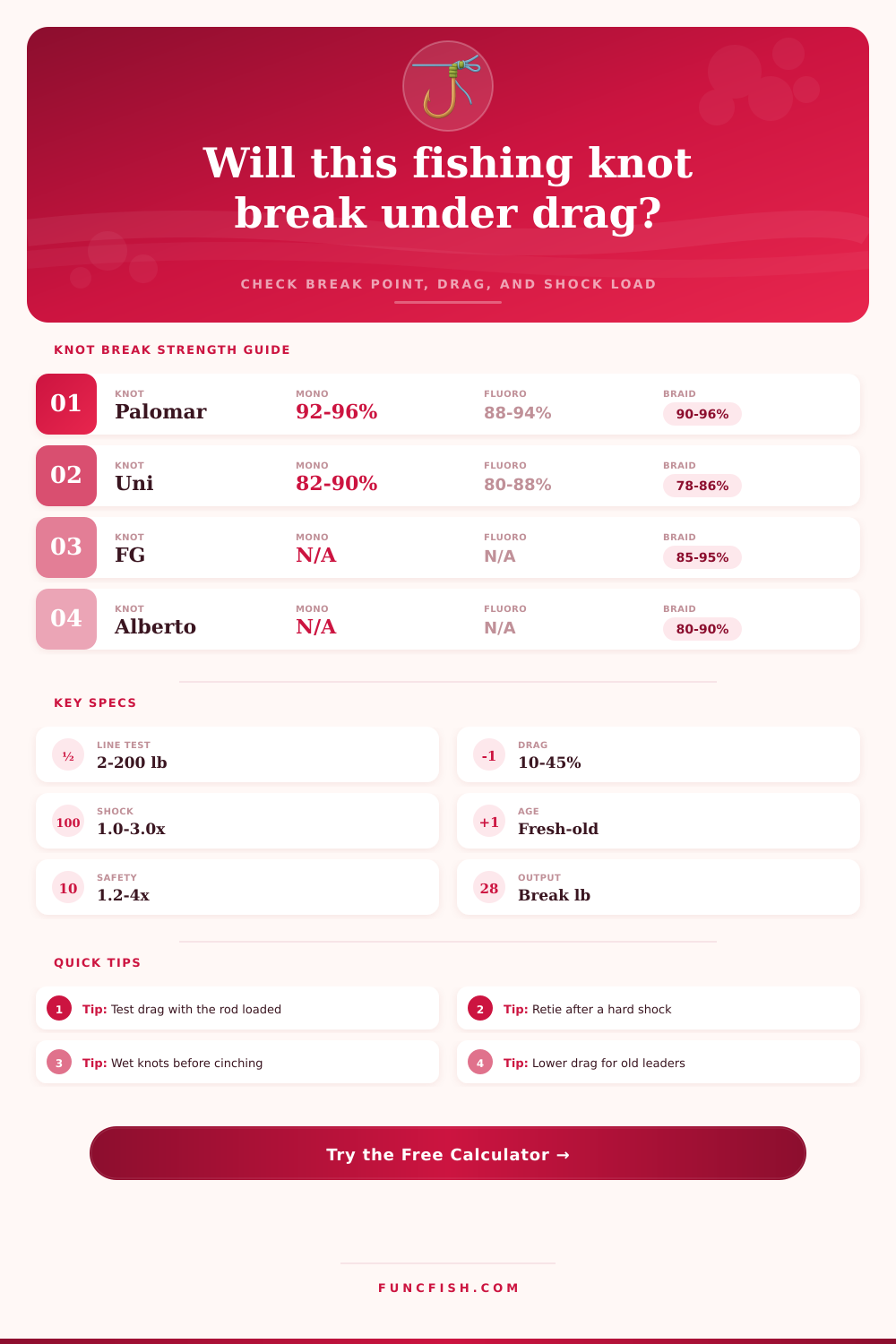
| Knot type | Best application | Typical retention | Break risk cue |
|---|---|---|---|
| Palomar | Hooks, lures, swivels | 88-96% | Crossed loop on fluoro can cut itself |
| Improved clinch | Light mono terminal rig | 76-88% | Can slip on braid or heavy shock |
| Uni knot | Terminal knot or simple leader | 78-90% | Needs more turns on slick line |
| Double uni | Main line to leader | 80-88% | Bulk and uneven coils reduce break point |
| FG knot | Braid to mono or fluoro leader | 85-95% | Fails if braid does not bite the leader |
| Alberto | Braid to heavier leader | 80-90% | Wrap reversal must seat cleanly |
| Bimini twist | Doubled line loop | 92-98% | Loop damage lowers shock margin |
⚖Drag and shock load reference
| Fishing load | Shock multiplier | What it models | Drag note |
|---|---|---|---|
| Smooth trolling pull | 1.0-1.2x | Steady line load through drag | Can fish closer to target drag |
| Normal fight surges | 1.2-1.5x | Head shakes, short runs, hooksets | Good for balanced freshwater setups |
| Boat-side dive | 1.5-1.8x | Short hard pull on a bent rod | Back off drag when leader is short |
| Surf shock leader | 1.8-2.4x | Sinker launch, waves, sudden stops | Use heavier leader and lower fight drag |
| Heavy cover shock | 2.2-3.0x | Snags, locked drag, abrupt hooksets | Requires large break reserve |
💧Material and leader behavior table
| Material | Stretch | Knot behavior | Break-strength adjustment |
|---|---|---|---|
| Nylon monofilament | High | Forgiving under surge and easy to seat | Best all-around shock buffer |
| Fluorocarbon | Medium-low | Stiffer and heat sensitive when dry cinched | Wet carefully, avoid crossed wraps |
| Braided PE | Very low | Slick and thin, so grip turns matter | Shock load reaches knot quickly |
| Copolymer | Medium | Usually close to mono but less stretchy | Balanced break and handling |
| Fused superline | Low | Slick coating can flatten under a knot | Use extra wraps and test pull |
| Coated wire | None | Kinks lower real break point | High safety factor recommended |
📝Safety factor guide
| Safety factor | Use case | Drag behavior | Retie trigger |
|---|---|---|---|
| 1.2x | Fresh knot and controlled fish | Aggressive drag close to break point | After any heavy pull |
| 1.5x | Clean tournament rig | Firm but still measured | After a snag or dock rub |
| 2.0x | Balanced everyday fishing | Good mix of pressure and reserve | When tag or wraps look changed |
| 2.5x | Leader knots and light hooks | Lower drag protects weak points | After leader contact |
| 3.0-4.0x | Old, unknown, or abrasive rig | Conservative drag only | Retie before fishing hard |
💡Break-point checks
Drag scale tip: Set drag with the rod loaded because guide friction and rod angle raise the effective pull at the knot. A straight-line bench pull can look safer than the rig feels during a boat-side surge.
Retie trigger: If peak load is close to the adjusted break point, reduce drag first and retie next. Heat, salt grit, crossed wraps, and a tiny tag can all turn a normal hookset into the actual break event.
The break strength of a knot are not the same as the rated strength of a fishing lines. The break strength of a knot depends on several variable. Most people know the strength of there fishing line is based on the rating of the line.
However, the knot create a reduction of the strength of the fishing line. The strength of the fishing line when tie in a knot reduce because the tying of the knot impact the line. Several variable must be considered before determining the break strength of the knot create by the fishing line.
How Knots Reduce Fishing Line Strength
One of the main variable that will impact the strength of the fishing line when tie in a knot is the efficiency of the knot. The efficiency of the knot impact the strength of the fishing line because not all knots has the same efficiency. For instance, braided lines requires the knots to have a certain grip on the braided fishing line to avoid the line slipping through the knot.
In contrast, fluorocarbon lines can be damaged if the wrap of the knot create a crossing of the fishing line when the knot is cinched. Additionally, monofilament lines can stretch to absorb a surge in the strength of the fishing line, but only if the knot is seated proper on the fishing line and the knot remain wet. Another variable to consider is the type of fishing line used.
Fishing lines can be braided, fluorocarbon, and monofilament lines. Each type of line will have different impact on the strength of the knot and the strength of the fishing line. For instance, the strength and type of shock load will have an impact on the strength of the line.
A steady pull on the fishing line will rarely create a break in the line, but a shock load from a fish diving in the water or a sinker being moved by a wave in the water could break the line. The shock load can be factored into the fishing line strength calculator to provide an accurate estimation of the strength of the fishing line. The drag setting on the fishing line will be multiplied by the shock load strength for that calculation.
The calculation will compare the result with the adjusted break point of the fishing line to determine the risk of the fishing line breaking. The type of leader used in the fishing line will impact the break point of the fishing line. For instance, using a light leader will create a weak point in the fishing line, protecting the main fishing line from abrasion, but will lower the break point of the fishing line.
In contrast, a heavy leader will increase the break point but will introduce stiffness into the fishing line. The angle of the fishing rod will also introduce additional variable into the calculation. If the rod is angled high above the water, the pull on the knot will be stronger due to friction between the fishing line and the rod guides.
The fishing line strength calculator takes into consideration the angle of the fishing rod so that the angler doesnt have to calculate the angle of the fishing rod theirselves. The condition of the knot will also impact the strength of the fishing line. For instance, wet knots will have more strength than dry knots.
If the knot is dry, the heat that may have been applied to the knot while cinching the fishing line may have weakened the knots. If the line being used is fluorocarbon, heat may be created when the knot is cinched. This heat could weaken the fluorocarbon line.
The angler can select the condition of the knot in the fishing line strength calculator to factor in the impact of the condition on the strength of the line. The output of the fishing line strength calculator is a modeled reserve margin of the fishing line. The reserve margin can be expressed as a percentage.
A large percentage indicates that the fishing line allow for a fish to out-run the fishing line, but a narrow percentage indicates that the drag must be lowered or the knot must be retied. The reference tables provided with the calculator can be used to determine the typical percentage of the reserve margin for different type of knots. These tables can help the angler to decide whether a given type of knot is appropriate for the type of shock load that may act on the fishing line.
The fishing line strength calculator can help the angler to view the fishing rig as a system of the different component interacting with each other. The line test, knot, leader, drag, and shock load influence each other. Changing one element may impact the others; it is important to ensure that all elements is considered before making changes to the fishing rig.
Consider the knot as the potential weak link in the fishing rig. Fishing line older than a few year should of have the drag setting for the line lowered. Fluorocarbon line should be wetted prior to cinching the knot.
If the fishing line has experienced a hard pull, the knot should be retied. The fishing line strength calculator allows anglers to see how much the various component of the fishing rig will reduce the strength of the line in the real world.