Jack Crevalle Weight Calculator
Estimate jack crevalle weight from fork length, widest girth, body depth, school or solitary class, surf, inlet, or offshore habitat, condition, forage, confidence, and units.
📌Jack crevalle presets
⚙Measurements and field context
Model: this calculator starts with fork length times girth squared, adds a body-depth cross-check for the deep jack profile, then adjusts for schooling behavior, habitat, forage, condition, and measurement confidence.
Jack crevalle weight estimate
Calculator output appears after entering measurements.
Calculation breakdown
📊Jack crevalle profile cards
School Runner
Inlet Adult
Solo Bruiser
Photo Estimate
🔎Jack species comparison grid
Jack Crevalle
Deep-bodied coastal jack with a broad shoulder and hard-fighting profile.
Horse-eye Jack
Similar body depth, often a touch leaner for the same fork length.
Blue Runner
Smaller jack profile; length-girth estimates need lighter coefficients.
Almaco Jack
Compact offshore jack with deeper shoulders and a heavier body plan.
Amberjack
Longer offshore frame; this jack crevalle model should not replace it.
📘Reference tables
| Fork length | Lean girth | Full girth | Estimated weight window |
|---|---|---|---|
| 12 in / 30 cm | 5.0 in / 13 cm | 5.8 in / 15 cm | 0.5 to 0.8 lb / 0.2 to 0.4 kg |
| 18 in / 46 cm | 7.6 in / 19 cm | 8.8 in / 22 cm | 1.7 to 2.5 lb / 0.8 to 1.1 kg |
| 24 in / 61 cm | 10.2 in / 26 cm | 12.0 in / 30 cm | 4.1 to 6.0 lb / 1.9 to 2.7 kg |
| 30 in / 76 cm | 13.0 in / 33 cm | 15.3 in / 39 cm | 8.4 to 12.8 lb / 3.8 to 5.8 kg |
| 36 in / 91 cm | 15.8 in / 40 cm | 18.5 in / 47 cm | 15 to 23 lb / 6.8 to 10.4 kg |
| 42 in / 107 cm | 18.4 in / 47 cm | 21.5 in / 55 cm | 25 to 39 lb / 11.3 to 17.7 kg |
| Habitat setting | Weight factor | Shape clue | Best measurement |
|---|---|---|---|
| Open surf trough | 0.97 | Fast, sometimes lean schooling fish | Fork length plus girth |
| Inlet current line | 1.00 | Balanced current-built adult shape | Girth at the shoulder |
| Jetty or rock pile | 1.02 | Mixed bait and deep structure | Girth and body depth |
| Nearshore reef edge | 1.04 | Fuller adult feeding profile | Depth cross-check |
| Offshore wreck or rig | 1.08 | Heavier solitary adult potential | Girth and condition |
| Bay channel or pass | 0.99 | Variable tide and bait profile | Confidence setting |
| Forage or condition | Calculator effect | Likely body read | Range note |
|---|---|---|---|
| Sparse glass minnows | Trims weight | Lean belly for length | Wider if girth estimated |
| Mixed anchovy or pilchard bait | Neutral baseline | Average bright fish | Standard field range |
| Mullet run feed | Raises fullness | Deep belly and hard shoulders | Girth matters most |
| Menhaden or threadfin schools | Strong positive | Heavy bait-crasher shape | Use measured depth |
| Post-spawn or drawn down | Lowers condition | Long frame, slimmer belly | Expect lower midpoint |
| Confidence setting | Base range | Use when | Calculator note |
|---|---|---|---|
| High | 6% | Board, straight tape, measured girth | Narrowest practical field estimate |
| Standard | 11% | Quick fork length and girth | Good dock or beach estimate |
| Rough | 18% | Moving fish or curved tape | Adds spread for handling error |
| Photo | 30% | Photo, memory, or guessed girth | Broad comparison only |
This calculator estimates field weight only. Use a certified scale when a tournament, record, or research measurement requires exact weight.
💡Measurement tips
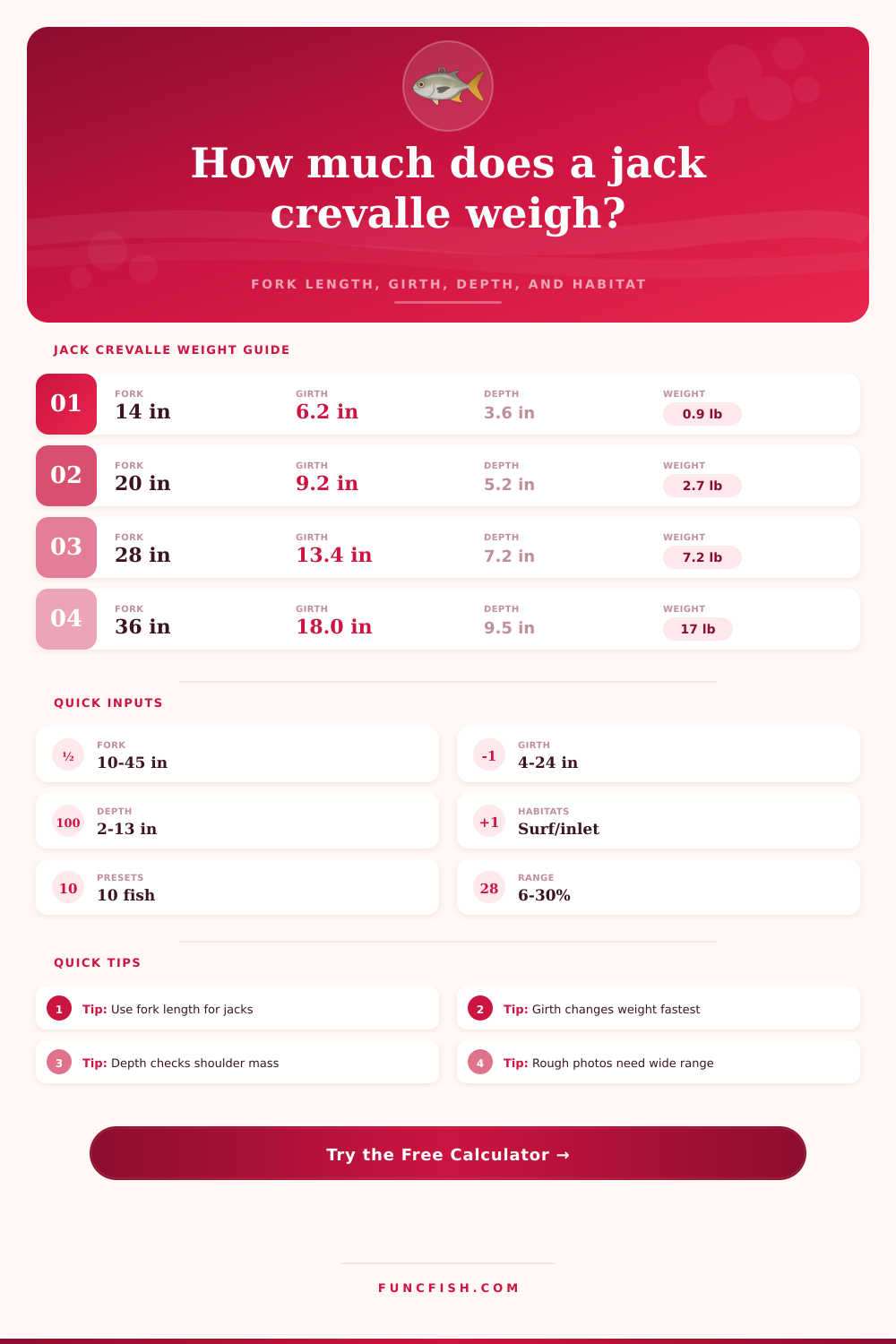
Jack crevalle have a deep forked tail, so fork length is a cleaner calculator anchor than total tail-tip length. Keep the fish straight and read nose to fork.
Girth is squared in the core estimate, while body depth checks whether that girth belongs to a deep adult or a long lean runner. Measure both when possible.
Jack crevalle fish species vary significant in weight and body shape. The weight of the jack crevalle may be the same as another fish of the same species, but the food sources available to the jack crevalle will cause the weight to differ. In addition to the length of the fish, the weight of the jack crevalle will also depend on the girth and body depth of the fish.
A tool is available to calculate the weight of a jack crevalle based on its fork length, girth, body depth, habitat, schooling behavior, and forage signals. This tool is helpful in that it reflects the actual jack crevalle in front of you using multiple data point. Fork length is the first measurement used in calculating the weight of the jack crevalle.
How to Estimate the Weight of a Jack Crevalle
As a starting point, the length of the tail fork of the fish is a reliable measurement of the size of the fish. However, it doesnt account for the volume of the fish. The girth of the fish is another measurement that can be used to calculate the weight of the jack crevalle.
However, the girth squared carry alot of weight in the calculation of the jack crevalle’s weight. This measurement allows for the volume of the fish to be account for. The body depth of the fish is another measurement that is used.
This accounts for the thickness of the body of the fish. Based off the length, girth, and body depth measurement of the jack crevalle, the calculator will also account for the habitat and the condition of the fish. The habitat in which the fish live will also affect the weight of the jack crevalle fish.
For example, a jack crevalle living in an inlet has a balanced body shape because the fish must move with the tide. In contrast, jack crevalle fish living near an offshore wreck will have more mass. This is because the food near these offshore wrecks are richer in nutrients.
Furthermore, the behavior of the school of jack crevalle will also play a role in the weight of the fish. For example, jack crevalle fish in a small surf school will be lean. This is due to the competitive environment within the surf school.
A solitary jack crevalle will have a different weight due to not having to compete with other fish. This measurement is accounted for in the calculator so that each user need not memorize these different formulas. Finally, the forage of the jack crevalle and the condition of its body are the last measurement accounted for in the calculator.
A jack crevalle may gain a lot of belly mass by eating a lot of mullet. However, after spawning, a jack crevalle may have lost some of its weight. This is accounted for in the calculator in the form of a condition index number that reflects the current weight of the jack crevalle compared than the expected profile.
A high condition index means the weight of the jack crevalle is heavier than the expected profile for that habitat. A low condition index means the weight of the jack crevalle is lighter than the expected profile for that habitat. The condition index doesnt judge the jack crevalle, but it does provide a means of showing whether the measurements of that individual jack crevalle are above or below the average for that specific class of jack crevalle.
The accuracy of the weight estimate for the jack crevalle is dependent upon the accuracy of the measurements that is obtained from the fish. For example, if the weight of the jack crevalle is estimated from a tape measure while the jack crevalle is sitting on a calm dock, then the measurements will have a narrow range of error. However, if the measurements are obtained from a photograph of the fish from an angled perspective, or if the fish is being measured while it is moving within the water, the range of error for the weight measurement will be larger.
The reason for this error is that the errors in the original measurement of the girth of the jack crevalle will be squared in the calculation of the weight of the fish. Squaring an error will create a larger error in the weight estimation. The reference tables located on this page describe the different error ranges for different sizes of jack crevalle from each of the different habitats.
It is often assumed that a longer fish will weigh more then a fish of the same species that is shorter in length. However, jack crevalle often break this rule. Two jack crevalle of the same fork length may have very different weights due to the different girth and depth of each individual fish.
The calculator makes these difference in weight visible. This information can be helpful in determining whether a jack crevalle should be kept for its meat, or in comparing the weight of the current jack crevalle to the weight of jack crevalle caught in previous fishing seasons. One of the main purpose for which this tool can be used is to measure the weight of a jack crevalle while it is at the rail of the fishing boat.
By plugging these measurements into the tool, while the jack crevalle is still in the water, it will provide an estimation of the weight of the jack crevalle. This estimation will allow an individual to determine if the jack crevalle is an average fish of that species, or if it is an unusually heavy specimen. Additionally, the weight of the jack crevalle will allow an individual to determine if the next jack crevalle to join the school is likely to be heavier or lighter than the current jack crevalle.
By using these measurements on different jack crevalle over time, an individual can improve their ability to visual estimate the weight of a jack crevalle. In order to gain an accurate estimation of the weight of a jack crevalle, it is important to measure the specific jack crevalle that you have caught. The length of the jack crevalle, the girth of the jack crevalle, and the depth of the jack crevalle must be measured.
In addition to these measurements, it is also important to consider the habitat in which the jack crevalle lives, the schooling behavior of the jack crevalle, and the types of forage that exists in its habitat for those jack crevalle. Each of these factors will help to describe the volume of the jack crevalle. Once these measurements and considerations have been made, the calculator will provide the weight of the jack crevalle.
Thus, the individual must focus upon providing accurate measurements of the specific jack crevalle that is in front of them.