Barbel Weight Calculator
Estimate river barbel weight from total length, widest girth, body depth, river flow class, body condition, season and feeding index, measurement confidence, and unit system.
📌Named barbel presets
⚙Measurements, river flow, and confidence
Model: barbel are long, muscular river cyprinids, so this estimator starts with length x girth squared, checks body depth, then adjusts for flow class, condition, season feeding, and confidence range.
Barbel weight estimate
Calculation breakdown
📊Barbel profile data grid
Young River Barbel
Adult Firm Barbel
Double-Figure Barbel
Lowland Trophy
🐟River coarse fish comparison grid
Barbel
Long, muscular river cyprinid; girth grows quickly in mature fish.
Chub
Thick-headed river fish, usually deeper through the shoulders than barbel.
Common Carp
Rounder and deeper; much heavier than barbel at the same length.
Bream
Slab-sided coarse fish where body depth can dominate the estimate.
Tench
Compact, thick-bodied stillwater fish with heavy belly and shoulders.
📘Reference tables
| Barbel class | Total length | Typical girth | Typical depth | Weight guide |
|---|---|---|---|---|
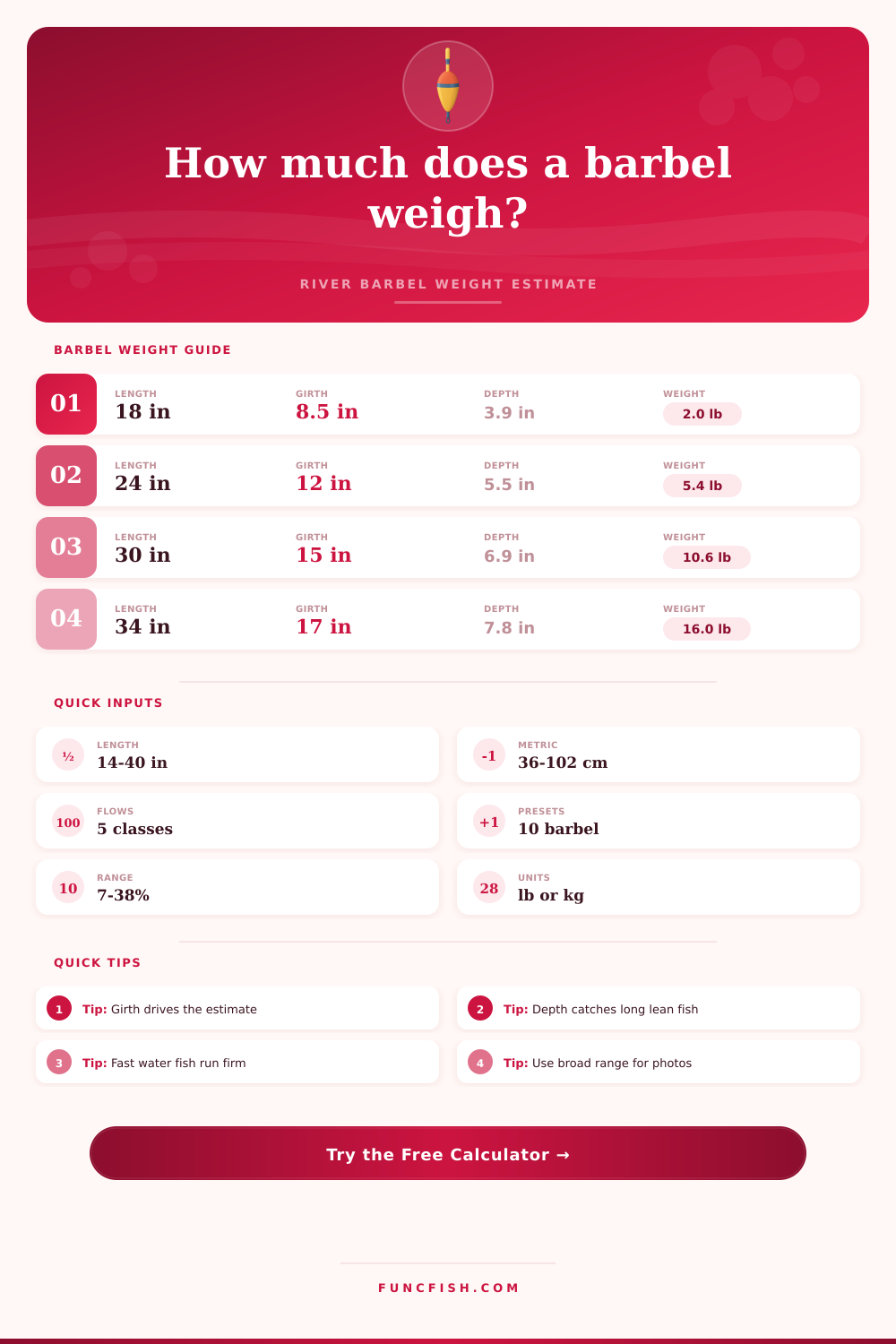
| Young river barbel | 14-21 in / 36-53 cm | 6.5-10 in / 17-25 cm | 3-4.8 in / 8-12 cm | 1-4 lb / 0.45-1.8 kg |
| Adult firm river barbel | 22-28 in / 56-71 cm | 10.5-13.8 in / 27-35 cm | 4.8-6.4 in / 12-16 cm | 4-9 lb / 1.8-4.1 kg |
| Double-figure barbel | 29-33 in / 74-84 cm | 14-16.8 in / 36-43 cm | 6.3-7.7 in / 16-20 cm | 10-15 lb / 4.5-6.8 kg |
| Specimen heavy barbel | 32-36 in / 81-91 cm | 16-18.8 in / 41-48 cm | 7.3-8.6 in / 19-22 cm | 14-20 lb / 6.4-9.1 kg |
| Lowland trophy barbel | 36-40 in / 91-102 cm | 18-21 in / 46-53 cm | 8.2-9.6 in / 21-24 cm | 18-25 lb / 8.2-11.3 kg |
| River flow class | Shape tendency | Girth factor | Depth factor | Model note |
|---|---|---|---|---|
| Thin fast upper river | Long and lean | 0.94 x | 0.96 x | Fast water can produce firm, narrow fish. |
| Steady gravel glide | Balanced muscle | 1.00 x | 1.00 x | Baseline barbel profile for the calculator. |
| Creased pushing flow | Firm shoulders | 1.02 x | 1.01 x | Current-built fish, range stays moderate. |
| Lowland slow bend | Rounder belly | 1.07 x | 1.05 x | Slower, richer reaches can carry heavier fish. |
| Coloured flood water | Variable fullness | 1.03 x | 1.02 x | Confidence range widens in swollen water. |
| Season and feeding index | Fullness effect | Best measurement cue | Range note | Calculator factor |
|---|---|---|---|---|
| Winter slow feeding | Firm but less belly | Shoulder depth | Stable if measured | 0.96 x |
| Spring build-up feeding | Improving reserves | Girth at belly | Moderate range | 1.03 x |
| Post-spawn recovery | Lean and variable | Both girth and depth | Use wider range | 0.90 x |
| Summer active feeding | Baseline active fish | Length and girth | Normal range | 1.00 x |
| Autumn heavy feeding | Full belly reserve | Widest girth | Often heavier | 1.08 x |
| Unknown season or feeding | Neutral | All measurements | Wider range | 1.00 x |
| Confidence setting | Use when | Range width | Profile blend | Practical output |
|---|---|---|---|---|
| Measured length, girth, and depth | Fish was measured with board and tape | +/- 7% | Measured shape dominates | Tightest field estimate |
| Measured length, estimated girth or depth | Length is solid, shape is approximate | +/- 13% | Small profile blend | Good bank estimate |
| Quick bank estimate | Fast handling or awkward position | +/- 20% | Moderate profile blend | Broad but useful range |
| Photo or memory estimate | No tape or angled photo only | +/- 30% | Strong guardrail | Visual estimate only |
💡Measurement tips
For barbel, girth has the biggest effect because the primary formula squares it. Measure at the fullest belly and shoulder area with the tape level.
Fast-water fish can look long and light, while lowland fish may carry more belly. If flow or shape is uncertain, choose a lower confidence setting.
This calculator estimates barbel weight only. It does not provide fishing rules, seasons, limits, licenses, harvest guidance, or location advice.
Barbel fishing require that you measure the barbel that you have caught. You must measure the lengths of the barbel, the girth of the barbel, and possibly the depth of the barbel. Each of these characteristic provides information that is used to calculate the weight of the barbel.
Estimating the weight of the barbel is helpful to understand the growth of that barbel and allow for comparisons of the barbel with other anglers catch. Length alone is not a measurement that will indicate the weight of the barbel. Barbel of the same length can has different weights due to the differing body shapes of the fish.
Measuring a Barbel to Estimate Weight
Barbel with a larger girth will weigh more than barbel of the same length with a smaller girth. Depth is another variable in calculating the weight of the barbel, as well. Depth will help to determine if the barbel has a long and thin body relative to the weight of the barbel.
Therefore, length, girth, and depth are all variable that you must provide to the barbel weight calculator in order to provide an accurate estimate of the weight of the barbel. The flow of the river in which the barbel is caught can impact the weight of the barbel. Barbel that live in area with fast river flows will typically have less body fat and weigh less than barbel that live in slow rivers.
Therefore, flow can be a variable in the barbel weight calculator. If a flood caused the water to be a certain color after, the depth and girth measurements could be less reliable than if the barbel was measured in normal river conditions; thus, a wide range can be selected in the calculator in this scenario. The season in which the barbel was caught and its feeding history will impact the weight of the barbel.
For example, a barbel that has accessed the food that is available during the autumn months will be heavier than a barbel that has only accessed the spring food. Therefore, the condition of the barbel can be entered into the calculator to determine whether the barbel has a full belly or is leaner than average. This data will impact the barbel weight calculation.
Another variable in the barbel weight calculator is the confidence in the measurements that are provided for the length, girth, and depth of the barbel. If you measure the length, girth, and depth of the barbel with measuring tape and a measuring board, the weight range for the barbel will be narrow. However, if you approximate those measurements or take them from a photograph, the weight range will be wide to account for the less reliable measurements.
Reference tables can provide information regarding the weight of the barbel based off the length of the barbel. The tables can illustrate the girth and depth of barbel of different lengths. These references can help to ensure the accuracy of the girth and depth measurements.
For example, a reference table can display the girth of a barbel of thirty-two inches in length. Using this information, an angler can determine if there girth measurement of the barbel is accurate. Many error in the weight estimation of barbel can be made in the measuring of the barbel.
For example, if the angler measures the girth of the barbel too high on the shoulder of the barbel, it will not account for the maximum circumference of the barbel. If the measuring tape is pressed into the body of the barbel, the weight will be underestimated. If the length of the barbel is measured along a curved portion of the body, the length will be incorrect.
These error cannot be corrected by the barbel weight calculator. It is possible for some barbel to not conform to the average weight of a barbel. For example, a barbel that live in a specific pool for many years can be heavier than the average barbel; it may have gained more weight from the food that is available in that specific pool.
Additionally, a barbel that has moved into an area with fast river flows may have less body fat than average. The barbel weight calculator provides an estimation of the weight of a barbel, but cannot account for each individual barbel caught by anglers. However, by using the tool correctly, the measurements of the barbel can be transformed into a weight estimate that contains data to back it up.
It dont look like it can fix everythin but its a good start. You should of checked the depth too.