Zig Rig Depth Calculator
Calculate zig hooklink length from water depth, target swim layer, lead position, hooklink stretch, foam or bait buoyancy, wind drift, fish activity layer, and line angle.
📌Named zig rig presets
⚙Zig depth inputs
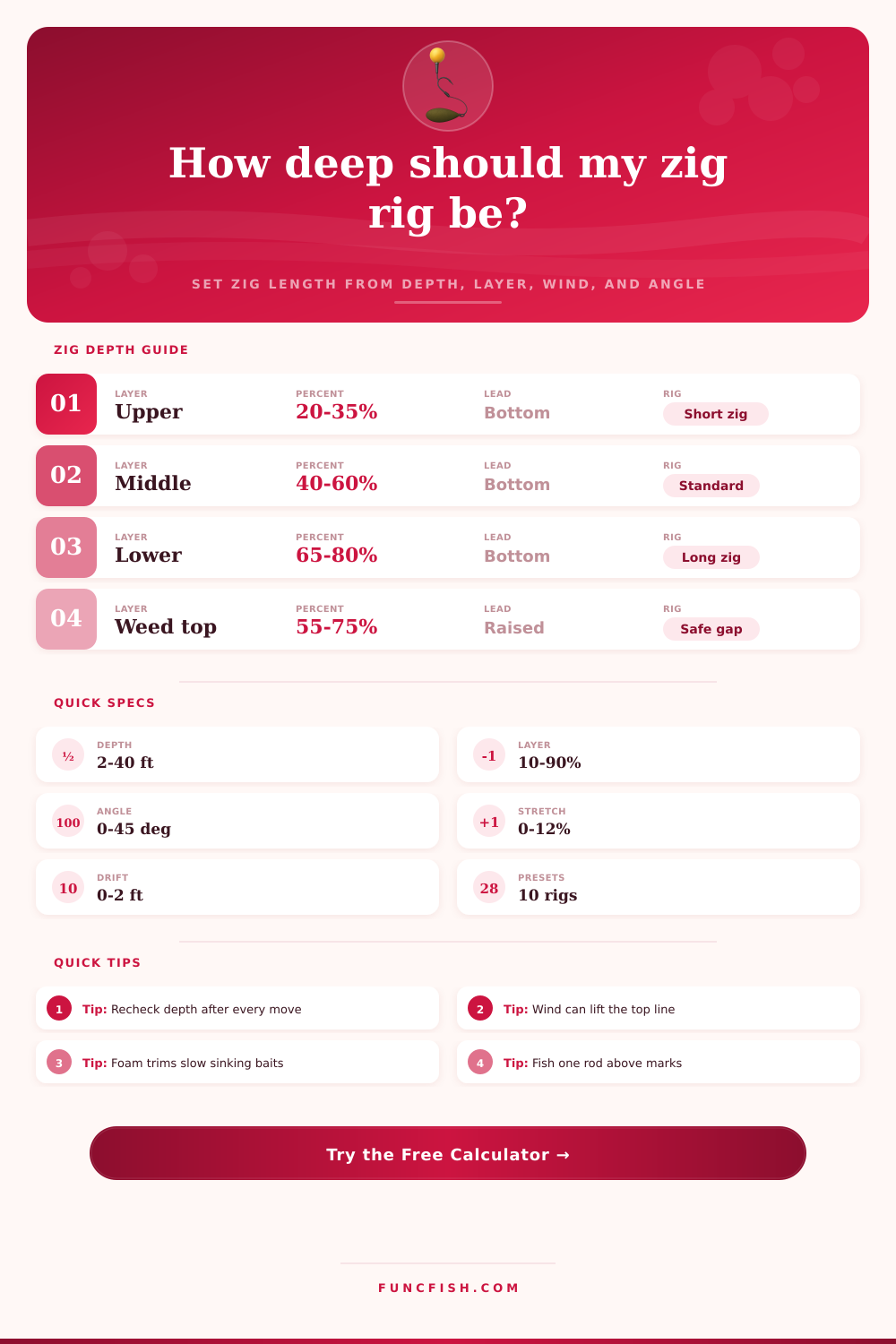
Layer convention: target swim layer is measured down from the surface. A 30% layer in 20 ft of water means the bait target is 6 ft below the surface and 14 ft above a bottom lead.
Zig rig depth match
Set the zig to match the selected swim layer while allowing for line angle, stretch, buoyancy, and drift.
Calculation breakdown
🧰Zig line and buoyancy grid
Mono 10 lb
Fluoro 12 lb
Zig Line 11 lb
Large Foam
📊Zig depth reference tables
| Swim sign | Layer percent | Depth example | Zig adjustment |
|---|---|---|---|
| Rolling or sipping near surface | 10-25% down | 2-5 ft in 20 ft | Start high, then drop in small steps. |
| High liners after casting | 25-40% down | 5-8 ft in 20 ft | Fish above the marks before going lower. |
| Midwater shows or bubbles | 40-60% down | 8-12 ft in 20 ft | Set one rod slightly above and one below. |
| Fizzing over weed or silt | 60-80% down | 12-16 ft in 20 ft | Keep the bait clear of weed and debris. |
| No signs in cold water | 65-90% down | 13-18 ft in 20 ft | Work lower third with slow changes. |
| Lead position | Height offset | When useful | Calculator effect |
|---|---|---|---|
| Bottom inline or lead clip | 0 ft / 0 m | Clean bottom, standard fixed zig. | Full height is measured from lake bed. |
| Bottom helicopter lead | 0.1 ft / 0.03 m | Long zigs with low-tangle setup. | Small offset for swivel and bead stack. |
| Lead plugged into light silt | -0.4 ft / -0.12 m | Soft bottom where lead sinks in. | Adds length so bait does not sit low. |
| Lead held on weed top | 1.5 ft / 0.46 m | Weed beds, choddy debris, soft silkweed. | Subtracts raised lead height from zig length. |
| Adjustable zig float stop | 0.3 ft / 0.09 m | Fine depth changes without retying. | Adds controller allowance and drift penalty. |
| Foam or bait | Lift profile | Depth correction | Best use |
|---|---|---|---|
| Trimmed foam slow lift | Low-medium | +0.05 ft | Pressured fish that reject oversized foam. |
| Standard zig foam | Medium | +0.10 ft | Balanced default for most carp zigs. |
| Large high-lift foam | High | +0.25 ft | Deep water or longer hooklinks. |
| Small pop-up bait | Medium-high | +0.15 ft | Subtle food bait profile with lift. |
| Soaked or dulled foam | Lowering | -0.15 ft | When foam has taken on water or slime. |
| Condition | Line angle | Wind drift | Depth response |
|---|---|---|---|
| Calm close range | 0-8 degrees | 0-0.3 ft | Use the calculated length directly. |
| Light breeze | 8-15 degrees | 0.3-0.8 ft | Check line belly before recasting. |
| Crosswind | 15-28 degrees | 0.8-1.5 ft | Shorten slightly to keep bait on layer. |
| Strong wind tow | 28-40 degrees | 1.5-2.5 ft | Expect more swing and lower confidence. |
| Long-range deep zig | 20-45 degrees | 0.5-2 ft | Use heavier lead and recheck stretch. |
📐Zig depth and rig comparison grid
| Rig style | Depth control | Strength | Tradeoff |
|---|---|---|---|
| Fixed bottom-lead zig | Very precise after measuring | Clean contact and simple bite indication | Retie to make large layer changes. |
| Adjustable zig float | Quick top-to-bottom changes | Excellent for searching active layers | More surface hardware and drift influence. |
| Weed-top raised lead zig | Precise above weed canopy | Keeps bait out of soft weed | Requires honest weed height estimate. |
| Short margin zig | Simple shallow-water control | Fast to cast and reset | Limited in deeper open-water swims. |
| Long deep-water zig | Targets suspended fish in pits | Reaches layers bottom baits miss | More angle, stretch, and landing complexity. |
| Over-depth search zig | Works slightly above visible signs | Useful when carp rise to feed | Can sit too high if wind bows the line. |
💡Zig depth tips
When carp show in the upper third, set the first zig just above the visible layer. A suspended bait often fishes better over a fish than directly underneath it, especially in bright water.
Crosswind and surface tow bow the line and can drag the bait shallower or sideways. Use the drift allowance and line-angle score before judging whether the fish ignored the foam.
A zig rig is a fishing rig that sits somewhere in between bottom fishing and surface fishing. With a zig rig, you can present your bait to the carp at any specific height. Carp dont always stay on the bottom of the lake or the surface of the lake.
The height of the bait that you use with your zig rig are important for the success of the rig. If you use the correct height for the bait, the zig rig will work effective. However, if you use the incorrect height for the bait, the fish will swim past the bait.
How to find the right bait height for a zig rig
Depth of the water is one of the factor to consider when determining the bait height. Yet, depth is not the only factor that determines the height of the bait. The same amount of depth in the lake may contain fish at different heights on different day.
For example, there may be fish at six feet of depth in a lake that is eighteen feet deep on one day. Yet, on another day, there may be fish at fourteen feet of depth in the same amount of water. In this situation, you must determine your target swim layer.
The target swim layer is the depth of the water where you want your bait to sit. Your target swim layer will convert your water depth measurement to a measurement of the height of your bait above the lead. If you do not determine your target swim layer, your essentially guessing where the fish is.
The position of the lead will also change the height of the bait. If your lead sits on the lake bed on clean gravel, then the depth of the lead measures the height of the bait. However, if your lead is sitting on soft silt in the lake bed, the lead will sink into the lake bed.
In this situation, your lead will end up at a lower height. If your lead is on the lake bed and resting on weeds, the lead will sit higher than the lake bed. Depending on the height of the lead, you may need to use a shorter hooklink to ensure that the bait reach the target swim layer.
Depending on where the lead ends up when it is cast into the water, there will be small adjustments to the height of the bait. Buoyancy will also change the height of the bait. If you use foam or pop-up baits in your zig rig, the bait will have more lift.
This added lift will change the height of the bait. In situations with deep water, you can use a shorter tied length of hooklink so that your bait will reach the target swim layer. However, if there is too much lift from the foam, the bait may rise too high above your target swim layer.
Therefore, you must consider the amount of lift that the foam will provide when fished and the extra lift when the line is at an angle to the water. The angle of the fishing rod and the drift of the wind can also impact the height of the bait. If you point your fishing rod almost straight down into the water, the extra length of the fishing line will be very little.
However, if you point the rod at a distance or if there is a crosswind on the fishing spot, the wind will create a bow in the fishing line. This bow will lift the bait. This lifting motion will also move the bait sideways.
You must make allowances for the drift of the bait caused by the wind. If not, the height of the bait may end up higher than you calculated with your zig rig calculator. The material of the hooklink can also change the height of the bait.
Hooklinks with more stretch will require a shorter tied length to reach the same height as hooklinks with less stretch. Hooklinks with more stretch will extend when under tension. Hooklinks with less stretch will hold to their length.
However, if your hooklink has less stretch, it will allow for more movement of the bait from the line above it. You can calculate the stretch of the hooklink and blend it with the known behavior of that material so that you adjust the length of the hooklink according to its stretch. There are tables that you can reference to determine the target swim layer of the fish in the lake.
If you see fish rolling near the surface, the target swim layer should be high. If you see fish fizzing over weeds, the target swim layer should be just above the weed layer. If you see fish in the middle of the lake, it is difficult to read the swim layer of the fish.
If you see fish in the middle of the lake, you can fish one rod slightly above the fish and the other rod slightly below the fish. Many anglers make mistake with their zig rigs. One mistake is treating the zig rig as a fixed rig.
The depth of the water may change as you move to a new swim layer. The angle of the fishing rod may change as the wind changes direction. A foam that adds lift to the bait in the margins of the lake may provide too much lift in the open water.
You must recheck your target swim layer after every move. It is also useful to have pre-tied lengths of hooklink of different lengths at all times. This will allow you to quickly swap hooklink instead of retying the hooklink in the dark when you move fishing spots.
Small changes to the target swim layer will have a more bigger impact on your fishing results than changes in the color or flavor of the bait. The goal is to learn to read the water well so that your first choice for your target swim layer is close to the actual location of the fish. If you can identify the location of the fish, you can determine the rest of the zig rig.
The zig rig calculator will help you to avoid having to perform the arithmetic calculations necessary to determine each component of the rig.