Wind-on Leader Length Calculator
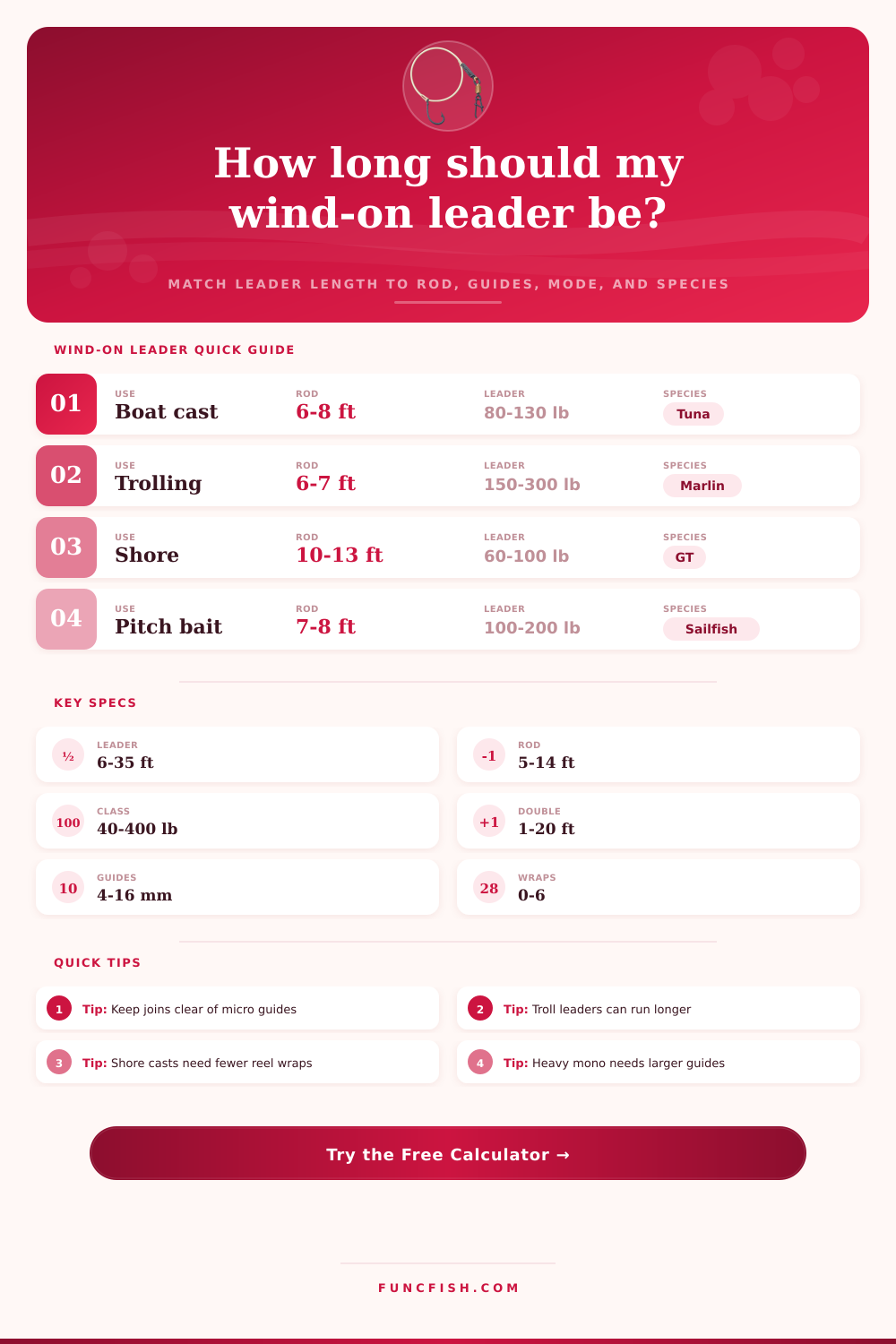
Estimate a finished wind-on leader length for boat, shore, casting, trolling, and pitch-bait rigs using rod length, double-line overlap, guide clearance, leader class, mainline test, and target species.
📌Named wind-on leader presets
⚙Wind-on leader inputs
Wind-on leader estimate
Your leader length, guide clearance, and offshore handling fit will appear here.
Calculation breakdown
🧵Leader class data grid
Light Cast
Tuna Cast
Stand-up Troll
Heavy Game
📊Reference tables
| Wind-on preset | Finished length | Rod position | Double line | Use note |
|---|---|---|---|---|
| Bluefin boat casting | 10-16 ft / 3.0-4.9 m | 1-3 reel wraps | 3-6 ft / 0.9-1.8 m | Short enough for fast casts |
| Marlin trolling | 22-35 ft / 6.7-10.7 m | 2-5 reel wraps | 8-16 ft / 2.4-4.9 m | Deck hand-off and boat-side control |
| GT shore popping | 6-12 ft / 1.8-3.7 m | Connection near or outside tip | 2-5 ft / 0.6-1.5 m | Minimize guide impact on hard casts |
| Swordfish drop rig | 18-30 ft / 5.5-9.1 m | Leader can sit on reel | 8-20 ft / 2.4-6.1 m | Longer handling leader for deep drops |
| Pitch bait leader | 12-22 ft / 3.7-6.7 m | 1-3 wraps on spool | 4-10 ft / 1.2-3.0 m | Clean feed and leader touch control |
| Target species | Leader class | Mainline range | Length tendency | Leader concern |
|---|---|---|---|---|
| Tuna, school to giant | 80-200 lb / 36-91 kg | 50-130 lb / 23-59 kg | Medium | Guide passage and abrasion |
| Marlin and sailfish | 100-400 lb / 45-181 kg | 50-130 lb / 23-59 kg | Long | Boat-side handling |
| Giant trevally | 100-200 lb / 45-91 kg | 60-130 lb / 27-59 kg | Short | Castability through guides |
| Wahoo or kingfish | 80-200 lb / 36-91 kg | 40-100 lb / 18-45 kg | Short to medium | Bite or wire section bulk |
| Shark or heavy surf | 150-400 lb / 68-181 kg | 50-130 lb / 23-59 kg | Medium | Shock, chafe, and guide size |
| Guide setup | Inside diameter | Suggested loop bulk | Clearance ratio | Best use |
|---|---|---|---|---|
| Micro casting guides | 4-6 mm / 0.16-0.24 in | 2.0-3.0 mm | 2.0x or more | Short leaders, slim connections |
| Heavy spinning guides | 6-10 mm / 0.24-0.39 in | 3.0-4.5 mm | 1.8x or more | Tuna casting wind-ons |
| Boat rod ring guides | 8-14 mm / 0.31-0.55 in | 4.0-6.5 mm | 1.6x or more | Stand-up trolling leaders |
| Roller guides | 10-18 mm / 0.39-0.71 in | 5.0-8.0 mm | 1.4x or more | Heavy wind-ons and big game |
| Connection outside guides | Any size | Not passing | Not required | Hard shore casts and bulky loops |
| Connection style | Build allowance | Typical bulk | Guide behavior | Length effect |
|---|---|---|---|---|
| Served loop-to-loop | 12-18 in / 30-46 cm | Medium | Good with standard guides | Adds moderate build length |
| Hollow-core splice | 18-30 in / 46-76 cm | Low | Smoother through guides | Adds longer bury allowance |
| Dacron loop wind-on | 16-24 in / 41-61 cm | Medium high | Better on large guides | Good for trolling leaders |
| Twisted mono loop | 8-14 in / 20-36 cm | High | Keep outside small guides | Shorter build but bulkier |
| Wire bite section | 10-24 in / 25-61 cm | High | Usually outside guides | Adds bite length near terminal end |
🛥Offshore leader comparison grid
Short Casting Wind-on
6-12 ft Best when the loop must clear guides fast on poppers, stickbaits, or surf casts.Boat Casting Wind-on
10-18 ft Enough abrasion buffer for tuna while keeping several wraps manageable.Pitch and Live Bait
12-22 ft Lets the angler feed line cleanly while a deck hand can reach leader.Trolling Wind-on
20-35 ft Longer leader gives boat-side control and a smoother hand-off.💡Wind-on length tips
Guide fit: If the wind-on loop is bulky or the smallest guide is under the recommended clearance ratio, keep the connection outside the tip or shorten the finished leader.
Deck handling: Trolling and pitch-bait leaders often need more finished length than casting leaders because the crew may need several feet of leader before the fish is controlled.
Determining the correct length for a wind on leader is an important task in fishing. The length of a wind-on leader can impact whether or not a fishing leader will pass through the guides on the fishing rod, or even if it will cause a tangle in the fishing line. If the leader become too long or too bulky for the fishing rod, the leader can become jammed within the fishing rods guides, which can result in the loss of the caught fish.
In order to make certain that a fishing line and leader setup function properly, there are several different variable that must be considered in the decision of the length of the wind-on leader. One of the first variables to consider in the decision of the length of a wind-on leader is the mode and scenario of the fishing. Fishing mode relate to the way that a fisherman casts and fishes for there species of choice.
How to Choose the Right Wind-On Leader Length
Additionally, fishing scenario relates to the specific area where the fisherman is fishing. For instance, a fisherman using a popper from a boat will require a short wind-on leader to ensure that it pass through the rod guides without hesitation. In contrast, a person trolling for marlin will require a longer wind-on leader so that there is enough line for the crew to hold onto while fighting the marlin.
Each of these variables must be inputted into the calculator in order to adjust for any changes in the base length of the wind-on leader that the calculator calculates. The second variable to consider is the length of the fishing rod. Rod length can impact the length of the wind-on leader that is required for that fishing rod.
For instance, if a fisherman utilize a short fishing rod, they will require a different length of wind-on leader than an individual that utilize a longer fishing rod. Longer rods provide more distance between the reel and the fishing rods tip. Additionally, the length of the rod will impact the number of inches of the wind-on leader that can pass through the guides during a cast.
The calculator considers both of these variables in order to provide the best length for the wind-on leader. More specifically, the calculator consider the length of the fishing rod as well as the length of the double-line section of the leader; both of which impact the length of the wind-on leader. The third variable to consider is the leader class (strength) and the mainline test (strength).
For example, if a fisherman is using a 100-pound wind-on leader with an 80-pound mainline, there will be different handling characteristic of that fishing setup than if they are using a 100-pound leader with a 50-pound mainline. The calculator calculates these two variables; the difference in strength between the leader and the mainline impacts the bulk of the leader. Additionally, another variable to consider is the type of fish that is being targeted.
For example, a person that is fishing for tarpon will likely utilize a different wind-on leader than an individual who is fishing for marlin. This is due to the different abrasion demand of each of these fish species. The fourth variable to consider is the issue of guide clearance.
Guide clearance relates to the ability of the wind-on leader to pass through the rod guides. Bulky wind-on leaders may pass through the large rollers on a boat, but may become jammed within small micro guides on the fishing rod. The calculation of guide clearance consider the diameter of the smallest guide on the fishing rod in comparison to the bulk of the wind-on leader.
If the guide clearance is an issue, the wind-on leader can be shortened, the connection can be moved outside of the guides, or a different, slimmer style of splice can be used instead. Beyond these four main variables, the calculator also provide a score to the suggested wind-on leader of the calculation. This score, referred to as the fit score, rates the abilities of the length of the wind-on leader, the leader class, and the fishing rod guides to work good together.
A score above ninety is considered a well-suited fit for the fisherman’s fishing rod. A score in the low seventies indicates the setup will work as the fisherman intends, but may require more care when fishing. The reference table to the wind-on leader calculator provide a number of different presets for those who fish for bluefin tuna, marlin, or GT species popping.
However, every fisherman does not follow these as rules; the length of the wind-on leader should of been adjusted to the fisherman’s rod, guides, and personal fishing preference. Finally, the wind-on leader calculator can be used to establish a baseline length for the fisherman’s specific fishing rod for there main fishing scenario. When the calculated length of the wind-on leader is tested in the water, the fisherman can determine if it is the correct length for their fishing scenario.
If the leader does pass through the guides smoothly with the fishing rod, and if the length feel correct to the fisherman, then it is a reliable wind-on leader. However, if the leader does become jammed within the guides, the fisherman should return to the calculator to adjust the inputs to the wind-on leader to find the best length for their fishing scenario.