Bimini Twist Length Calculator
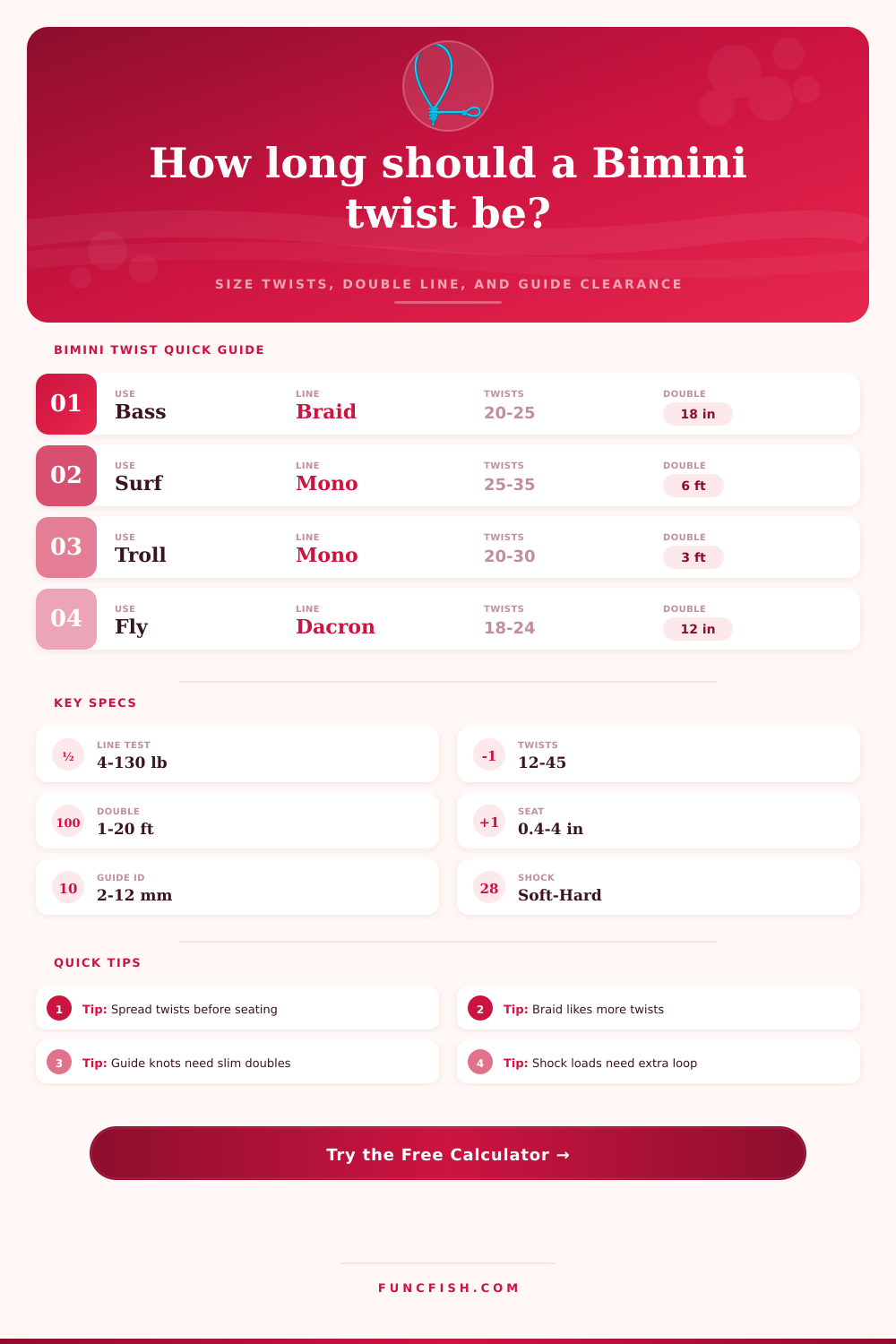
Estimate Bimini twist barrel length, starting loop cut length, finished double-line length, guide clearance, and shock margin from line test, material, twist count, and application.
📌Named Bimini twist presets
⚙Bimini twist settings
Bimini twist length results
Full breakdown
🧵Line material behavior grid
Nylon Mono
Braided PE
Fluorocarbon
Dacron / Hollow
🔗Knot and double-line comparison grid
Bimini Twist
Doubled-line loop with high shock retention. Longest tying span, but the load is shared across two legs.
Spider Hitch
Fast doubled-line loop with more compact tying. Usually lower strength than a carefully seated Bimini.
Surgeon's Loop
Very quick double loop for light line. Bulk increases quickly and guide travel is less tidy.
No Double Line
Shortest connection. Useful for clean casting, but it removes the shock-spreading benefit of the double.
📊Bimini twist reference tables
| Line material | Typical twists | Seat behavior | Length note |
|---|---|---|---|
| Nylon mono | 20-30 twists | Compresses smoothly | Allow moderate shrink after seating. |
| Fluorocarbon | 18-26 twists | Stiff and heat sensitive | Keep the double shorter and wet the knot well. |
| Braided PE | 25-45 twists | Slick and thin | More twists improve grip without much bulk. |
| Copolymer | 20-30 twists | Balanced bedding | Similar to mono with slightly less stretch. |
| Hollow-core braid | 18-28 twists | Soft and bulky | Often used with wind-on or loop-to-loop systems. |
| Dacron backing | 18-24 twists | Soft fiber barrel | Use a compact double for fly backing loops. |
| Application | Finished double | Shock priority | Guide reading |
|---|---|---|---|
| Light spinning | 12-30 in / 30-76 cm | Low to medium | Usually passes guides if the barrel is slim. |
| Power plug casting | 2-4 ft / 0.6-1.2 m | Medium to high | Check the smallest running guide before casting hard. |
| Surf shock casting | 6-20 ft / 1.8-6.1 m | High | Often places the knot outside the tip or uses larger guides. |
| Trolling and live bait | 2-6 ft / 0.6-1.8 m | High surge load | Guide pass matters less than loop strength. |
| Vertical jigging | 18-48 in / 46-122 cm | High short shock | Small guides favor braid and a compact finish. |
| Fly backing loop | 8-18 in / 20-46 cm | Low to medium | Bulk matters near reel guides and spool layers. |
| Line test class | Typical diameter | Double-line use | Starting loop allowance |
|---|---|---|---|
| 4-10 lb finesse | 0.10-0.28 mm | Small braid or fly loops | Add 2-5 in / 5-13 cm over target. |
| 12-30 lb inshore | 0.18-0.55 mm | Leader loops and casting doubles | Add 4-10 in / 10-25 cm over target. |
| 40-80 lb offshore | 0.35-0.90 mm | Trolling, jigging, wind-on | Add 8-18 in / 20-46 cm over target. |
| 100-130 lb big game | 0.95-1.25 mm | Heavy mono doubles | Add 14-30 in / 36-76 cm over target. |
| PE braid main line | 0.12-0.45 mm | Slim loop-to-loop joins | Add 3-9 in / 8-23 cm over target. |
| Clearance situation | Target ratio | Best finish | Practical note |
|---|---|---|---|
| Micro guide casting | 3.0x knot bulk | Rizzuto or minimal finish | Keep tags aligned and inspect for ticking. |
| Standard spinning guides | 2.4x knot bulk | Half hitches or Rizzuto | Most braid doubles pass if the barrel is compact. |
| Large surf guides | 1.8x knot bulk | Half hitches | Bulk tolerance is better, but shock load is higher. |
| Knot outside guides | Not limiting | Secure finish | Choose length for shock margin rather than pass-through. |
💡Bimini twist calculation tips
Seat length check: The knot seat length input should be the compact twisted barrel after the knot is closed. If you only know the open twist span, enter the closest seated estimate and use the breakdown to see the modeled shrink allowance.
Guide clearance check: A Bimini creates a doubled line plus a finish bump, so clearance is about bulk and tag direction, not just the visible barrel length. Retest after changing finish style or guide mode.
The Bimini twist knot use a double line to create a loop, and there are many different ways to use the Bimini twist knot in fishing application. You can use a Bimini twist knot to create a leader loop for your jigging setup, or you can use the Bimini twist to create a long shock section for your surf casting application. The length of the Bimini twist is important because this knot consume some of the line that you use when you tie it.
The Bimini twist seat compress when you tie the knot, and the Bimini twist finish add some bulk to your knot. You must account for the length that the Bimini twist consumes to ensure that the knot reaches the length that you require for your fishing application. The materials of the fishing line that you use is also important variable in the Bimini twist because different lines behave differently when you tie the knot.
Choosing the right Bimini twist length for fishing
Monofilament line and fluorocarbon lines will compress more than braided lines. This means that monofilament and fluorocarbon line will lose more of the target length that you select for your double length when you tie the Bimini twist. Braided lines does not compress, and they have more twist than the other line materials.
However, the barrel created by braided lines remain thinner than the other line materials. Depending on the use of the Bimini twist, you can also select different application for your Bimini twist. For example, if you are performing a surf shock cast, you will need to allow for extra line to assist with the surge of the boat.
However, if you are using the Bimini twist for fly fishing, you will want your connection to stay as close to your reel as possible. The calculator will calculate the amount of line that you will need for these different application. The seat length is a critical variable that you select in the Bimini twist calculator.
This measurement is based on the actual tying of the Bimini twist. You must use the measurement of the closed barrel rather than the open span of the Bimini twist. If you use the open span measurement, the Bimini twist calculator will suggest that you use more line than you should.
The Bimini twist calculator will model the compression of the line based on the diameter of the line. Additionally, the calculator will allow you to view the effect that different finish style will have on your Bimini twist. A Rizzuto knot finish will reduce the bulk created by the Bimini twist, but it may also reduce the strength of the Bimini twist.
A loop lock finish will increase the security of the Bimini twist, but it will also increase the chance that the Bimini twist will catch on a small guide. The size of the guide that you use can impact the Bimini twist. The Bimini twist calculator compares the ratio of the doubled line to the finish bump to the tolerance of your guide mode.
If you are using micro guide on your casting rod, you may find that your Bimini twist creates a barrel that is too large for the guides and creates a clicking noise when you cast your line. The outside-guides mode is used for application where the double line remains above the tip of your fishing rod. This scenario include application like using a long trolling leader.
In these situations, the shock margin decides the length of the Bimini twist, not the size of the guides. Many people make mistake when tying a Bimini twist. For example, the number of twist that people use on 30-pound test line may not be suitable for using on 65-pound test braided lines.
This can lead to a barrel that is either too loose or too tight for the test strength of the line. Additionally, people often measure the finished length of the Bimini twist once it is seated into the line. However, this will not provide you with the information that you need to determine the length of the starting loop for your Bimini twist.
You must take into account the seating loss of the Bimini twist, the length of the finish tag, and the shock stretch that the double line will experience. By running the number in the Bimini twist calculator before you tie the knot, you can determine the primary function of your Bimini twist. If your Bimini twist is primarily used to clear the guides in your fishing rod, the calculator will let you know if the bulk of your Bimini twist comes close to the limit of your fishing guides.
However, if the Bimini twist is used to absorb the shock of a hook set or a launch from the surf, the shock margin will let you know if the length of your double line is long enough. These score are displayed so that you can keep these two priority in mind so that one hides the other. If you become familiar with the Bimini twist calculator, you will eventually be able to recognize the impact that altering a single input has on the other scores.
For example, if you increase the number of twist on braided fishing lines, the fit score will improve because braided lines require more twist to lock. However, increasing the target double length on fluorocarbon lines will impact the guide score because fluorocarbon lines do not compress as much as braided lines. These type of changes will help you to understand the various trade-off of tying a Bimini twist.
Once you are familiar with these types of alteration, you will have a clearer picture of the type of compromise that you must make when you tie a Bimini twist.